



Contents: Removal ⤓ Installation ⤓
To start an internal combustion engine, a small electric motor is required - a starter. In order for the engine to start, the starter must give the engine a rotation speed of at least 300 rpm. But this can be achieved provided that the starter is functioning normally and the battery is charged.
The starter consists of a drive housing and a pole housing with a collector. The pole housing and collector contain the anchor and collector, as well as the brush holder. The brush holder contains carbon brushes, which are wearing parts that wear out slowly but constantly. If the brushes are heavily worn, the starter stops working normally.
The front housing of the drive contains a gear drive. When voltage is supplied to the starter through the ignition switch, the gear moves along the thread to the toothed ring of the flywheel using a traction relay located on the housing of the drive. As soon as the gear reaches the stop of the threaded shaft, it engages with the flywheel. Now the torque is transmitted from the starter to the engine to develop the required number of revolutions. When the engine starts, the gear receives acceleration from it, that is, it rotates faster than the engine for a short time and disengages, due to which the connection between the starter and the engine is broken.
Since a high current is required to start the combustion engine, it is necessary to ensure that the wires are connected perfectly during maintenance. Corroded contacts should be coated with a protective paste.
Depending on the engine type, COLT/LANCER is equipped with 12-volt starters of varying power: on petrol engines 0.7/1.2 kW; on diesel engines 2.0 / 2.2 kW.
Removal
Disconnect the ground cable from the battery.
Caution: This erases data in the electronic memory, such as the engine fault memory or the radio receiver code. Disconnect the battery only when the ignition is switched off, otherwise the fuel injection device control unit may be damaged. Before disconnecting the battery, read the instructions in the "Radio receiver" and "Removing and installing the battery" sections.
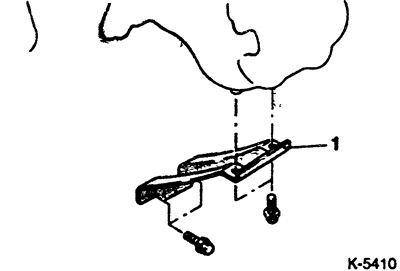
84/90hp engines: Remove the intake manifold bracket.
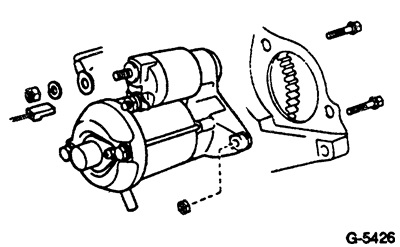
Disconnect the wire from terminal 50 (to the ignition switch) on the starter.
Disconnect the battery wire from terminal 30.
Remove 2 bolts from the gearbox and remove the starter motor with the clutch housing.
Installation
Insert the starter, tighten the 2 bolts to 30 Nm.
The article is reprinted from this source [MitsubishiMan]
Screw the wire onto terminal 30 with a force of 15 Nm.
Place the cable connector onto terminal 50 until it snaps into place.
If removed, insert the intake manifold support and tighten the 4 bolts to 20 Nm.
Connect the ground cable to the battery.
If they are available, set the time on the clock and enter the security code into the radio.