



Contents: Checking and adjusting the axial…⤓ Checking the pull-in winding of the…⤓ Checking the holding winding of the…⤓ Idle test ⤓ Checking the return of the relay…⤓
Checking and adjusting the axial clearance of the starter pinion with direct drive
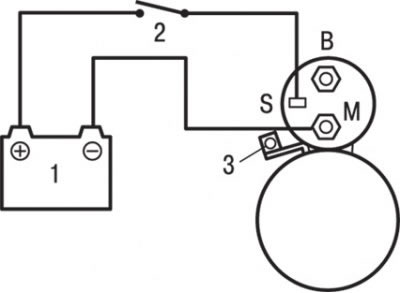
Fig. 9.12. Diagram for checking and adjusting the axial clearance of the starter gear with direct transmission: 1 – battery; 2 – switch; 3 – stator excitation winding wire
1. Disconnect the stator winding wire from the "M" terminal of the traction relay (Fig. 9.12).
2. Connect the wires from the battery terminals to the "S" and "M" terminals of the traction relay as shown in Fig. 9.12.
3. Turn the key in the ignition switch to the "ON" position, the drive gear will extend to the stop.
Attention! This test must be carried out quickly, no longer than 10 s, to prevent the winding from burning out.
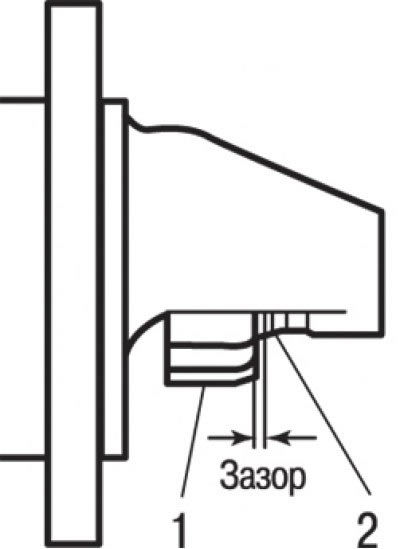
Fig. 9.13. Measuring the axial clearance between the drive gear and the limiting ring: 1 – gear; 2 – limiting ring
4. Using a feeler gauge, measure the axial clearance between the drive gear and the limiting ring (Fig. 9.13). It should be within 0.5–2.0 mm.
5. If the axial clearance is outside the nominal range, adjust it by installing (removing) adjusting shims between the traction relay and the front cover.
Checking the pull-in winding of the relay
1. Disconnect the stator winding wire from the "M" terminal of the traction relay.
2. Connect the wires from the battery terminals to terminals "S" and "M" as shown in Fig. 9.12.
Attention! This check must be carried out quickly, within no more than 10 seconds, to prevent the winding from burning out.
If the drive pinion extends, the pull-in winding is OK. If not, replace the traction relay.
Checking the holding winding of the traction relay
1. Disconnect the stator winding wire from the "M" terminal of the traction relay.
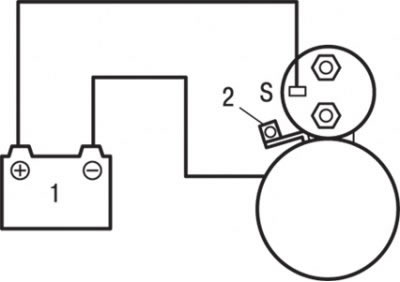
Fig. 9.14. Checking the holding winding of the traction relay: 1 – battery; 2 – excitation winding wire
2. Connect the wires from the battery terminals to the "S" terminal and the starter housing as shown in Fig. 9.14.
Attention! This check must be carried out quickly, within no more than 10 seconds, to prevent the winding from burning out.
3. Manually extend the drive gear until it stops (to the limit ring).
4. If the drive gear remains in the extended position, the holding winding is OK. If the gear retracts, there is a break in the holding winding. In this case, replace the traction relay.
Idle test
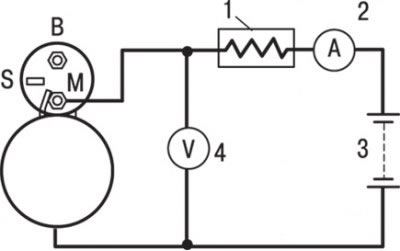
Fig. 9.15. Idle mode test circuit: 1 – rheostat; 2 – ammeter; 3 – battery; 4 – voltmeter
1. Clamp the starter in a vice with soft jaws and connect the wires from a fully charged storage battery to its terminals as follows: connect in series between the "M" terminal of the starter and the positive terminal of the storage battery an ammeter (with a scale of 100 A) and a rheostat with a carbon sliding contact, as shown in Fig. 9.15.
2. Connect a voltmeter with a 15 V scale in parallel to the stator winding circuit.
3. Set the rheostat slider to the maximum resistance position.
4. Connect the wire from the negative terminal of the battery to the starter housing.
5. Using the rheostat, set the voltmeter voltage to 11.5 V.
6. Check that the maximum current consumption is no more than 60 A, and that the starter armature rotates freely, without jerking or jamming.
Checking the return of the relay anchor
1. Disconnect the stator winding wire from the "M" terminal of the traction relay.
2. Connect the battery to terminal "M" and the starter housing (see Fig. 9.14).
Attention! This check must be carried out quickly, no more than 10 seconds, to prevent the winding from burning out.
Pull the drive pinion out by hand and release it. If the pinion immediately returns to its original position, the traction relay is OK. If not, replace the traction relay.
Caution: Be careful not to pinch your fingers with the gear.