



Contents: Checking the resistance of the…⤓ Engines 2.0 and 2.6 l ⤓ Checking the resistance of the…⤓ Checking the resistance of the…⤓ Engines 2.4 and 3.0 l (12-valve) ⤓ Engine 3.0 l (24-valve) ⤓ Engine 3.5 l ⤓
Checking the resistance of the additional resistor
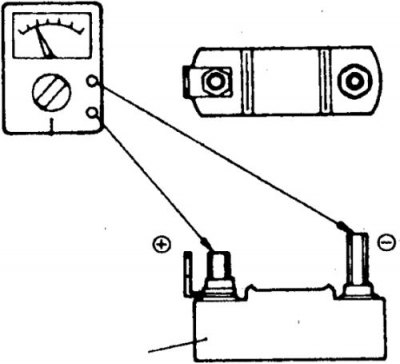
Engines 2.0 and 2.6 l
1. Check the resistance of the additional resistor.
2. Check the resistance of the primary winding between the + and - terminals.
3. Replace the coil if necessary.
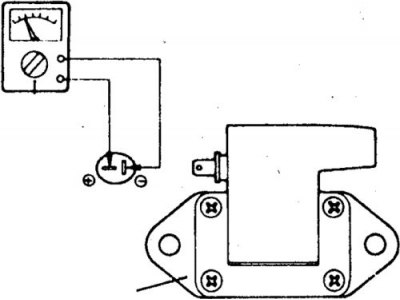
4. Check the resistance of the secondary winding between the high voltage terminal and the + terminal.
5. Replace the coil if necessary.
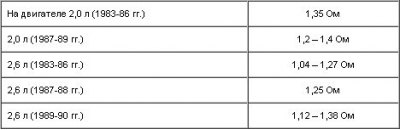
Resistance of additional resistor
Checking the resistance of the primary winding
Primary winding resistance
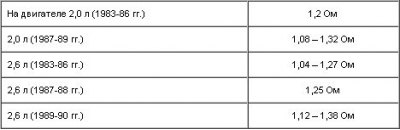
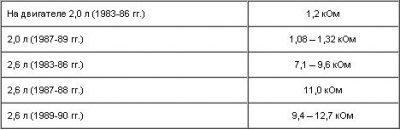
Checking the resistance of the secondary winding
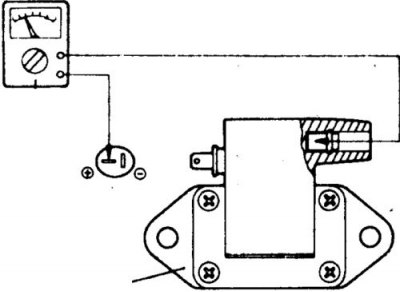
Secondary winding resistance
Engines 2.4 and 3.0 l (12-valve)
Checking the coil on 2.4 and 3.0L engines (12-valve)
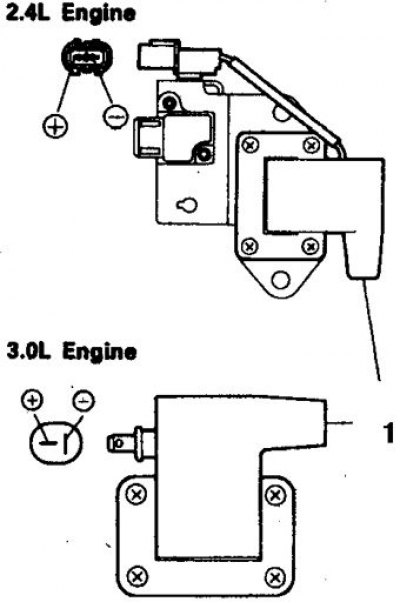
1. High voltage terminal
1. Check the resistance of the primary winding between the + and - terminals, which should be 0.72–0.88 Ohms.
2. Otherwise, replace the coil.
3. Check the resistance of the secondary winding between the high voltage terminal and the + terminal, which should be 10.3–13.9 kOhm.
4. Otherwise, replace the coil.
5. Check the coil insulator for cracks and defects.
Engine 3.0 l (24-valve)
Ignition Coils and Primary Winding Resistance Test on a 3.0L 24-Valve Engine
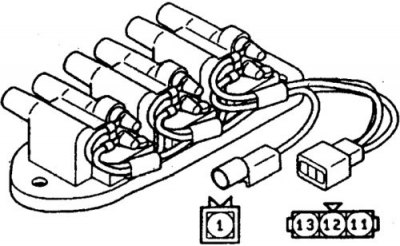
Checking the resistance of the secondary windings on a 24-valve 3.0L engine
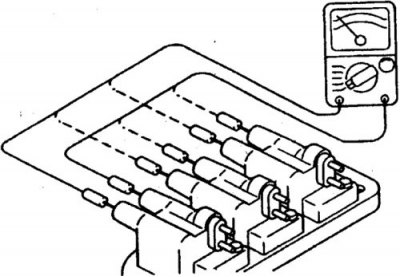
1. Check the resistance of the primary winding between terminal 1 of the connector and the terminals of each of the coils. The resistance should be within 0.6–0.81 Ohm.
2. Check the resistance of the secondary winding between the high-voltage terminal and the terminals of coils A, B and C, which should be 11.3–15.3 kOhm.
3. Check the coil insulator for cracks and defects.
Resistance measurement points

Engine 3.5 l
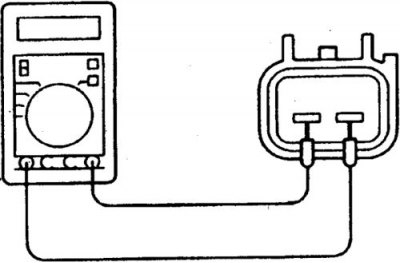
Checking the resistance of the primary winding of the ignition coil on a 3.5L engine
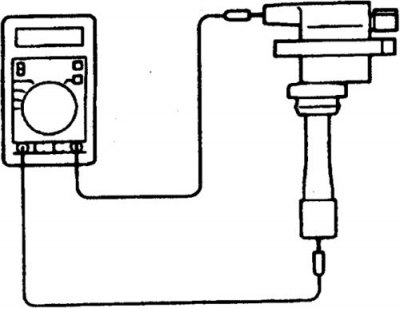
Checking the resistance of the secondary winding on a 3.5L engine
1. Check the resistance of the primary winding between the terminals of the coil of each cylinder (1st and 4th, 2nd and 5th, 3rd and 6th). The resistance should be within 0.69–0.85 Ohm.
2. Check the resistance of the secondary winding between the high-voltage terminals of the coil of each cylinder (1st and 4th, 2nd and 5th, 3rd and 6th). The resistance should be within 15.3–20.7 kOhm.
3. Check the coil insulator for cracks and defects.