



Removal
Before you begin removing parts, perform the following operations:
- a) Drain the coolant.
- b) (GDI engine) Remove the engine cover.
- c) Remove the air filter.
- d) Remove the battery and battery tray.
The parts are removed in the order of the numbers indicated in the "Thermostat" figure.
When removing parts, pay attention to the operation of removing the lower radiator hose.
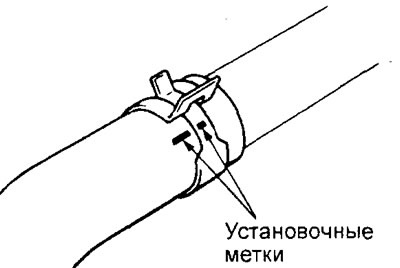
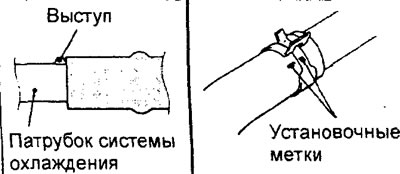
After marking the relative positions of the radiator hose and clamp, disconnect the radiator hose.
Caution: After disconnecting the hoses from the radiator, it is necessary to plug the holes in the hose and radiator to prevent dust or foreign particles from getting into them.
Examination
1. Check that the thermostat valve is tightly closed at room temperature (20°C).
2. Check the thermostat for defects or damage. If there are various deformations, visible damage or other defects, replace the thermostat.
3. Check for rust or deposits on the thermostat valve. If rust or deposits are found, clean the valve.
4. Checking the operation of the thermostat.
a) Immerse the thermostat in a vessel with water and heat the water while stirring it.
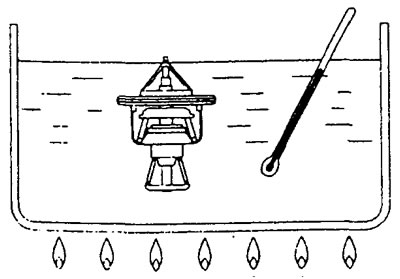
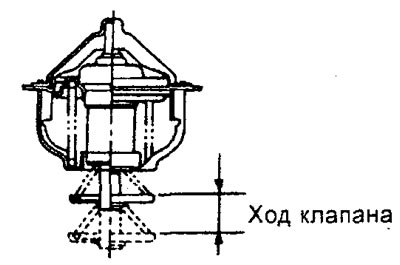
b) Check that the valve opening start temperature, the valve full opening temperature and the valve stroke value when fully open correspond to the nominal values.
Nominal values:
Valve opening start temperature
- Engine 4G15 — 82 ±1.5°C
- Engine 4G93 — 85 ±1.5°C
Full valve opening temperature
- Engine 4G15 - 95°C
- Engine 4G93 - 98°C
- Valve stroke when fully open is 8.5 mm or more
Note: Measure the distance from the bottom of the valve to the thermostat housing when it is fully closed and then fully open, then calculate the valve stroke.
Installation
Installation of parts is carried out in the reverse order of removal.
When installing parts, please pay attention to the following operations:
1. Installing the thermostat.
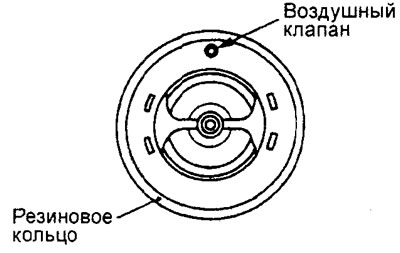
Install the thermostat so that the air vent is located at the top, as shown in the figure, and aligned with the corresponding mark on the thermostat housing.
Attention:
- It is necessary to ensure that there is no oil on the thermostat rubber sealing ring.
- Be careful not to bend or scratch the sealing ring when installing.
2. Connecting the lower radiator hose.
a) When connecting the lower radiator hose, push the hose onto the pipe until it stops against the protrusion of the pipe, then tighten the clamp
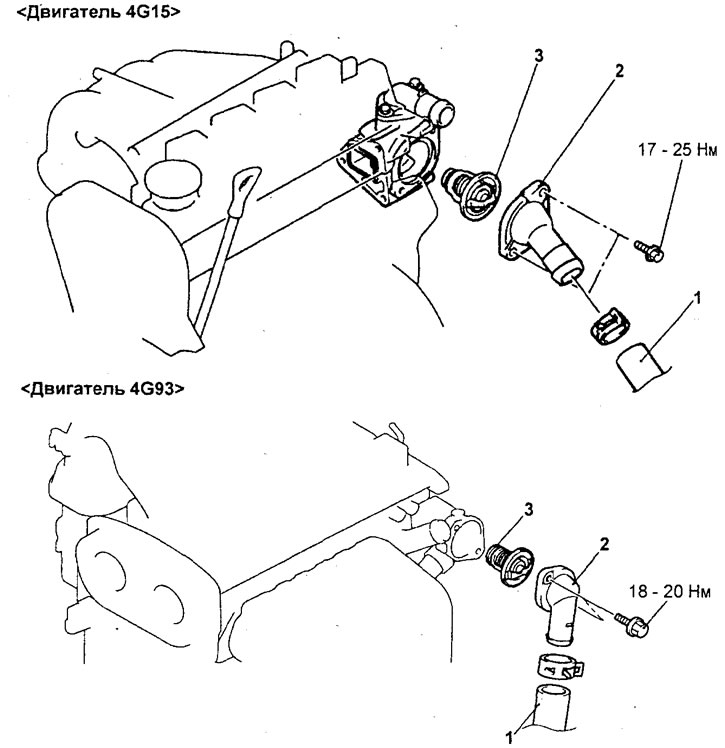
Thermostat (GDI engines). 1 - connection of the lower radiator hose 2 - inlet pipe of the cooling system, 3 - thermostat.
(Information copied from the website www.MitsubishiMan.ru)
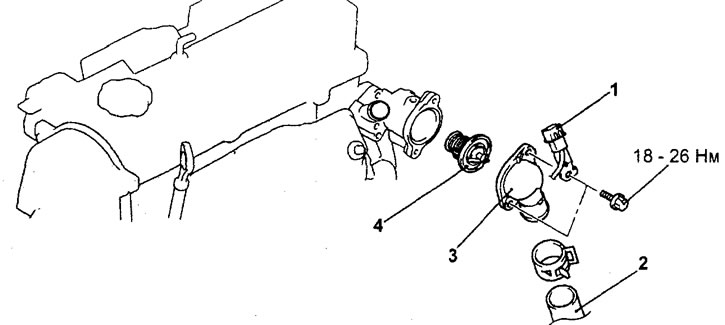
Thermostat (engine 4G15-MPI). 1 - oxygen sensor connector, 2 - lower radiator hose connection, 3 - cooling system inlet pipe, 4 - thermostat.
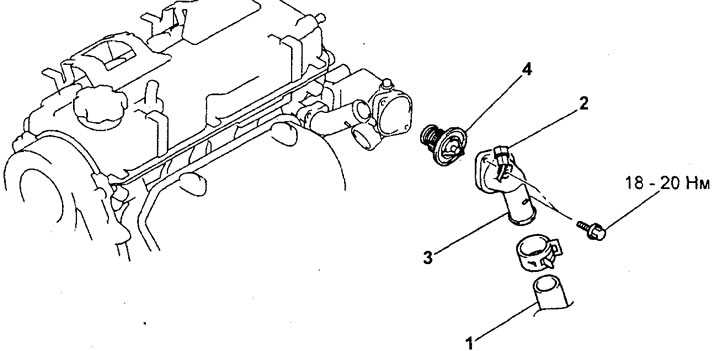
Thermostat (engine 4G93-MPI). 1 - lower radiator hose connection, 2 - oxygen sensor connector, 3 - cooling system inlet pipe, 4 - thermostat.
b) The hose clamp should always be installed in the position in which the clamp was previously installed. Therefore, before installing the clamp, align the installation marks on the hose clamp and the radiator hose, then connect the hose.
After completing the installation of the parts, perform the following operations:
- a) Install the battery tray and battery.
- b) Install the air filter.
- c) (GDI engine) Install the engine cover.
- d) Fill with coolant.