



Contents: Location of system components ⤓ Main injection system relay,…⤓ Fuel pump relay ⤓ Intake Air Temperature Sensor ⤓ Coolant temperature sensor ⤓ Throttle position sensor ⤓ Accelerator Pedal Position Sensor ⤓ Sensor - switch of released…⤓ Oxygen sensor ⤓ Catalytic Converter Temperature…⤓ Nozzles ⤓ Throttle servo ⤓
Note: The procedures for checking the EGR servo and the canister purge solenoid valve are given in the relevant section of the chapter "Emission Control System".
Location of system components
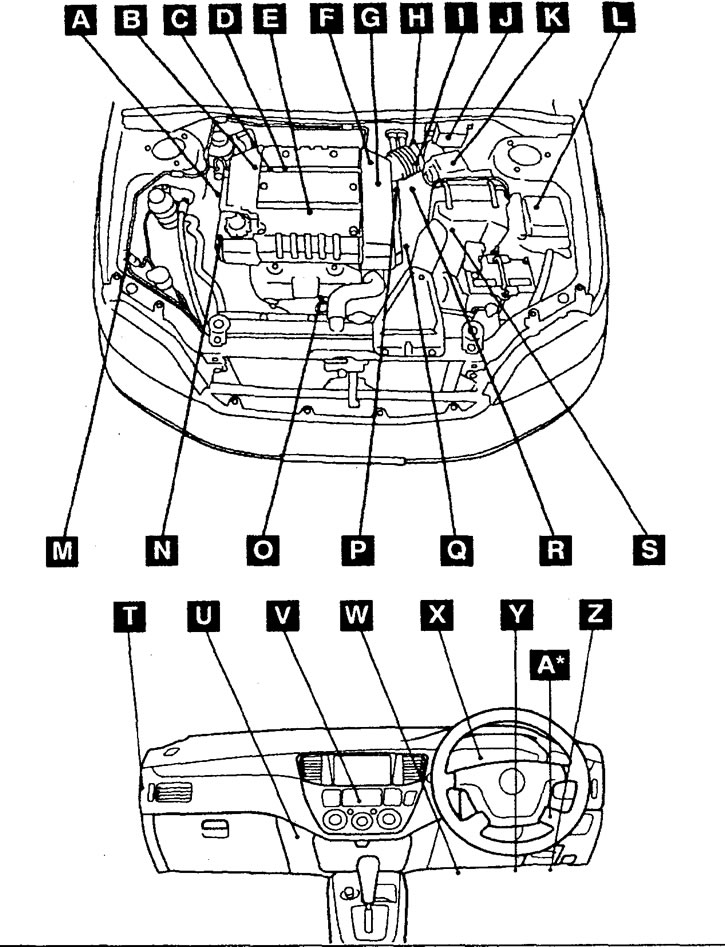
Location of fuel injection system components. A - crankshaft position sensor, B - fuel pressure sensor, C - knock sensor, D - injector, E - ignition coil (with built-in power transistor), F - electromagnetic valve for evaporative canister purge, G - EGR valve servo drive, H - throttle position sensor (channels No.1 and No.2), I - throttle servo drive, J - injector control signal generator, K - mass air flow sensor (with built-in intake air temperature sensor and atmospheric pressure sensor), L - injection system main relay, injector control relay and throttle servo drive relay, M - coolant pressure sensor, N - power steering hydraulic fluid pressure switch, O - oxygen sensor, P - coolant temperature sensor, Q - camshaft position sensor, R - start prohibition switch, S - CVT driven pulley speed sensor, T - throttle servo controller, U - engine and CVT electronic control unit, V - air conditioning switch, W - diagnostic connector, X - "CHECK ENGINE" indicator, Y - electrical equipment electronic control unit, Z - accelerator pedal position sensor (channels No.1 and No.2), A* - fuel pump relay (No. 1 and No.2) in the tank.
1. The location of the components may vary depending on the engine type, year of manufacture and vehicle modification. However, the location of the main components of the fuel injection system (sensors and actuators of the engine management system) is generally the same on engines of the same series.
2. Some components of the fuel injection system located on the gearbox or in the exhaust system may not be shown in the figures provided.
Main injection system relay, injector control relay and throttle servo relay
1. Check for a short circuit between terminals "2" and "3" of the relay connector when power is not supplied.
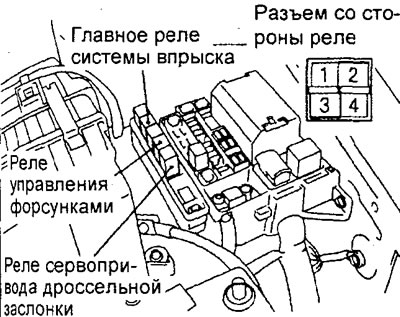
2. Connect the negative battery cable to terminal "2" of the relay and the positive battery cable to terminal "3" of the relay and check that the circuit is closed between terminals "1"-"4" of the relay when power is supplied from the battery.
Fuel pump relay
1. Check for a short circuit between terminals "1" and "4" of the relay connector when power is not supplied.
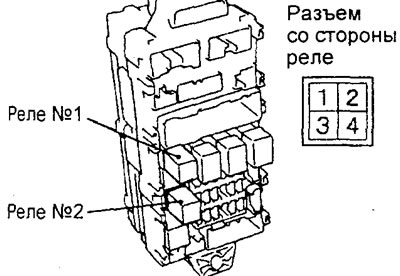
2. Connect the negative battery terminal wire to terminal "1" of the relay and the positive battery terminal wire to terminal "4" of the relay and check that the circuit is closed between terminals "2"-"3" of the relay when power is supplied from the battery.
Intake Air Temperature Sensor
1. Disconnect the mass air flow sensor connector.
2. Measure the resistance between connector terminals "5" and "6".
Nominal resistance:
- at 20°C - 2.3-3.0 kOhm
- at 80°C - 0.30-0.42 kOhm
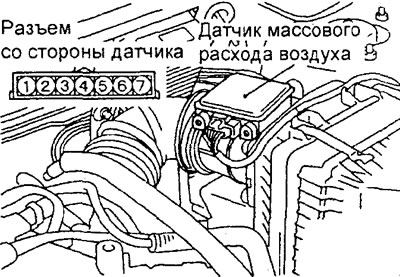
3. Measure the resistance by heating the sensor with a hair dryer. As the temperature increases, the resistance should decrease.
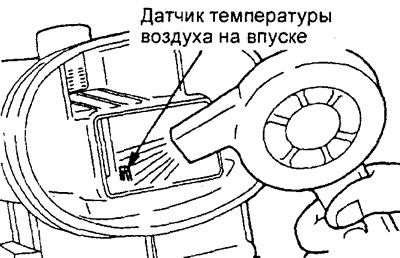
4. If the resistance does not correspond to the nominal value or does not change, replace the mass air flow sensor.
Coolant temperature sensor
1. Remove the coolant temperature sensor.
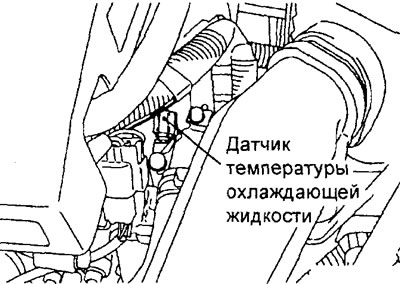
Engine 4G15.
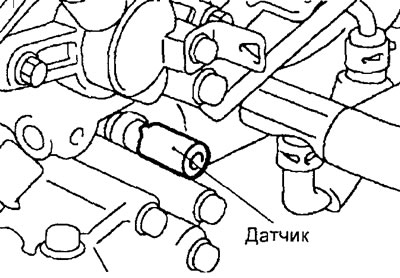
Engine 4G93.
2. Measure the resistance between the sensor terminals by immersing its sensitive element in hot water.
Nominal resistance:
- at 20°C - 2.10-2.70 kOhm
- at 80°C - 0.26-0.36 kOhm
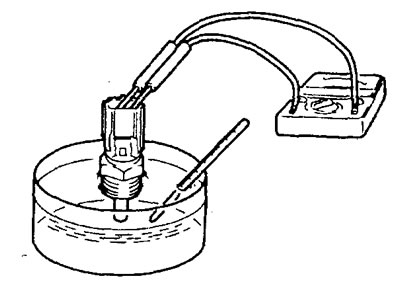
3. If the measured resistance differs significantly from the nominal value, replace the coolant temperature sensor.
4. Install the coolant temperature sensor in place, applying sealant to the sensor threads.
Sealant - ЗМ NUT Locking Part # 4171 or equivalent
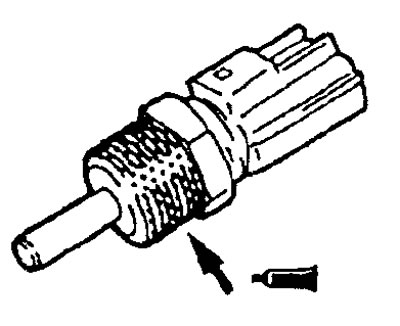
5. Tighten the sensor to the specified torque.
Tightening torque: 29 Nm
Throttle position sensor
1. Disconnect the throttle position sensor connector.
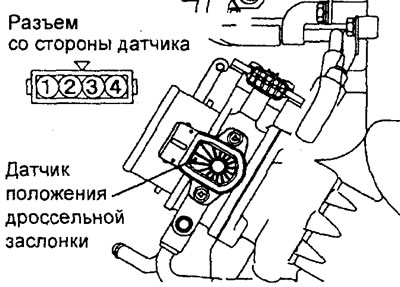
Engine 4G15.
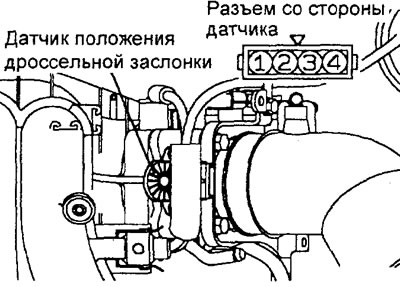
Engine 4G93.
2. Measure the resistance between the "ground" and "power" terminals of the sensor connector - terminals "3" and "1".
Nominal resistance - 1.7 - 3.3 kOhm
3. Measure the resistance between terminals "1"-"2" and "1"-"4" of the sensor connector, slowly opening the throttle valve from the fully closed position (idle) to the fully open position. The resistance should change smoothly in proportion to the throttle valve opening angle.
4. If the resistance differs from the nominal value or does not change smoothly, replace the throttle position sensor.
Note: After replacing the throttle position sensor, it must be adjusted.
5. Connect the sensor connector.
Accelerator Pedal Position Sensor
1. Disconnect the sensor connector.
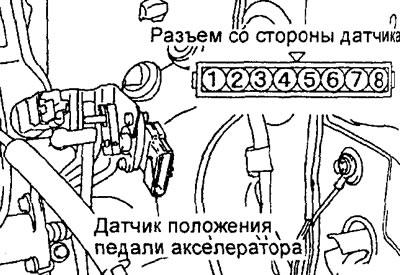
2. Measure the resistance between the specified terminals ("ground" and "power") of the sensor connector.
Conclusions:
- (channel #1) - "1" and "2"
- (channel #2) - "7" and "8"
Nominal resistance - 3.5 - 6.5 kOhm
3. Measure the resistance between the specified terminals ("power" and "signal") of the sensor connector, slowly pressing the accelerator pedal. The resistance should smoothly change proportionally to the degree of pressing the pedal.
Conclusions:
- (channel #1) - "2" and "3"
- (channel #2) - "8" and "6"
4. If the resistance differs from the nominal value or does not change smoothly, replace the accelerator pedal position sensor.
Note: After replacing the accelerator pedal position sensor, it must be adjusted.
5. Connect the sensor connector.
Sensor - switch of released accelerator pedal
1. Disconnect the accelerator pedal position sensor connector.
2. Check the condition of the circuit between terminals "4" and "5" ("sensor-switch" and "ground") with different positions of the accelerator pedal.
Nominal value:
- The pedal is pressed - the circuit is open
- The pedal is released - the circuit is closed
3. If faulty, replace the accelerator pedal position sensor.
Note: After replacing the accelerator pedal position sensor, it must be adjusted.
4. Connect the sensor connector.
Oxygen sensor
1. Disconnect the oxygen sensor connector and connect the test lead harness to the connector on the sensor side.
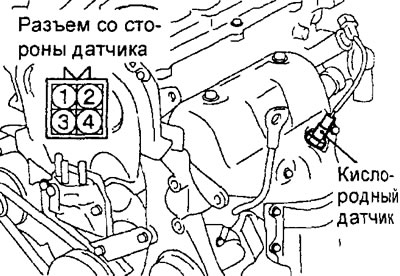
2. Measure the resistance between terminals "1" and "3" of the oxygen sensor connector (terminals "+" and heating element).
Nominal resistance (at 20°C) - 11-18 Ohm
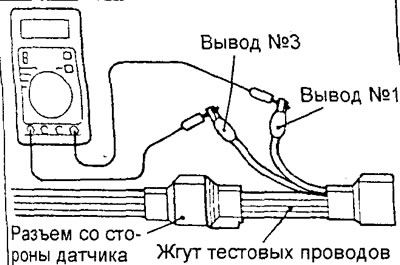
3. If the measured resistance does not correspond to the nominal value, replace the sensor.
4. Warm up the engine (engine coolant temperature 80°C or more).
5. Apply battery voltage to terminals "1" and "3" of the oxygen sensor connector (terminals "+" and "-" of the heating element).
Caution: Do not reverse the polarity, incorrect connection of the wires may damage the oxygen sensor.
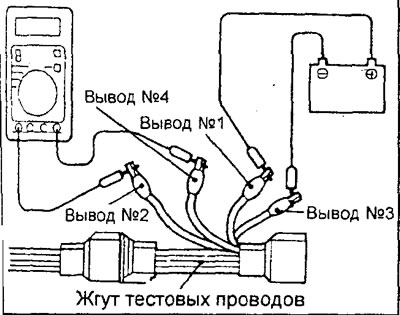
6. Connect the voltmeter to terminal "2" and to terminal "4" of the oxygen sensor connector.
7. Periodically pressing the accelerator pedal, measure the output voltage of the oxygen sensor. When the air-fuel mixture is slightly enriched with an increase in engine speed (acceleration), a working oxygen sensor should output a voltage of 0.6-1.0 V.
8. If there are any defects, replace the oxygen sensor.
9. Disconnect the test lead harness and connect the connector to the sensor.
Catalytic Converter Temperature Sensor
1. Disconnect the sensor connector.
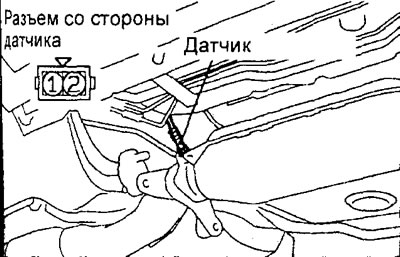
2. Measure the resistance between the sensor connector terminals.
Nominal resistance (at 20°C) - 1 MOhm and higher
Note: At 400°C the sensor resistance should be 3.44 kOhm.
3. If the measured resistance does not correspond to the nominal value, replace the sensor.
Nozzles
1. Disconnect the intermediate injector connector.
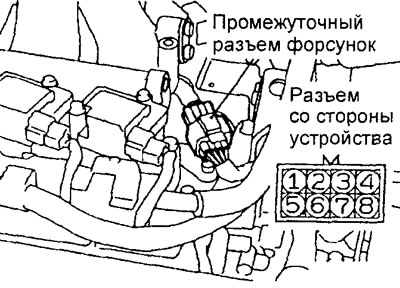
Engine 4G15.
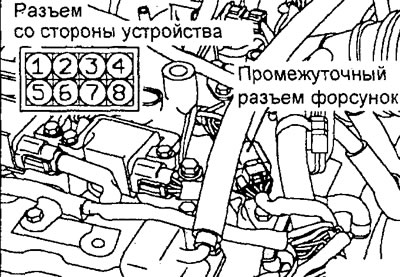
Engine 4G93.
2. Measure the resistance in the injector circuit according to the table below.
Nominal resistance (at 20°C) - 0.9-1.1 Ohm
| Nozzle | Conclusions |
| 1 | "1" - "2" |
| 2 | "3" - "4" |
| 3 | "5" - "6" |
| 4 | "7" - "8" |
3. Connect the intermediate connector of the injectors.
Throttle servo
Checking the operation of the servo drive
1. Disconnect the air intake hose from the throttle body.
2. Turn on the ignition.
3. Make sure that the throttle valve opens and closes in accordance with the accelerator pedal pressure.
Checking the resistance of windings
1. Disconnect the throttle servo connector.
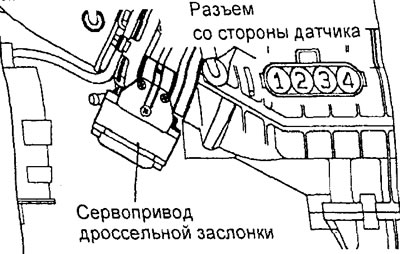
2. Measure the resistance between terminals "1" and "3" and terminals "2"-"4" of the throttle servo connector.
Nominal resistance (at 20°C) - 1.35-1.65 Ohm
3. Make sure there is no short circuit between each terminal and the servo housing.
4. If the measured resistance does not correspond to the nominal value, replace the throttle servo.