



Contents: Abbreviations ⤓ A ⤓ B ⤓ IN ⤓ G ⤓ D ⤓ AND ⤓ 3 ⤓ AND ⤓ TO ⤓ L ⤓ M ⤓ N ⤓ ABOUT ⤓ P ⤓ R ⤓ WITH ⤓ T ⤓ X ⤓ C ⤓ Ch ⤓ Sh ⤓ Eh ⤓
Abbreviations
ABS (Anti-lock braking system) - anti-lock braking system. An electronically controlled feedback system that prevents the wheels from locking during braking and maintains the vehicle's handling and directional stability.
ATF (Automatic Transmission Fluid) - automatic transmission working fluid.
DOHC (Double-overhead camshaft) - a type of engine valve timing mechanism that uses two camshafts located in the cylinder head, one of which controls the intake valves, the other the exhaust valves.
IC - an abbreviation used to denote an integrated circuit.
LED (Light-emitting diode) - an abbreviation used to denote a light-emitting diode (see "LED").
SOHC (Solo Overhead camshaft) - a type of valve timing mechanism that uses one camshaft located in the cylinder head.
TCS (Traction Control System) - a traction control system or anti-skid system designed to maintain the amount of slippage of the vehicle's drive wheels within established limits by monitoring the amount of their slippage and correspondingly reducing the torque on the engine.
VIN (Vehicle Identification Number) - vehicle identification number. Used to identify the engine cylinder block and car body (motorcycle frames).
A
Car tires - one of the most important elements, which is an elastic shell located on the wheel rim. The tire is designed to absorb minor vibrations caused by imperfect road surfaces, to implement and perceive forces arising in the contact patch and to ensure a high coefficient of adhesion. By type of construction, depending on the location of the cord (frame element), there are diagonal and radial tires. In radial tires, the cord threads are arranged along the shortest distance between the beads. In diagonal ones - at some angle and intersect each other. Currently, only radial tires are installed on passenger cars. Bias tyres continue to be used on motorcycles, mopeds, earthmoving and agricultural machinery.
Hydroplaning - a condition in which a film of water separates the tire and the road surface. It occurs when the pressure of a wedge of water, not displaced from the contact patch of the tire with the road, lifts the tire off the road. The tendency to aquaplaning depends on the thickness of the water film on the road surface, the speed of the vehicle, the shape of the tread pattern, its wear and the pressure exerted by the tire on the road.
Depreciation - the process of damping shock loads and vibrations.
Ampere (A) - unit of measurement of current strength.
Amp-hour (A-h) - unit of measurement of battery capacity.
Antifreeze - an aqueous solution of alcohols, glycols, glycerin and some inorganic salts that does not freeze at low temperatures and allows to reduce the freezing temperature of the coolant and increase its anti-corrosion properties.
B
Drum brake - a type of brake mechanism, the main parts of which are the brake drum and brake shoes with brake linings. Drum brakes are designed as an internal shoe brake, the shoes of which are pressed against the inner surface of the brake drums rotating with the wheels by means of pistons in the wheel cylinder. Thus, the car is braked.
Infinite resistance (∞) is the resistance value that characterizes an open electrical circuit.
Beating - the magnitude of the radial or axial deviation during rotation of the body (for example, a brake disc).
(The article is based on data from the website mitsubishiman)
Lateral clearance - stroke size (maximum distance) between two elements of a mechanism, one of which is necessarily stationary.
IN
Vacuum gauge - a device for measuring vacuum.
Shaft - a rod-shaped element of a mechanism designed to transmit torque.
Watt (W) - unit of power.
Top dead center (TDC) - the position of the piston in the cylinder, corresponding to the maximum distance between any point of the piston and the axis of rotation of the crankshaft (conditionally initial position of the crankshaft, zero degrees of crank rotation).
Wobbling - see "Shimmy".
Water pump - a mechanically driven device designed for forced circulation of coolant in the engine cooling system.
Air intake — a structural element of a machine used to collect ambient air and supply it to various internal systems, units and components for various applications: as a coolant, an oxidizer for fuel, to create a reserve of compressed air, etc. Air is taken in by means of pressure created by the flow of incoming air, or by vacuum created, for example, by the stroke of a piston in a cylinder.
Volt (V) - unit of measurement of electric current voltage.
Fuel injection - fuel-air mixture, dosed electronically and fed into the engine intake manifold (central or single point injection) or directly into the cylinder (distributed injection).
All-season oil (Multigrade oil) - motor oil that meets the requirements of more than one viscosity grade according to the SAE classification (Society of Automotive Engineers) (see viscosity levels according to SAE), and therefore may be suitable for use over a wider temperature range than an oil of a single viscosity grade.
Sleeve - a cylindrical piece of metal or other material used between two moving parts.
Electric current rectifier - a mechanical, vacuum tube, semiconductor or other device designed to convert alternating input electric current into direct output electric current.
Valve opening height - the maximum distance that the valve rises above the seat during opening.
Viscosity - property of fluid bodies (liquids and gases) resist the movement of one part relative to another.
G
Generator - a device designed to convert the mechanical energy of rotation of an internal combustion engine into electrical energy for recharging the battery and powering the electrical circuit of a vehicle.
Sealant - a polymeric substance from liquid to pasty, with the ability to seal various joints, seams, and connections.
Hygroscopicity - the property of some substances to absorb water vapor from the air. For example, brake fluids have this property, therefore, in order to maintain the qualities necessary for the normal functioning of the brake system, it is necessary to maintain the tightness of the storage vessels, as well as the elements of the brake system.
Cylinder liner - a cylindrical part made of high-carbon alloy steel, inserted into a cylinder block made of aluminum alloys.
Hypoid transmission - (short for hyperboloid), a special type of helical gear transmission, carried out by bevel gears with intersecting axles. Hypoid gear wheels can have oblique or curved teeth; the angle of intersection of the axes is usually 90°.
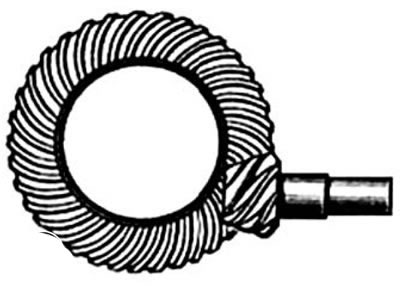
Main gear - a gear mechanism of a car transmission used to transmit and change the direction of torque from the drive shaft (gearboxes) to the drive wheels, as well as to change the traction force.
D
Double helical gears (herringbone gears) - gears that are a combination of two helical gears with opposing teeth (in the shape of the letter V). The axial moments of both halves of such a wheel are mutually compensated, so there is no need to install axles and shafts in special bearings.
Detonation - a supersonic complex consisting of a shock wave and an exothermic chemical reaction behind it. Internal combustion engines with spark ignition are quickly destroyed by detonation, as they are designed for slow combustion of the combustible mixture. Rapid detonation combustion sharply increases the pressure in the combustion chamber, which leads to rapid engine failure. In case of strong detonation - less than a minute. Fuel with a higher octane rating is better at resisting detonation.
Engine detonation - isochoric (explosive) process of combustion of a fuel-air mixture without performing work with the conversion of fuel combustion energy into the temperature and pressure of gases. The flame front spreads at the speed of an explosion, leading to strong impact loads on the parts of the cylinder-piston and crank-connecting rod groups, and thereby causing increased wear of these parts. High gas temperatures lead to burnout of the piston bottoms and burning of the valves.
Diaphragm - an elastic membrane that acts as a partition between two chambers with variable pressure.
Diaphragm spring - an elastic element in the form of a diaphragm, providing a uniform pressing force around the circumference.
Diode - a semiconductor device containing one PN junction, which ensures that electric current flows in only one direction.
Disc brake - a braking mechanism in which, unlike a drum brake, the brake shoes are pressed against the brake disc.
Length in free state - the length of the element measured in the unloaded state.
AND
Liquid Crystal Display - a flat display based on liquid crystals, as well as a monitor based on such a display.
3
Bully - the formation as a result of seizure of a groove visible to the naked eye with the displacement of the material both to the sides and in the direction of sliding.
Gap - the distance between two parts (for example, between the piston and the cylinder, between the bearing and the shaft).
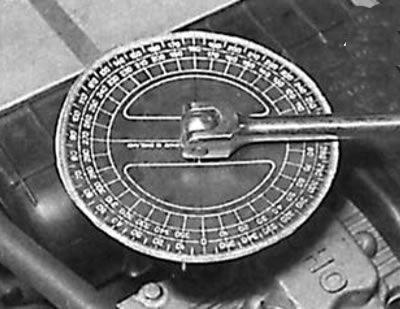
Tightening at an angle - a method of tightening a threaded connection by turning a bolt or nut at a certain angle. A special angle wrench is used for tightening at an angle (see picture).
Toothed drive belt - a belt designed to transmit torque between shafts without slipping (for example, to drive the gas distribution mechanism).
AND
Needle bearing - a type of rolling bearing in which the rolling element is small diameter rollers (needles) placed between two rings (internal and external) made of high carbon steel.
Tire wear indicator - an indicator in the form of transverse stripes that becomes visible when the tire tread reaches its wear limit, indicating the need to replace the tire with a new one.
Dial type indicator - a measuring device with a pointer indicator, designed to measure the amount of play in moving elements of mechanisms.
TO
Glow ignition - premature self-ignition of the fuel-air mixture from a hot substance, such as carbon deposits formed in the combustion chamber, or from overheated (more than 700-800°C) parts - spark plugs, heads, exhaust valves, etc. Pre-ignition disrupts the process of normal combustion of gasoline and is directly related to the development or occurrence of detonation. Combustion during glow ignition is similar in its physical nature to normal combustion, but it begins earlier, over a larger area, and proceeds faster. Premature ignition is a self-developing process, so the moment of spontaneous ignition occurs earlier and earlier. The pressure and temperature in the combustion chamber increase significantly, and their maximums can be reached even before the piston reaches TDC. All this causes an increase in loads on the parts of the cylinder-piston group and the crankshaft, an increase in engine noise, including dull knocks, which are quite difficult to distinguish from a number of engine sounds. But the main thing is that glow ignition leads to a significant increase in thermal loads on the surfaces that form the combustion chamber. Typically, the piston melts and/or burns out and the spark plug electrodes melt.
Camber - see Collapse.
Combustion chamber - the volume formed by the combination of engine parts in which the combustion of the combustible mixture occurs. The design of the combustion chamber is determined by the operating conditions and purpose of the mechanism.
Cardan shaft - a device for transmitting torque between units whose relative position in space is not constant: for example, from a gearbox (transfer case) to the drive axles in the case of a classic or all-wheel drive configuration. Also used in the safety steering column to connect the steering shaft and the steering actuator (steering gear or steering rack).
Caster (castor or castor, from English Caster angle) — the angle between the vertical and the projection of the wheel rotation axis onto the longitudinal plane of the vehicle. Longitudinal tilt ensures self-alignment of the steering wheels due to the vehicle speed.
Catalytic converter - an element that purifies exhaust gases from internal combustion engines by converting toxic components into more harmless compounds.
Oxygen sensor - oxygen sensor in the engine exhaust manifold. Allows you to estimate the amount of free oxygen remaining in the exhaust gases.
Valve - a device installed on a pipeline or vessel and designed to open or close when certain conditions occur (increasing the pressure in the vessel, changing the direction of the medium flow in the pipeline). Valves have a large number of design variations. Valves can be single-seat or double-seat, the latter are usually used only as distribution and control valves. Depending on the direction of flow through the valves, valves are divided into straight-through, straight-through and angle valves. In straight-through valves, the working medium at the outlet of the housing has the same direction as at the inlet. Straight-through valves are straight-through valves with a straightened flow line. They have lower hydraulic resistance compared to straight-through ones. In angle valves, the direction of flow of the medium at the outlet is perpendicular to the direction of flow at the inlet.
Valve clearance - clearance between valve stem and tappet (camshaft), designed to compensate for thermal expansion during operation of the internal combustion engine.
Allen key - a hexagonal rod inserted into the internal hexagonal groove of the bolt head.
Wheelbase - the distance between the axles of the front and rear wheels of the vehicle.
Compression - a force action on a gaseous body, leading to a decrease in the volume it occupies, as well as to an increase in pressure and temperature. Compression occurs in compressors, as well as during operation of an internal combustion engine and other devices.
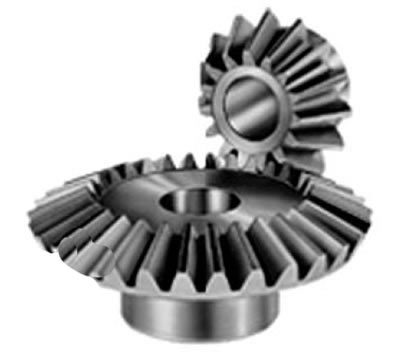
Bevel gears - used to change the direction of torque by an angle of 90°.
Lock-nut (lock nut) - a nut used to secure an adjusting nut or other threaded elements in one position.
Taper - deviation from the cylindrical shape of holes or shafts, characterized by a change in diameter over a certain length.
Indigenous (support) journal - the mounting surface of the crankshaft or camshaft.
Main bearings - bimetallic plain bearings installed on the main bearings of the crankshaft or camshaft.
Transmission (KP, gearbox, gear shift box (KPP)) - obsolete terms, currently not used in technical terminology) - a mechanism used in the transmission of vehicles with internal combustion engines, designed to change the engine torque in magnitude and direction, as well as for long-term disconnection of the power unit from the propeller (wheels or tracks). According to the type of control, a distinction is made between mechanical and automatic transmissions.
Short circuit - an electrical connection of two points of an electrical circuit with different potential values, not provided for by the design of the device and disrupting its normal operation. A short circuit can occur when the insulation of current-carrying elements is damaged or due to mechanical contact between elements operating without insulation. A short circuit is also a condition when the load resistance is less than the internal resistance of the power source.
Helical gear - a gear whose teeth are located at an angle to the axis of rotation, ensuring smoother, and therefore less noisy, engagement of the gear teeth. The disadvantage of helical gears is the occurrence during operation of a mechanical moment directed along the axis of rotation of the gear, which requires the use of thrust bearings, as well as increased heat generation, as a consequence of the increase in friction surfaces of the teeth. Double helical (herringbone) gears are free from these problems (see Double helical gears).
Torque (moment of force) - a physical quantity that characterizes the rotational effect of force on a solid body.
Body — a part of a vehicle designed to accommodate passengers and cargo. The body is attached to the car frame. There are also frameless bodies that simultaneously function as a frame - all other components and assemblies of the car are attached to them.
L
Lambda probe (λ-probe) - see "Oxygen sensor".
M
Manometer - a device designed to measure pressure.
"Weight" - short circuit of the electrical circuit in the car to the battery through the body.
Micrometer - a particularly precise measuring instrument designed for measuring external diameters.
Multimeter - a measuring device designed to measure voltage, current and resistance of an electrical circuit.
N
Bottom dead center (BDC) - the position of the piston in the cylinder, corresponding to the minimum distance between any point of the piston and the axis of rotation of the crankshaft (conditionally initial position of the crankshaft, zero degrees of crank rotation).
Bore gauge - a measuring device designed to measure the internal diameter of a hole.
Newton - unit of measurement of force.
Newton meter (Nm) is a unit of measurement of torque.
ABOUT
Overrunning clutch (freewheel clutch) — a mechanical transmission part that prevents the transmission of torque from the driven shaft back to the driving shaft if, for some reason, the driven shaft begins to rotate faster. The most well-known application of the overrunning clutch is in bicycle drive. At the moment when the rider stops pedaling and the bike continues to move by inertia, the overrunning clutch is activated, disconnecting the wheel from the pedals, and they do not hit the legs. Sometimes overrunning clutches are used in cars with two-stroke engines, for which the "engine braking" mode is impossible due to design features (more precisely, the principle of lubrication), which can disable them. Another widespread application of the overrunning clutch is its use in internal combustion engine starters to prevent the starter from being destroyed by the running engine.
Ovality - the difference in hole diameters measured in mutually perpendicular directions.
Octane number - a value characterizing the resistance of fuel to detonation.
Ohm (Ω) is a unit of measurement of electrical circuit resistance.
Ohmmeter - a device for measuring the resistance of an electrical circuit.
Ignition timing - ignition of the working mixture in the engine cylinder before the piston reaches TDC.
Axial clearance (axial play) - play of the element in the axial direction.
Axis - a rod-shaped element of a mechanism which, unlike a shaft, does not transmit torque but is intended solely for positioning rotating parts.
Coolant - the working fluid of the engine cooling system, which consists of water, antifreeze, special additives that protect the cooling system of the internal combustion engine from corrosion processes and the fluid itself from thermochemical destruction. Nowadays, mainly ethylene glycol-based coolants are used. All ethylene glycol coolants differ in quality from each other only in the set (or absence) necessary additives and the degree of dilution with water. Glycol-based coolants are not hazardous to humans. They are poisonous only when taken internally.
P
Gear ratio - the ratio of the number of teeth of the driving gear to the number of teeth of the driven gear in a gear transmission, the number of teeth of the worm wheel to the number of worm entries in a worm gear transmission, the number of teeth of the large sprocket to the number of teeth of the small sprocket in a chain transmission, and also the diameter of the large pulley (or roller) to the diameter of the smaller one in a belt or friction transmission.
AC - an electric current that periodically changes in magnitude and direction (usually sinusoidal). Thus, this type of current has properties that are favorable for the transmission of electrical energy over a distance, since it allows for easy voltage transformation in transformers. Three-phase alternating current generators are widely used in automobiles due to their more compact dimensions compared to direct current generators.
Flat feeler gauge - a strip of a certain thickness made of high-alloy steel, designed to measure gaps between parts.
Electrolyte density - a value characterizing the state of the battery electrolyte.
Suspension — a set of parts, units and mechanisms connecting the machine body with the supporting elements (wheels, rollers, skis, etc.). The suspension is designed to reduce dynamic loads and ensure their uniform distribution on the supporting elements during movement, and also serves to improve the traction qualities of the machine.
Bearing - a mechanical element used to reduce friction and the associated wear and heat generation processes between two working surfaces in contact with each other. The most common bearings found in a car are ball, roller, needle, tapered and plain bearings (bimetallic inserts).
Plain bearings - a support or guide for a mechanism or machine in which friction occurs when mating surfaces slide. A plain bearing is a housing with a cylindrical hole into which a liner or bushing made of antifriction material and a lubricating device are inserted. Between the shaft and the bearing sleeve hole there is a gap filled with lubricant, which allows the shaft to rotate freely.
All-wheel drive — a vehicle transmission design in which the torque generated by the engine is transmitted to all wheels. It is necessary to distinguish between the designations of all-wheel drive AWD (All Wheel Drive) and 4WD, because contrary to popular belief, they are not the same thing: AWD means permanent or automatically connected all-wheel drive, and 4WD means all-wheel drive that is connected and disconnected manually.
Half shaft - a shaft designed to transmit torque from the main transmission to the wheels of the vehicle.
Piston pin - a rod designed to connect the piston to the upper head of the connecting rod.
Firing order - the order of ignition of the fuel-air mixture in the cylinders of an internal combustion engine.
D.C - directed movement of electric charges that does not change in magnitude and direction.
Maximum permissible value - the value of a geometric or physical indicator of a part, upon reaching which further use of the part is impossible or unsafe. The part needs to be replaced with a new one.
Fuse - a device that breaks an electrical circuit when the current strength is exceeded and, thus, prevents damage to the elements of the electrical circuit.
Drive shaft - any shaft used to transmit torque.
Suspension breakdown - a situation in which the suspension spring, as a result of hitting an obstacle, is compressed to the limit and the impact is transmitted to the rubber stops, and through them to the body elements. Often the suspension cannot withstand such overloads and collapses
Circuit conductivity - the reciprocal value of resistance in an electrical circuit. Characterizes the closed state of the circuit.
Bleeding air from the hydraulic system - the process of removing air from the elements of the hydraulic system (brakes, clutch, cooling, power steering, etc.) through specially designed fittings or valves.
Pad - any sealing material between two metal parts, designed to seal the mating surfaces.
Extreme Pressure Additive - a coating that reduces the risk of metal scuffing in threaded connections exposed to high temperatures (for example, car exhaust pipe bolts).
R
Radial clearance - play of the part in the radial direction relative to the axis of rotation.
Radiator - a device for heat dissipation, a heat exchanger. In an engine cooling system, the radiator is designed to transfer heat from the coolant to the atmosphere.
Collapse (camber, from English. Camber angle) — the angle between the vertical and the plane of rotation of the wheel. Camber is considered negative if the wheels point top-side inward, and positive if top-side outward.
Transfer case - a unit for distributing torque from the engine to several drive mechanisms, which in most cases also increases the number of gears in the transmission. For example, in off-road vehicles the transfer case:
- Distributes torque between the drive axles in such a way as to ensure the best possible vehicle cross-country ability without the occurrence of a negative phenomenon - "power circulation" in the transmission;
- Increases torque on the drive wheels within the limits necessary to overcome the rolling resistance of the wheels when driving on poor roads and off-road, as well as on steep climbs;
- Ensures stable movement of the vehicle at low speed when the engine is operating at maximum torque.
Boring of a cylinder bore - increasing the internal diameter of the cylinder bore by mechanical processing to the repair size (see "Repair size").
Grinding - the process of updating the valve seating surfaces and their seats in the cylinder head.
Adjusting washer - washers of a certain thickness, designed to adjust the geometric parameters of the mechanism (gaps, beatings, etc.).
Voltage regulator (voltage stabilizer) - an electrical device that receives power from an external power source and produces at its output a voltage that is independent of the supply voltage (provided that the supply voltage does not exceed the permissible limits).
Relay - an electrical device designed to close and open electrical circuits with high current, controlled by low currents.
Repair size - a standardized size, increased relative to the nominal, used during major repairs of a particular unit (for example, piston-cylinder liner systems). Depending on the degree of increase in size relative to the nominal, there are first, second, third, etc. repair sizes with a certain step (for example, 0.5 mm).
WITH
LED - a semiconductor device that emits light when an electric current is passed through it.
Spark plug — a device for igniting the fuel-air mixture in a wide variety of heat engines. Spark plugs are used in gasoline internal combustion engines. The ignition of the combustible mixture is produced by an electric discharge with a voltage of several thousand or tens of thousands of volts, which occurs between the spark plug electrodes. The spark plug fires at each cycle, at a certain point in the engine's operation.
Free play - the amount of travel before the action begins, caused by the weakening of the rod connections or other elements of the mechanism. For example, free travel of the brake pedal is the distance that the brake pedal travels before the brake mechanisms begin to operate.
Seasonal oil (Monograde Oil) -motor oil that meets the requirements of more than one viscosity grade according to the SAE classification (Society of Automotive Engineers) (see viscosity levels according to SAE), can be used in a more limited temperature range than dual viscosity grade oils.
Charging system - a system designed to charge a car battery.
Launch system - a system designed to start an internal combustion engine by forcibly rotating the crankshaft with an electric motor (starter).
Fuel vapor recovery system - a system designed to capture fuel vapors from the fuel system and prevent them from escaping into the atmosphere.
Engine management system - an electronic system designed to control the processes of fuel-air mixture intake, ignition and exhaust gas release in an internal combustion engine.
Resistance - a value characterizing the properties of a conductor.
Starter (in an internal combustion engine) — a device that spins the crankshaft to start the engine.
Compression ratio - the ratio of the volume of the above-piston space of the cylinder with the piston position at the bottom dead center (BDC) to the volume of the above-piston space of the cylinder with the piston position at the top dead center (TDC), that is, to the volume of the combustion chamber. The concept of compression ratio should not be confused with the concept of compression, which means (at a certain structurally determined degree of compression) the maximum pressure created in the cylinder when the piston moves from bottom dead center (BDC) to top dead center (TDC) (for example: compression ratio -10:1, compression - 14 atm.).
Retaining ring - an elastic ring used to prevent movement of cylindrical parts and shafts. The internal retaining ring is installed in a groove in the housing; outer retaining ring - into the groove in the outer cylindrical surface of the axle.
Convergence — the angle between the direction of movement and the plane of rotation of the wheel. Very often they talk about the total toe-in of two wheels on one axle. Some vehicles allow you to adjust the toe-in of both the front and rear wheels.
T
Fuel-air mixture - a charge consisting of a mixture of fuel and air, supplied to the cylinder of an internal combustion engine.
Turbocharger (gas turbine supercharger) - a device that uses the energy of exhaust gases to force air or a fuel-air mixture into an internal combustion engine. For low power engines (automobile) turbochargers with a centripetal turbine are used, and on high-power engines (tractor, diesel locomotive, marine) - with axial turbine. The compressor is always centrifugal, since the axial compressor has a more complex design and a tendency to surge.
Valve opening angle - the position of the crankshaft at which the valve opens (inlet or outlet).
Angle of transverse inclination — (KPI) the angle between the vertical and the projection of the steering gear axis onto the transverse plane of the vehicle. This angle ensures self-alignment of the steering wheels due to the weight of the vehicle.
Carbon filter - the main component of the fuel vapor recovery system, consisting of activated carbon granules designed to capture fuel vapors from the fuel system and prevent them from entering the atmosphere.
Sealing ring - a sealing element in the form of a ring, made of elastic material (for example, rubber).
Thrust washer - a washer installed between two components located on an axis (shaft) to ensure the required amount of axial clearance.
X
Honing - a type of abrasive processing of materials using honing heads (hones). Mainly used for processing internal cylindrical holes (from 2 mm) by combining the rotary and reciprocating motion of the hone with sliding abrasive bars fixed to it with abundant irrigation of the surface being processed with a cutting fluid. One of the types of finishing and finishing machining. Allows you to obtain a hole with a deviation from cylindrical shape of up to 5 µm and a surface roughness of Ra=0.63+0.04.
C
Gas distribution mechanism drive chain - a chain designed for synchronous transmission of rotation from the crankshaft to the camshaft(s) of the engine.
Cetane number — a characteristic of the flammability of diesel fuels that determines the ignition delay period of the mixture (the time interval from the injection of fuel into the cylinder until the start of its combustion). The higher the cetane number, the less delay and the more calmly and smoothly the fuel mixture burns.
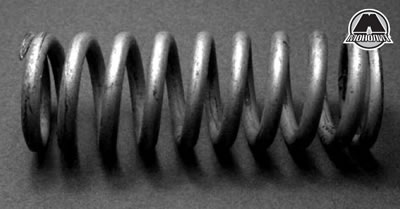
Coil spring (helical, spiral) - a cylindrical spiral made of elastic wire of various sizes, designed to accumulate and absorb mechanical energy, which is widely used in the design of the car.
Ch
Rotation frequency - a value characterizing the speed of rotation of a body (shaft). Measured in the number of revolutions per unit of time.
Worm gear (toothed screw transmission) — a mechanical transmission achieved by engaging a worm and a worm wheel mated with it.
Sh
Ball bearing - a bearing consisting of two rings (internal and external) made of hardened steel and a set of balls between them.
Connecting rod - an element of the crank mechanism designed to transmit mechanical energy from the piston to the crank (crankshaft).
Connecting rod bearings - bimetallic liners, which are plain bearings installed in the lower head of the connecting rod to reduce friction between the connecting rod and the crankshaft.
Shimmy (wobbling) - the effect of the beating of the front wheel of a motorcycle or car that occurs at speed, causing the steering wheel to beat and the trajectory of movement to "wobble" from side to side. Shimmy is dangerous because it occurs not at low speeds, but only at high speeds. It requires immediate action from the driver, but even that does not guarantee success.
CV joint (constant velocity joint) - a mechanical device that provides transmission of high torque at rotation angles of up to 70 degrees relative to the axis. It is used in the drive systems of passenger cars with independent suspension on the front and, less commonly, rear wheel axles.
Calipers - a high-precision measuring device designed for measuring internal and external diameters.
Eh
Electrolyte - a substance whose solution or melt conducts electric current. In automotive applications, a solution of sulfuric acid used in a battery to cause a chemical reaction that converts energy into electrical energy.
Electronic control unit - a processor that controls the electronic components of a particular system (for example, by ignition of the engine).