
English Русский
Български
Беларускі
Український
Српски
Hrvatski
Română
Polski
Slovenský
Magyar
Articles Bookmark Contacts Sitemap   
Company Audi Company Ford Company Hyundai Company Kia Company Mazda Company Mercedes-Benz Company Nissan
MitsubishiMan.ru


Home Colt Lancer Galant L200 Outlander Pajero Others
Lancer 9 (2000-2007, petrol) Lancer 3 and 5 (1984-1992)

MPI (Multi-Point Injection) Fuel Injection Device (Mitsubishi Lancer 3)

  • Home
  • Lancer
  • 3 (1984-1992)
  • Power unit
  • Fuel injection
  • MPI (Multi-Point Injection) Fuel Injection Device
0
Contents: MPI injection device diagram ⤓ MPI Fuel Supply ⤓
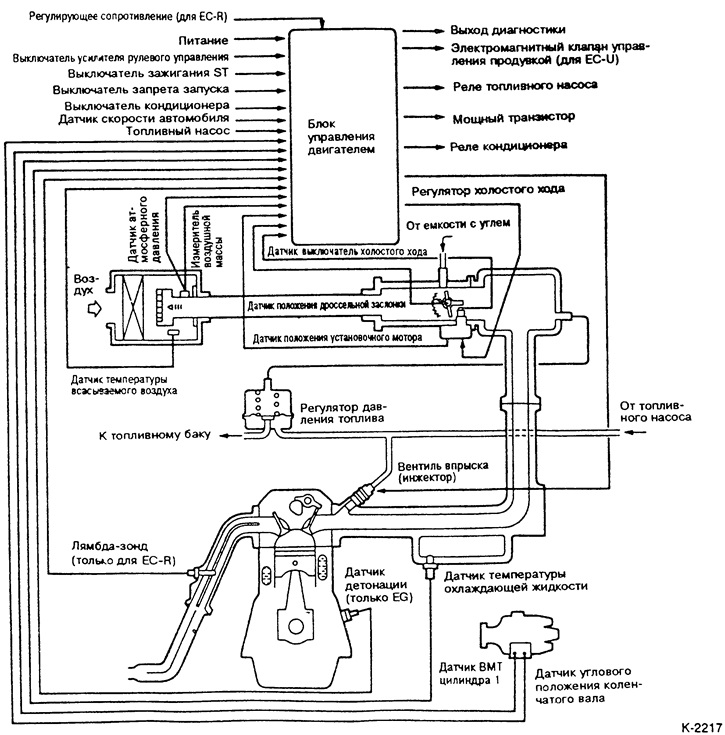
The MPI injection device is an electronic fuel injection device that injects fuel depending on the engine operating mode into the intake pipe directly before the intake valves.

Fuel is pumped from the fuel tank by an electric fuel pump and fed through the fuel filter to the distribution line and then to the injection valves. The pressure regulator on the line ensures constant pressure in the fuel system when the vacuum pressure of the suction changes. The sucked air is cleaned in the air filter and fed to the engine through the intake manifold.

The air filter housing contains an air mass meter that measures the amount of incoming air and transmits this information to the control unit in the form of electrical pulses. Based on these pulses and engine speed signals, the engine control unit roughly calculates the fuel injection moment. To more accurately determine the injection moment, signals from other sensors are also used, such as the atmospheric pressure meter or intake air temperature sensor.

The injection/ignition system control unit processes the data coming from the sensors and calculates the injection moment and the amount of fuel injected based on the parameter field stored in its memory. With a longer opening of the injection valve (injector), more fuel will be injected per one crankshaft revolution. Injection is performed sequentially, i.e. the injection valves are controlled separately in the ignition sequence.


The lambda probe (oxygen sensor) measures the oxygen content in the exhaust gases and transmits information to the control unit in the form of voltage. The control unit changes the ratio between fuel and air in the mixture based on this information so that the exhaust gases burn in the catalytic converter in an optimal way.

The fuel tank air release valve is controlled depending on the engine operating mode. The evaporated fuel in the fuel tank is accumulated in the activated carbon filter and released through the combustion valve. Thus, fuel vapors are mostly used economically and are not released into the air.

(The original material is posted on the website: www.mitsubishiman.ru)

MPI injection device diagram


The picture shows a 1.5L engine


MPI Fuel Supply


The picture shows a 1.5L engine
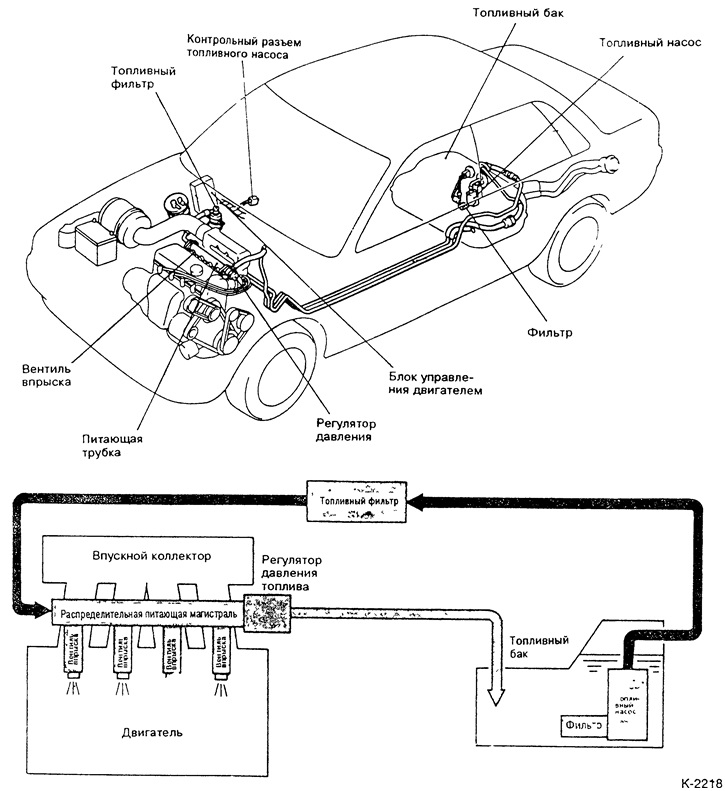


The control unit is located in the passenger compartment on the right side next to the glove compartment.


The fuel pump is located in the fuel tank and is immersed in the fuel. This reduces noise and the formation of fuel bubbles. The safety valve opens at a pressure of 4.5-6 bar and thus prevents excessive pressure build-up in the fuel line. The check valve maintains the pressure in the fuel line when the engine is stopped on the distribution line and constantly maintains the pressure at 3.3 bar higher than the pressure in the intake manifold. The pressure value is therefore around 2.7 bar (turbo engine 2.55 bar).

The injection valves (injectors) are controlled by the control unit and during the operation of the injection device. When current flows through the winding of the electromagnet, the needle of the injection valve is drawn in and fuel is injected. When the current circuit is broken, the spring returns the needle and the valve is locked.

The throttle body contains a throttle valve, which regulates the amount of air through the gas pedal. In addition, the throttle body contains an idle speed adjustment mechanism.

The idle speed controller (setting motor) regulates the air supply bypassing the throttle valve. Thanks to it, the engine speed is stabilized during the warm-up phase. The idle speed controller contains the setting motor position sensor and the idle speed switch sensor.

Caution: When working with the injection device and fuel lines, keep the area clean, see p. 6.2.
This article is available at: russian, bulgarian, belarusian, ukrainian, serbian, croatian, romanian, polish, slovak, hungarian
This article was reviewed by: Dmitry Vasiliev
Share with friends:
◀ Previous
Lancer 3 and 5: Fuel injection
Next ▶

Fuel injection device
Safety instructions for working with the fuel injection device
Relieving pressure in the fuel system
Checking the idle mode
Querying failure memory
Injection device fault codes
Similar materials for other Mitsubishi models

➤ Multi-Point Fuel Injection (MPI) System Mitsubishi Colt 2 and 3 (1983-1993)
➤ Multi-Point Injection (MPI) — Removal and Installation Mitsubishi Galant 5 (1983-1989, petrol)
➤ Removal and installation the fuel injection pump pulley Mitsubishi L200 4 (2005-2014, diesel)
➤ General information about the fuel supply and injection… Mitsubishi Outlander 1 (2003-2008)
➤ Removal and installation of fuel injection pump Mitsubishi Pajero 1 and 2 (1982-1999)
➤ Self-diagnosis function. Multi-point fuel injection (MPI)… Mitsubishi Space Star (1998-2005)
Link in different formats to this article
Comments and feedback from visitors
No comments yet


Add up two numbers 13 + 30


Lancer 9 (2000-2007, petrol) 
  • General information
  • User manual
  • Maintenance
  • Power unit
  • Repair of MPI engines
  • Repair of GDI engines
  • Engine overhaul
  • Cooling and lubrication system
  • MPI fuel injection system
  • GDI fuel injection system
  • Intake and exhaust system
  • Starting and charging system
  • Transmission
  • Automatic gearbox
  • Variator (CVT)
  • Drive shafts and gearbox
  • Chassis and running gear
  • Front suspension
  • Rear suspension
  • Steering
  • Brake system
  • Body and interior
  • Doors, locks and windows
  • Exterior (external elements)
  • Interior (internal elements)
  • Electrical equipment
  • Heater and air conditioner
  • Security system SRS
  • Equipment and devices
  • Wiring diagrams (saloon)
  • Wiring diagrams (wagon)
Lancer 3 and 5 (1984-1992) 
  • General information
  • Maintenance
  • Power unit
  • Engine repair
  • Lubrication system
  • Cooling system
  • Ignition system
  • Fuel system
  • Carburetor
  • Fuel injection
  • Diesel power system
  • Exhaust system
  • Transmission
  • Clutch
  • Car gearbox
  • Chassis and running gear
  • Front suspension
  • Rear suspension
  • Steering
  • Brake system
  • Wheels and tires
  • Body and interior
  • Exterior (external elements)
  • Interior (internal elements)
  • Heating system
  • Electrical equipment
  • Equipment and devices
  • Power devices
  • Electrical circuits
MitsubishiMan.ru © 2018–2026 • Mobile version • Articles about Mitsubishi • Contacts • Sitemap: EN BG BY UA RS HR RO PL SK HU • Site search • Bookmark
Colt 2 and 3 (1983-1993) · Colt 4 and 5 (1991-2003) · Colt 5 (1995-2003) · Lancer 3 and 5 (1984-1992) · Lancer 9 (2000-2007) · Galant 5 (1983-1989) · Galant 6 and 7 (1987-1998) · L200 4 (2005-2014) · Outlander 1 (2003-2008) · Pajero 1 and 2 (1982-1999) · Pajero 4 (2006-2021) · Carisma (1995-2004) · Space Star (1998-2005) ·
This resource sets cookies 🍪 to avoid bothering you with repeated data entry.