
English Русский
Български
Беларускі
Український
Српски
Hrvatski
Română
Polski
Slovenský
Magyar
Articles Bookmark Contacts Sitemap   
Company Audi Company Ford Company Hyundai Company Kia Company Mazda Company Mercedes-Benz Company Nissan
MitsubishiMan.ru


Home Colt Lancer Galant L200 Outlander Pajero Others
Lancer 9 (2000-2007, petrol) Lancer 3 and 5 (1984-1992)

Checking the ignition timing angle (Mitsubishi Lancer 9)

  • Home
  • Lancer
  • 9 (2000-2007, petrol)
  • General information
  • Maintenance
  • Checking the ignition timing angle
0
1. Before starting the inspection procedure, prepare the vehicle (see section "Checking the idle speed").

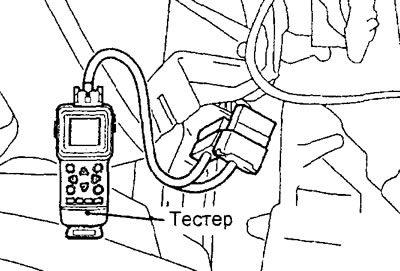
2. Turn off the ignition and connect the tester to the 16-pin diagnostic connector under the instrument panel.


3. Install the strobe light.

Note: For GDI engine, connect the timing light to the ignition coil power line of cylinder #1 (terminal "1").
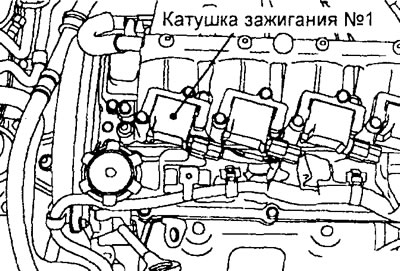


GDI engine.


4. Start the engine and let it idle.

5. Check that the idle speed corresponds to the nominal value (see section "Checking the idle speed").

6. Select the settings on the tester (subparagraph No.17 of the Actuator test item for MUT-II) corresponding to the setting of the basic ignition timing angle.

Note: For GDI engine, at this point the engine speed will be 700 rpm (4G15) or 750 rpm (4G93).


7. Check the value of the base ignition advance angle, which should be within the specified limits.

Nominal value...5+3°before TDC 8. If the basic ignition timing angle does not correspond to the nominal value, then perform troubleshooting and check the fuel injection system components (see the relevant chapter).

9. Press the reset button on the tester (the "Clear" button for MUT-II) to disable the basic advance angle mode (Actuator Test mode for MUT-II). Note: if this is not done, the forced control mode of the device will be maintained for 27 minutes. Driving the car under these conditions may cause engine damage.

10. Check that the ignition timing angle corresponds to the nominal value.

Nominal value: (approximately)
  • GDI Engine - 20° BTDC
  • Engine 4G15-MPI - 10° BTDC
  • Engine 4G93-MPI - 8° BTDC

Note:
  • Even under normal engine operation, the ignition timing angle varies within ±7°.
  • As the altitude increases, the ignition timing angle is automatically increased by approximately 5° from the nominal value.
  • For a GDI engine, after 4 minutes or more after the base advance mode is turned off, the spark advance angle will be approximately 5° BTDC.


11. Disconnect the strobe light.

12. Turn off the ignition and disconnect the tester.
This article is available at: russian, bulgarian, belarusian, ukrainian, serbian, croatian, romanian, polish, slovak, hungarian
This article was reviewed by: Arseny Pavlov
Share with friends:
◀ Previous
Lancer 9: Maintenance
Next ▶

Checking High Voltage Wires (MPI Engine)
Checking and cleaning spark plugs
Checking the battery status
Replacing the fuel filter
Replacing the coolant
Checking the idle speed
Checking for increased idle speed when the air conditioner is turned on
Checking the composition of exhaust gases at idle speed
Compression check
Checking the vacuum in the intake manifold
Similar materials for other Mitsubishi models

➤ Checking and adjusting the ignition timing angle Mitsubishi Colt 2 and 3 (1983-1993)
➤ Checking/adjusting the ignition timing Mitsubishi Galant 6 and 7 (1987-1998)
➤ Ignition switch Mitsubishi L200 4 (2005-2014, diesel)
➤ Checking free play and checking the steering wheel angle Mitsubishi Outlander 1 (2003-2008)
➤ Checking the ignition timing angle Mitsubishi Pajero 4 (2006-2021)
➤ Checking the ignition timing angle Mitsubishi Space Star (1998-2005)
Link in different formats to this article
Comments and feedback from visitors
No comments yet


Add up two numbers 50 + 13


Lancer 9 (2000-2007, petrol) 
  • General information
  • User manual
  • Maintenance
  • Power unit
  • Repair of MPI engines
  • Repair of GDI engines
  • Engine overhaul
  • Cooling and lubrication system
  • MPI fuel injection system
  • GDI fuel injection system
  • Intake and exhaust system
  • Starting and charging system
  • Transmission
  • Automatic gearbox
  • Variator (CVT)
  • Drive shafts and gearbox
  • Chassis and running gear
  • Front suspension
  • Rear suspension
  • Steering
  • Brake system
  • Body and interior
  • Doors, locks and windows
  • Exterior (external elements)
  • Interior (internal elements)
  • Electrical equipment
  • Heater and air conditioner
  • Security system SRS
  • Equipment and devices
  • Wiring diagrams (saloon)
  • Wiring diagrams (wagon)
Lancer 3 and 5 (1984-1992) 
  • General information
  • Maintenance
  • Power unit
  • Engine repair
  • Lubrication system
  • Cooling system
  • Ignition system
  • Fuel system
  • Carburetor
  • Fuel injection
  • Diesel power system
  • Exhaust system
  • Transmission
  • Clutch
  • Car gearbox
  • Chassis and running gear
  • Front suspension
  • Rear suspension
  • Steering
  • Brake system
  • Wheels and tires
  • Body and interior
  • Exterior (external elements)
  • Interior (internal elements)
  • Heating system
  • Electrical equipment
  • Equipment and devices
  • Power devices
  • Electrical circuits
MitsubishiMan.ru © 2018–2026 • Mobile version • Articles about Mitsubishi • Contacts • Sitemap: EN BG BY UA RS HR RO PL SK HU • Site search • Bookmark
Colt 2 and 3 (1983-1993) · Colt 4 and 5 (1991-2003) · Colt 5 (1995-2003) · Lancer 3 and 5 (1984-1992) · Lancer 9 (2000-2007) · Galant 5 (1983-1989) · Galant 6 and 7 (1987-1998) · L200 4 (2005-2014) · Outlander 1 (2003-2008) · Pajero 1 and 2 (1982-1999) · Pajero 4 (2006-2021) · Carisma (1995-2004) · Space Star (1998-2005) ·
This resource sets cookies 🍪 to avoid bothering you with repeated data entry.