
Raise and secure the front wheels of the vehicle.
Disconnect the ignition coil connectors.
Attention! Remove air only by turning the engine with a starter. If you bleed while the engine is running, air can get into the fluid. In the process of removing air, constantly replenish the tank with working fluid and make sure that its level does not fall below the mark «MIN» on the tank.
Turn the engine over with the starter several times (within 15–20 s), and turn the steering wheel five or six times a full turn to the left and right.
Connect the ignition coil connectors.
Start the engine (idling).
Turn the steering wheel left and right until you are sure there are no air bubbles in the fluid.
Make sure that the working fluid does not have a milky tint and its level is between the marks «MAX» And «MIN».
Also make sure that there is a slight change in the fluid level in the reservoir when the steering wheel is turned left and right.
Attention! If the fluid level in the reservoir rises sharply after stopping the engine, this means that air is not completely removed from the system. If the air is not completely bled from the system, it will cause abnormal noise in the hydraulic pump and flow control valve, this condition will reduce the life of the power steering system components.
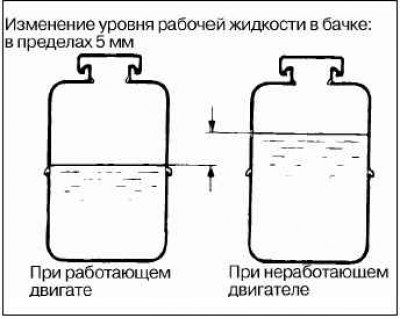
Change in the level of the working fluid in the tank: within 5 mm.
Check the difference in fluid levels with the engine running and not running.
If this level difference exceeds 5 mm, this means that air has not been completely bled from the hydraulic drive system. That is, the procedure for removing air from the system must be repeated.