
English Русский
Български
Беларускі
Український
Српски
Hrvatski
Română
Polski
Slovenský
Magyar
Articles Bookmark Contacts Sitemap   
Company Audi Company Ford Company Hyundai Company Kia Company Mazda Company Mercedes-Benz Company Nissan
MitsubishiMan.ru


Home Colt Lancer Galant L200 Outlander Pajero Others
Carisma (1995-2004) Space Star (1998-2005)

Bleeding the Power Steering Hydraulic System (Mitsubishi Carisma)

  • Home
  • Mitsubishi
  • Carisma (1995-2004)
  • Chassis and running gear
  • Steering
  • Bleeding the Power Steering Hydraulic System
0
1. Jack up the front wheels of the car and place the car on stands.

2. Manually turn the power steering pump pulley a few turns.

3. Make 5 or 6 full turns of the steering wheel left and right.

4. Disconnect the central high-voltage wire.

Caution: Do not locate the central high-tension wire near the fuel rail.


5. Make several short crankings of the starter while constantly turning the steering wheel left and right (five or six times within 15–20 seconds).

Attention! When removing air, it is necessary to constantly add fluid and make sure that its level does not fall below the lower position of the filter. If you remove air while the engine is running, air will be sucked in and enter the working fluid. Therefore, it is necessary to remove air from the hydraulic system only when the engine crankshaft is turned by the starter.


6. Connect the central high-voltage wire.

7. Turn the steering wheel right and left until the air bubbles in the power steering reservoir disappear.

8. Make sure that the working fluid is transparent, without cloudiness, and that its level in the tank corresponds to the normal position on the dipstick.

9. Make sure that the difference in fluid levels when turning the steering wheel left and right is insignificant.
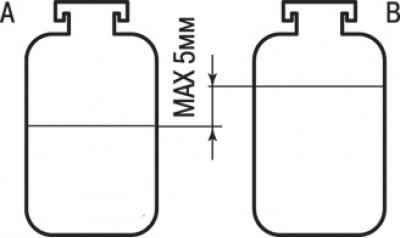


Fig. 13.6. Checking the level of working fluid in the reservoir of the hydraulic system of the power steering: A - with the engine running; B - with the engine not running


10. Check that the difference in the levels of the working fluid in the tank with the engine running and not running is within 5 mm (Fig. 13.6).

11. If the level difference reaches 5 mm or more, it means that the air has not been completely removed from the hydraulic system, so the air removal operation should be repeated.

Attention! If the fluid level rises sharply after the engine is stopped, it means that the air from the hydraulic system has not been completely removed. If the air from the hydraulic system of the power steering is not completely removed, extraneous noises will occur from the pump and the control valve, operation in this mode will lead to a reduction in the service life of the pump and other elements of the hydraulic system.
This article is available at: russian, bulgarian, belarusian, ukrainian, serbian, croatian, romanian, polish, slovak, hungarian
This article was reviewed by: Dmitry Vasiliev
Share with friends:
◀ Previous
Carisma: Steering
Next ▶

Replacing Power Steering Fluid
Checking the steering wheel's independent return to the center position
Checking the steering wheel turning force on a stationary vehicle
Checking the torque to start rotation of the ball joint of the steering rod end
Checking the steering wheel play
Checking the pressure generated by the power steering pump
Checking the hydraulic fluid pressure switch sensor
Steering wheel and steering shaft — removal and installation
Steering shaft repair
Steering gear with hydraulic power steering
Similar materials for other Mitsubishi models

➤ Power steering system — bleeding Mitsubishi Colt 2 and 3 (1983-1993)
➤ Checking the fluid level in the power steering system Mitsubishi Lancer 3 and 5 (1984-1992)
➤ Bleeding air from the hydraulic circuit of the power… Mitsubishi Galant 6 and 7 (1987-1998)
➤ Replacing brake fluid and bleeding air from the hydraulic… Mitsubishi L200 4 (2005-2014, diesel)
➤ Bleeding air from the power steering system Mitsubishi Outlander 1 (2003-2008)
➤ Bleeding the Power Steering Hydraulic System Mitsubishi Pajero 4 (2006-2021)
Link in different formats to this article
Comments and feedback from visitors
No comments yet


Add up two numbers 36 + 14


Carisma (1995-2004) 
  • General information
  • User manual
  • Maintenance
  • Power unit
  • Petrol engines 4G9
  • Diesel engines FBQT
  • Diesel engines F9Q
  • Cooling system
  • Injection system (MPI)
  • Injection system (GDI)
  • Engine electrical equipment
  • Transmission
  • Clutch
  • Mechanical gearbox
  • Automatic gearbox
  • Chassis and running gear
  • Steering
  • Brake system
  • Front suspension and shafts
  • Rear suspension
  • Body and interior
  • Exterior (external elements)
  • Interior (internal elements)
  • Doors, locks and windows
  • Air conditioner
  • Electrical equipment
  • Equipment and devices
  • Headlights and lighting
  • Electrical circuits
Space Star (1998-2005) 
  • General information
  • User manual
  • Maintenance
  • Power unit
  • Petrol engines 4G9
  • Petrol engines 4G1
  • Diesel engines F9Q1
  • Cooling system
  • Fuel injection system GDI
  • Fuel injection system MPI
  • Diesel supply system F9Q1
  • Ignition system
  • Diesel preheating
  • Transmission
  • Clutch
  • Mechanical gearbox
  • Automatic gearbox
  • Chassis and running gear
  • Suspension and drive shafts
  • Brake system
  • Steering
  • Body and interior
  • Exterior (external elements)
  • Interior (internal elements)
  • Doors, locks and windows
  • Heating and air conditioning
  • Electrical equipment
  • Power devices
  • Equipment and devices
MitsubishiMan.ru © 2018–2026 • Mobile version • Articles about Mitsubishi • Contacts • Sitemap: EN BG BY UA RS HR RO PL SK HU • Site search • Bookmark
Colt 2 and 3 (1983-1993) · Colt 4 and 5 (1991-2003) · Colt 5 (1995-2003) · Lancer 3 and 5 (1984-1992) · Lancer 9 (2000-2007) · Galant 5 (1983-1989) · Galant 6 and 7 (1987-1998) · L200 4 (2005-2014) · Outlander 1 (2003-2008) · Pajero 1 and 2 (1982-1999) · Pajero 4 (2006-2021) · Carisma (1995-2004) · Space Star (1998-2005) ·
This resource sets cookies 🍪 to avoid bothering you with repeated data entry.