



Contents: Intake and exhaust manifolds and…⤓ Checking the pneumatic drive of the…⤓ Removal ⤓ Installation ⤓
Intake and exhaust manifolds and turbocharger
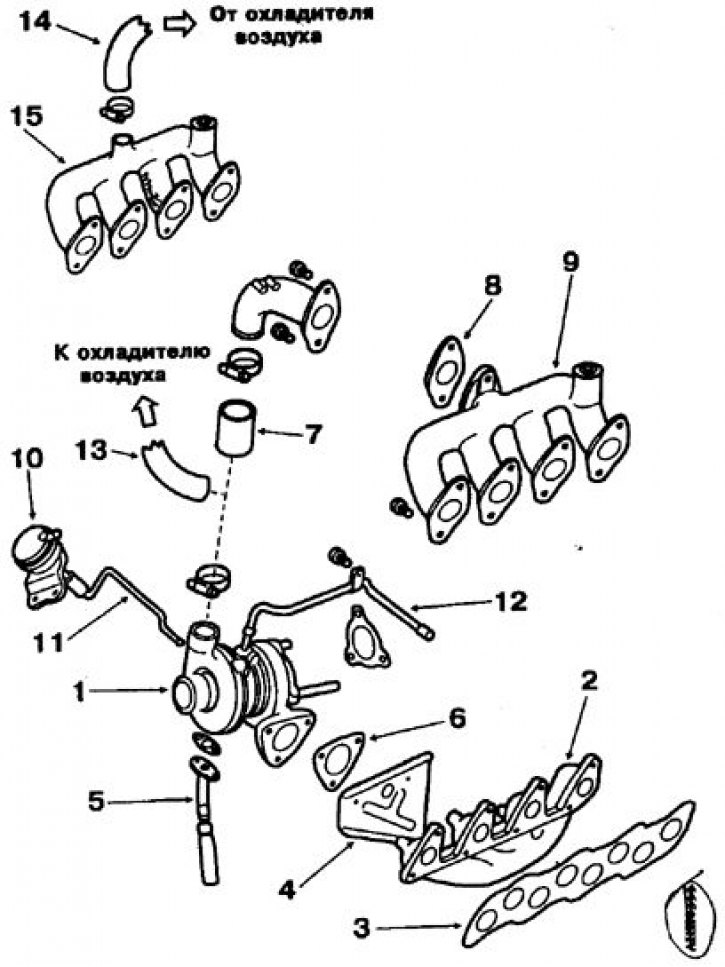
1. Turbocharger; 2. Exhaust manifold; 3. Gasket; 4. Thermal insulation shield; 5. Oil drain pipe; 6. Gasket between turbocharger and exhaust manifold; 7. Air duct connecting the turbocharger to the intake manifold; 8. Gasket; 9. Intake manifold of engines without air cooler; 10. Pneumatic drive; 11. Boost regulator control rod; 12. Oil supply pipeline; 13. Air duct connecting the turbocharger to the air cooler; 14. Air duct connecting the cooler to the intake manifold; 15. Intake manifold of engines with air cooler
Checking the pneumatic drive of the boost controller
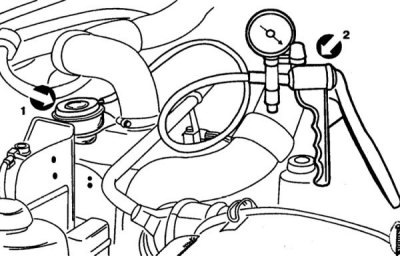
1. Pneumatic drive
2. Hand vacuum pump with pressure gauge
Removal
1. Disconnect and remove the battery.
2. On vehicles with engines equipped with an air-to-air cooler, remove the cooler as follows. Remove the two side heat-insulating shields.
3. Disconnect the hose from the boost control pneumatic drive.
4. Disconnect the hose from the boost pressure corrector.
5. Remove the upper thermal insulation shield.
6. Remove the boost control pneumatic actuator.
7. Remove the intake manifold.
8. Disconnect the oil supply line from the turbocharger.
9. Disconnect the exhaust gas supply pipe from the turbocharger.
10. Remove the heat shield from the exhaust manifold.
11. Remove the three bolts securing the turbocharger to the exhaust manifold.
12. Disconnect the oil drain hose from the pump branch pipe.
13. Remove the turbocharger.
14. Remove the exhaust manifold with the gasket.
Installation
1. The turbocharger is installed in the reverse order of removal, replacing all gaskets with new ones and observing the specified tightening torques.
2. After installing the turbocharger, perform the following operations:
- check the operation of the boost control pneumatic drive;
- disconnect the vacuum hose from the pneumatic drive and connect the hose fitting of the hand vacuum pump with a pressure gauge to the pneumatic drive branch pipe.
3. By creating pressure with the pump, determine using the pressure gauge the pressure at which the boost control drive rod moves approximately 1 mm.
4. The pressure gauge readings must correspond to the boost pressure value.
5. If the obtained value is slightly different from the normal value, check the boost control valve and boost pressure valve and replace them if necessary.
Attention! On the 4D56T engine, to avoid damage to the pneumatic drive diaphragm, do not create excess pressure greater than 0.9 kgf/cm².
7. Check the oil level in the engine crankcase.
8. Disconnect the wires from the electromagnetic engine stop valve on the high-pressure fuel pump and, cranking the engine with the starter, pump the lubrication system until the oil pressure indicator lamp goes out.
9. Connect the wires to the engine stop solenoid valve, start the engine and let it run for a while to make sure it works normally.