



Contents: General information ⤓ Rules for using seat belts ⤓ Diagonal lap seat belt ⤓ Automatic emergency seat belt…⤓
General information
1. All people in the vehicle must wear seat belts while the vehicle is moving.
2. The front seat belts are equipped with automatic emergency tensioners. The procedure for using such belts is similar to the procedure for using belts of a conventional design. The operating principle of emergency tensioners is discussed in more detail below in the corresponding subsection.
3. It is not permitted to use one seat belt to fasten more than one person.
4. The lumbar section of the belt should be positioned at hip level, covering the seated person"s hip joint, as the strongest element of the human skeleton.
[The text of the article was taken from the website mitsubishiman]
5. The shoulder section of the belt should not be passed under the arm or placed on the neck of the sitter.
6. Make sure that the belt is not twisted.
7. Remember that the seat belt is most effective when the seat back is in an upright position. Excessive tilt of the seat back increases the likelihood of the occupant sliding under the belt during an impact.
8. The seat belts have three anchor points, one of which is equipped with an inertial return device with automatic locking in case of jerks. Belts of this type do not require length adjustment.
9. When installing a special child seat, the seat belt should be set to the permanent locking position by pulling it completely out of the return device. Keeping it in the pulled out position, fix the child seat with it, acting in accordance with the instructions of the latter manufacturer. After the buckle is snapped, the excess length of the belt will be wound onto the drum of the return device and will be locked, ensuring reliable fixation of the child seat.
10. To return the belt to normal operation, remove the special child seat and allow the retractor to rewind the belt onto its inertia drum.
Rules for using seat belts

1. Slowly pull the belt out of the return device, place it over your shoulder and snap the belt buckle clip into the lock, then pull the shoulder section strap up, checking that the clip is securely fixed in the lock. Make sure that the belt strap is not twisted - a twisted belt is dangerous in itself.
2. Lower the lap section of the belt as far as possible, placing it as low on the hips as possible. Pull on the shoulder section to take up any slack and try to achieve a tight fit. If necessary, tighten the belt and achieve a tight fit of the shoulder section to the torso. The strap should pass diagonally across the occupant's chest so that the impact load falls mainly on the strongest upper torso.
Warning! Failure to wear seat belts can result in serious injury in the event of a traffic accident.
3. The driver of the vehicle, having fastened his seat belt, must ensure that all passengers are also properly fastened.
4. The correct position of the lap section of the belt will provide the safest possible absorption of the body's inertia in an accident, holding it by the strong bones of the hip joint. If the strap passes over the shoulder of the arm, the position of the upper anchor of the belt on the car pillar should be adjusted.
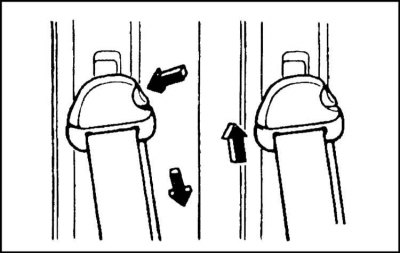
5. To adjust the position of the upper belt anchor, press the release button and slide the anchor up or down along the guide built into the pillar until the shoulder section of the belt is positioned correctly relative to your neck. The anchor has four locking positions.
Warning! Never pass the shoulder section of the belt under your arm or behind your back - this can have the most serious consequences in an accident.
6. An improperly functioning seat belt will not provide adequate protection for the driver/passenger in the event of an accident. Improper use of the belts may result in serious injury, damage or even death. If you are unsure whether the adjustments are correct, have your Mitsubishi service technician check the operation of the seat belts. Additional information on the seat belts in your vehicle is provided below.
Diagonal lap seat belt
1. The diagram of the routing and method of fastening the diagonal-lap design seat belt is shown in the illustration.
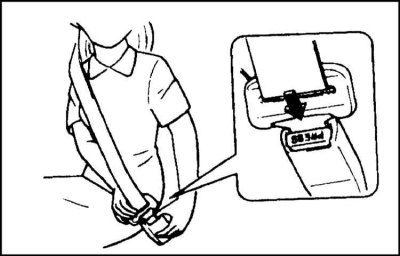
2. To unfasten the belt, press the red button marked PRESS, which is located on the buckle lock body. When the belt is being wound up by the retractor drum, hold it by the buckle bracket. After leaving the car, check that the belt does not get caught in the door opening or get jammed when the door is slammed.
3. Belts of diagonal-waist design are equipped with a return device of inertial type, the drum of which automatically takes up the slack of straps and constantly maintains a slight preliminary tension of the belt pressed to the body. Inertial belts practically do not restrict the movements of the person fastened with them and allow him to easily change the position on the seat. In case of a traffic accident or sudden braking of the car, the return device automatically locks the seat belt, ensuring the fixation of the body from dangerous movements.
4. The diagonal-lap seat belts used in the models of cars under consideration on all seats except the front ones are equipped with additional fasteners that ensure the possibility of reliable fixation of special child seats. More detailed information on this issue can be obtained at Mitsubishi branded service stations.
5. When the shoulder section of the belt is pulled out sharply, the locking mechanism of the return device is activated. The drum locks the belt, eliminating the possibility of dangerous6 The diagonal-lap seat belts used in the models of cars under consideration on all seats, except the front ones, are equipped with additional locks that ensure the possibility of reliable fixation of special child seats. More detailed information on this issue can be obtained from Mitsubishi branded service stations.
6. When the shoulder section of the belt is pulled out sharply, the locking mechanism of the return device is activated. The drum locks the belt, eliminating the possibility of dangerous movement of the passenger.
Automatic emergency seat belt tensioners
1. On some models, in order to provide additional protection for the driver/passenger, the front seat belts are equipped with devices that, when activated, automatically tighten the belts, which helps to eliminate the possibility of dangerous movement of the driver and passenger in the event of a traffic accident.
2. The automatic emergency tensioners are triggered by directional overloads that occur during a severe frontal collision. At the same time, the front airbags are ejected.
3. When the device is triggered, the seat belt remains in a tensioned position until the buckle clip is removed from the lock last.
4. The Supplemental Restraint System (SRS) indicator light illuminates to warn the driver of possible malfunctions in the automatic emergency belt tensioners.