



Contents: Operating principle of front airbags ⤓ SRS Malfunction Indicator Lamp…⤓ Side airbags ⤓ Seat belts with automatic emergency…⤓ Maintenance of SRS components ⤓
The devices and components that make up the supplemental safety system (SRS) include:
- a) Two front airbags. The driver's airbag module is housed in the steering wheel hub. The front passenger airbag is housed in a special cavity on the right side of the vehicle's instrument panel. The locations of both airbags are marked with warning signs "SRS AIRBAG";
- b) Directional overload sensors that are triggered in the event of a severe frontal impact;
- c) An electronic self-diagnostic system which, when the ignition is on, continuously tests the overload sensors, control unit, airbag gas generators and connecting electrical wiring of the corresponding circuits;
- d) Automatic emergency tensioners for front seat belts (see above);
- e) SRS malfunction indicator lamp, mounted in the instrument panel (see below);
- f) A spare autonomous power source designed to duplicate the main power supply system in the event of its failure during a vehicle collision.
Operating principle of front airbags
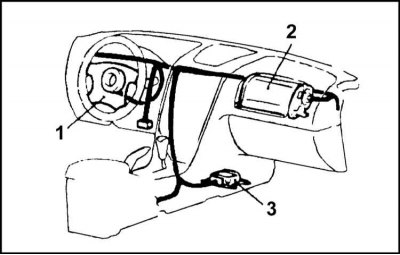
SRS Front Airbag Component Location Diagram
1 - Driver airbag module
2 — Passenger airbag module
3 — Control unit with directional overload sensor
1. Directional overload sensors react to the excess of a certain limit value, which may occur during a strong frontal collision. At the signal from the sensors, the control unit turns on the airbag gas generators, causing their immediate filling.
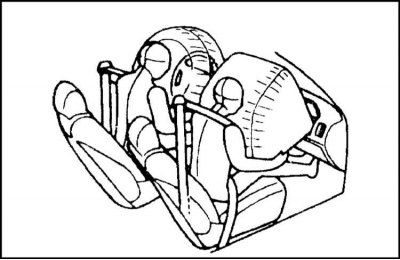
2. During a collision, the seat belt keeps the lower part of the occupant's body from moving. Front airbags help prevent injury to the driver and front passenger as a result of their head and chest striking the steering wheel/dashboard.
3. Since the signals for both airbags to operate come from the same sensors, both airbags operate simultaneously. However, it is possible that only one of the airbags will be activated. This becomes possible when the magnitude of the directional overloads that arose during the collision was on the edge of the gas generators' operating range. In this case, the seat belts provide sufficiently reliable protection for the driver and front passenger, while the effect of the airbag's operation will be minimal.
4. Immediately after the airbags are deployed and perform their functions, the gas is released from them, which allows the driver to maintain visibility and freely manipulate all vehicle controls.
5. The entire duration of the process from the moment the overload sensors send a signal to the release of gas from the airbags takes a fraction of a second. The airbags are triggered so quickly that the human ear is simply unable to perceive the pop of the gas generators when filling the airbags.
6. After a traffic accident in which the airbags were deployed, the interior of the car looks slightly smoky. In fact, this is a suspension of fine powder, which is usually sprinkled on the folded airbag shells. People with respiratory diseases may experience some discomfort from the gaseous products contained in the air, emitted by the airbag gas generators.
SRS Malfunction Indicator Lamp Operation Procedure
1. The SRS indicator lamp is mounted in the vehicle's instrument panel and is designed to warn the driver of failures in the additional safety system detected by the self-diagnosis system. On some vehicle modifications, the indicator lamp's activation indicates possible malfunctions in the side airbag units or automatic emergency seat belt tensioners.
2. When the ignition is turned on (the ignition key is turned to the "ON" [II] position), the indicator lamp lights up for a short time, then immediately goes out, which confirms that all system components are functioning properly.
3. If the warning light comes on at any other time, the vehicle owner should contact a Mitsubishi service station for help as soon as possible. Such situations include the following:
- a) The indicator lamp does not come on when the ignition key is turned to the ON (II) position;
- b) The indicator lamp remains on after the engine has been started;
- c) The indicator lamp comes on and lights up continuously or flashes while the vehicle is moving.
4. If the above symptoms of malfunction are present, the additional safety system may fail in the event of a vehicle accident.
Warning! Failure to heed the SRS warning light may result in serious consequences if the airbags fail during an accident.
Side airbags
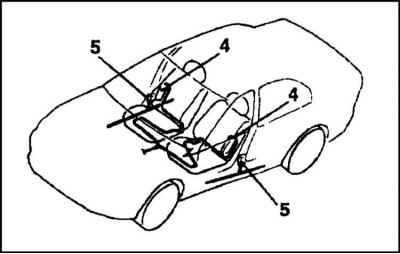
SRS side airbag component layout diagram
4 - Side airbags
5 — Directional overload sensors
1. Some models may be equipped with driver and front passenger side airbags as an optional extra. The airbag modules are mounted in the outer ends of the front seat backs. The locations of both side airbags are marked with the words "SIDE AIRBAG". The SRS indicator lamp on the vehicle's instrument panel also comes on if a fault is detected in the side airbag initiation circuits.
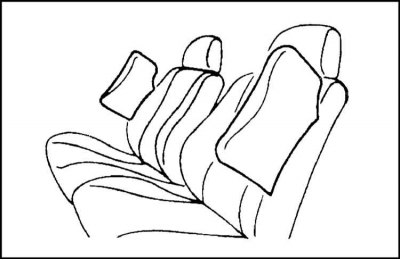
2. In the event of a severe side impact, the directional overload sensors record that the loads occurring exceed a certain threshold value and send an information signal to the control unit, which generates a command to trigger the gas generator of the corresponding side airbag. In this case, if the impact occurs from the passenger seat, the passenger side airbag will trigger even if there is no passenger in the front seat.
3. To ensure the best possible protection provided by airbags, the driver and passenger sitting in the front seat should sit up straight and be wearing seat belts.
(The material was borrowed from the website: «mitsubishiman.ru»)
Seat belts with automatic emergency tensioners
1. On some models, the front seat belts may be equipped with automatic emergency tensioners. The tensioners are activated by strong frontal overloads that occur during a frontal collision and provide instant selection of slack in the belts, as a result of which the belts tightly encircle the body of the occupant, significantly increasing the level of protection for the driver and front passenger.
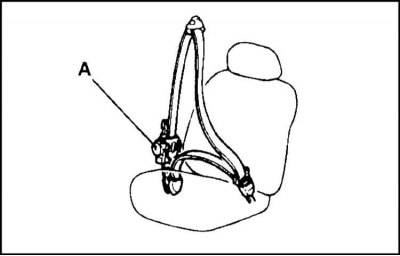
A - Tensioner
2. The tensioner (A) is mounted in the assembly of the belt return mechanism. The procedure for using such seat belts is similar to the procedure for using conventional belts equipped with inertial return devices. The tensioner operation mechanism is absolutely transparent to the user and does not require any additional skills or knowledge from the latter.
3. The tensioners are activated only under significant frontal overloads. The activation of the modules is accompanied by a loud bang and a small amount of smoke.
Note: The smoke released when the tensioners are triggered is safe for human health, but when inhaled directly it can cause irritation of the mucous membranes.
4. It should be noted that failures of tensioners to operate during a frontal collision in most cases are explained not by a malfunction of the system, but by the fact that the overloads that occur during the impact do not reach the threshold value at which the modules are activated.
5. As in the case of airbags, the modules of emergency tensioners are designed for a single deployment and after that are subject to replacement together with the belts - contact the Mitsubishi branded service stations. All claims regarding failures of SRS components are also accepted there.
Maintenance of SRS components
1. Airbags and automatic emergency seat belt tensioners practically do not require regular inspections and maintenance. However, the owner of a vehicle equipped accordingly should keep in mind the following points:
- a) After the airbags have been deployed, they must be replaced together with the system control unit. Do not attempt to dismantle the airbags on your own. These operations must be performed only in a car service workshop;
- b) If the SRS warning light comes on and indicates a fault in the system, you should immediately contact your nearest Mitsubishi service station for a full diagnosis and necessary repair of the system. Otherwise, the airbags may not deploy in an accident and may not perform their protective function;
- c) Only specially trained personnel are allowed to work with the additional safety system units. It is prohibited to independently dismantle the airbags and emergency seat belt tensioners from the vehicle. In the event of SRS failure or after emergency deployment of the airbags and seat belt tensioners, it is necessary to contact a Mitsubishi service station for repair or replacement of the system units;
- d) Do not open modules or modify the wiring of the airbag systems and automatic emergency seat belt tensioners - such intervention may lead to inadvertent deployment of the airbags and tensioners and cause injury to the operator or nearby people;
- e) Do not replace the front seats without first consulting a Mitsubishi Service Station. Careless or improper replacement or removal of the covers may result in the failure of the side airbags to deploy in the event of an accident.
2. When transferring the vehicle to another person, it is mandatory to inform the latter about all installed SRS elements, indicating the relevant points of the vehicle operating instructions.
3. On all models equipped with SRS, special warning signs are installed in the locations of the active elements of the system.
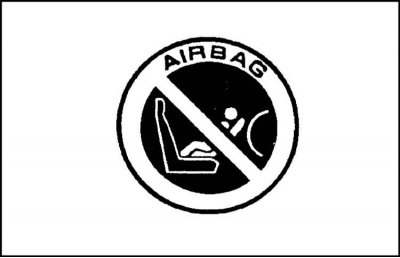
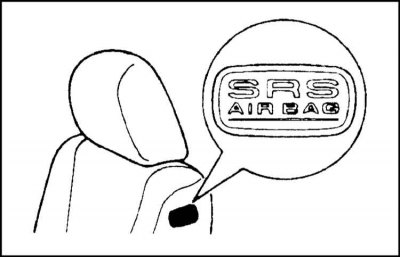
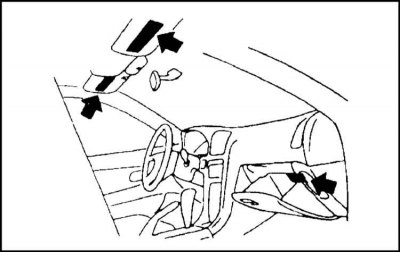
4. In addition, information labels warning of possible danger are attached to the places indicated in the accompanying illustration. Carefully read the text of the warnings - neglect of this information is fraught with the most serious consequences.