



Contents: Three-point seat belts with inertia…⤓ Three-point seat belt with inertia…⤓ Fastening seat belts ⤓ Unfastening the seat belt ⤓ Three-point seat belt for the middle…⤓ Lap seat belts ⤓ Seat belt height adjustment (front…⤓
If you are wearing a seat belt that is properly adjusted and are positioned correctly and securely in the seat with your back firmly against the seatback, the risk of injury and/or serious injury is greatly reduced.
If your vehicle is equipped with the Supplemental Restraint System (SRS), the front seats are equipped with pre-tensioner seat belts. Using these belts is similar to using regular seat belts.
Warnings
(1) The lap belt should always fit snugly across the hips, not across the stomach. A belt that is too high increases the risk of internal organ damage in the event of an accident.
(2) The diagonal part of the seat belt webbing should pass approximately through the middle of the shoulder and should never go around the neck. The belt webbing should fit snugly across the chest.
(3) The seat belt must be properly adjusted. Failure to do so reduces the effectiveness of the overall safety system and increases the risk of serious injury in an accident.
(4) The maximum protective effect of seat belts and air bags is achieved only if the seats are adjusted correctly. Adjust the seat back to the position closest to the vertical and sit up straight, pressing firmly against the seat back.
(5) Every passenger in the vehicle must always use a seat belt. Children must be seated in the rear seat and, if necessary, in an additional child seat.
(6) Do not fasten the seat belt if it is twisted, as this will reduce its effectiveness.
(7) Never use one belt to secure two people (including children). It is especially dangerous to secure a child when he or she is sitting on your lap.
(8) Never carry more people in a vehicle than there are seat belts.
Three-point seat belts with inertia mechanism
This type of belt does not require adjustment in length. After putting on such a belt, it automatically follows the movements of your body, but in the event of a sudden or strong jerk, the strap automatically locks to hold the person fastened with it.
Three-point seat belt with inertia mechanism (with automatic locking)
This type of belt works like a regular seat belt with an inertia mechanism. This type of belt does not require length adjustment, as once put on, it automatically follows your body movements. However, in the event of a sudden and/or strong collision, the belt automatically locks to hold the person's body.
[The original can be found on the website: MITSUBISHIMAN]
In addition to the crash locking function of the seat belt, this belt has a seat belt tensioner that works in the automatic child seat locking mode. To return the seat belt to the more convenient emergency locking mode, wait until the car stops, unbuckle and fully retract the belt, then bend it and rebuckle it.
Fastening seat belts
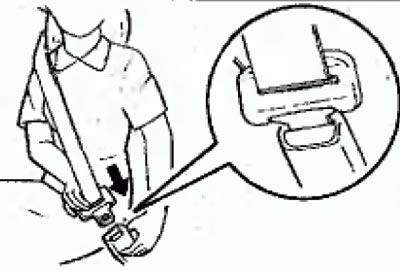
Take hold of the belt buckle, smoothly pull the tape and place it over the chest through the middle of the shoulder. Insert the buckle into the slot of the corresponding lock until you hear a click.
Note. If the seat belt cannot be pulled out because it is locked, pull the seat belt once and release it. After that, try again to gently pull out the belt.
Unfastening the seat belt
To unfasten the seat belt, press the button on the lock, which causes the buckle to be pushed out of the slot by the spring and the belt to be fully retracted.
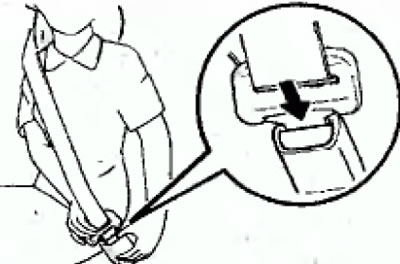
Note: Since the belt will retract automatically, hold the latch tongue to ensure the belt retracts smoothly.
Three-point seat belt for the middle rear seat
Do not use the third row center seat belt with any tongue not fastened, as this could result in serious injury or death in the event of sudden braking or a crash.
Fasten the rear seat center belt as shown in the illustrations.
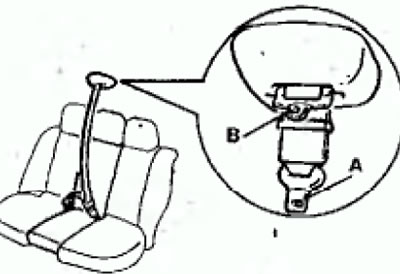
1. Pull out the lap belt and insert the latch tongue (A) into the black seat belt buckle (B).
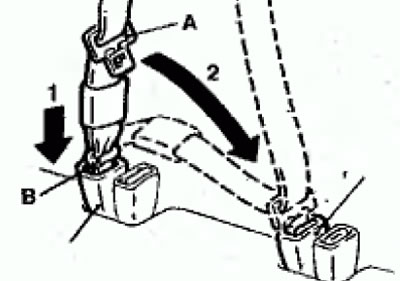
2. Insert the tongue (C) firmly into the red seat belt buckle (D).
If the rear seat center belt is not used, position the latch tongues as shown in the illustrations.
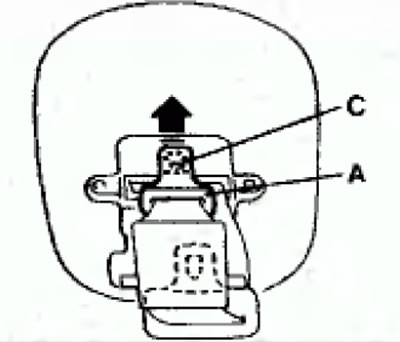
1. Pull the belt slightly and insert the latch tongue (A) (at the end of the belt) into the case marked (C).
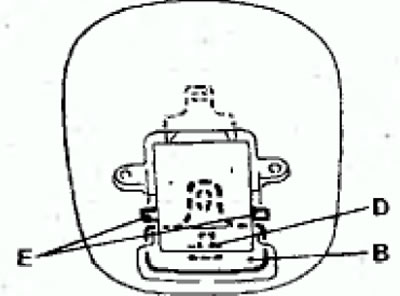
2. Align the tongue (B) with the mark (D), then insert the hook (E) into the hole in the case and fix the tongue in the appropriate position.
Lap seat belts
The lap belts must be adjusted beforehand. To do this, hold the bar at a right angle to the belt and pull the belt as shown in the figure so that it fits snugly around the body.
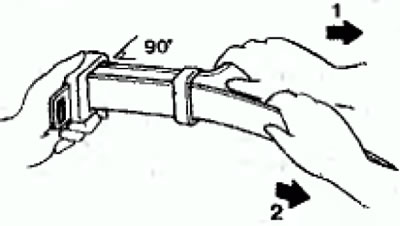
1. Tightening; 2. Weakening
Holding the belt bar (latch tongue) with your hand, insert it into the lock until it clicks.
Note: The buckle and the center lap belt bar are marked "CENTER". Be sure to check this marking before putting on the lap belt.
Seat belt height adjustment (front seats)
The height adjustment of the belt allows you to set the shoulder strap of the seat belt according to your height.
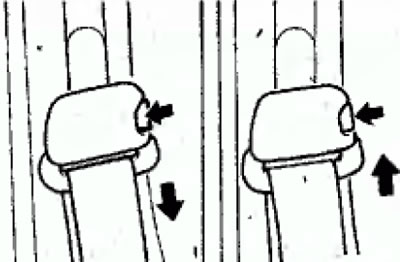
Press the button and move the slider with the bracket down or up to a position where the shoulder line of the belt is at the level of the middle of the shoulder, but in no case does it cover the neck. To fix the slider with the bracket, release the button.