



Note: When measuring idle speed and CO content, the radiator fan should not turn on. If it turns on, wait until it turns off.
Verification conditions
Check the muffler by covering the exhaust pipe with a rag while the engine is running. All connections must be tight.
Caution: Ensure adequate ventilation during this test. Otherwise, there is a risk of poisoning.
Check the play in the carburetor rods and axles, and repair or adjust if necessary (work in a workshop).
Warm up and turn off the engine. The lower radiator coolant hose should be warm.
Set the gearbox to neutral, apply the handbrake. With an automatic transmission, set the gearshift lever to the "P" position. On vehicles with power steering, set the steering wheel to the "straight ahead" position.
Turn off electricity consumers.
If the vehicle has a cold start cable (Choke button), the button must be fully depressed.
The air filter element must be clean, it is best to perform the adjustment with a new air filter element.
Connect the RPM meter and CO content meter according to the manufacturer's instructions; the air filter must be secured. If the vehicle has a distributor with a built-in ignition coil and does not have a tachometer, connect a measuring device, see the section "Setting the ignition timing".
FBC carburetor: Press the accelerator pedal once to unlock the fast idle speed. Pressing the accelerator pedal briefly will cause the lever to move away from the fast idle speed cam, thus unlocking the fast idle speed.
Start the warmed up engine and let it run at idle speed.
Check the ignition timing and the breaker closing angle, adjust if necessary.
Check the tightness of the intake tract. To do this, cover all the seals of the intake device with gasoline with a brush. If you briefly increase the idle speed, the engine may suck in air through the leaks. Localize and eliminate the leaks.
Warning: Do not inhale fuel vapors - toxic! Do not allow gasoline to come into contact with hot parts or the ignition system. Fire hazard!
Examination
Check idle speed, required values see item 7.10.
Increase idle speed to 2000-3000 rpm for a short time two or three times.
Check CO content, required value see p. 7.10.
If there are any deviations from the required values, adjust the idle speed and CO content as follows:
Conventional Carburetor / VV Carburetor
Adjustment
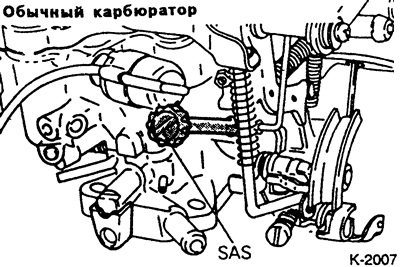
For a conventional carburetor, the idle speed adjustment screw is "SAS".
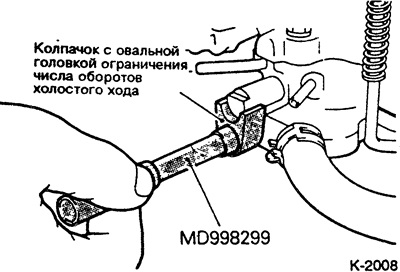
Adjustment screw for adjusting the CO content of a conventional carburetor. A special device MD-998299 is used to turn the screw.
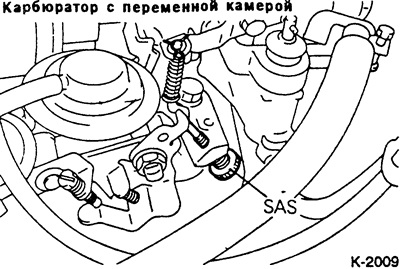
VV carburetor idle speed adjustment screw "SAS".
Original material on the website: MitsubishiMan
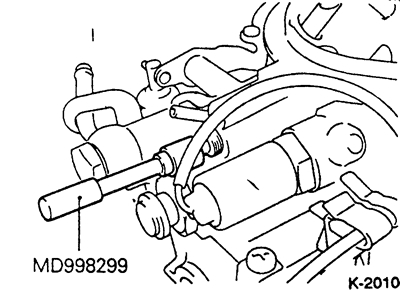
Adjusting screw for adjusting the CO content of the VV carburetor. A special device MD-998299 is used to turn the screw.
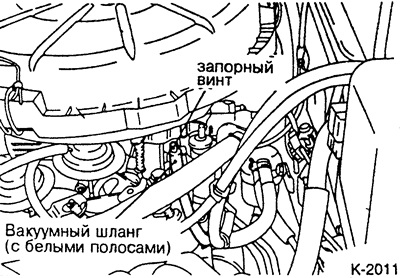
VV Carburetor: Disconnect the vacuum hose (with white stripes) from the idle air compensator. Plug the hose opening securely and set the hose aside.
Adjust the CO content and idle speed by alternately turning the adjusting screws.
Caution: Turn the CO content adjustment screw with great care.
Then increase the speed to 2500 rpm for about 2 minutes.
Let the engine idle for approximately 3 minutes.
Check the idle speed and CO content again and adjust if necessary.
Install a new seal.
Disconnect the measuring instruments.
FBC Carburetor
Usually, idle speed adjustment is not required if electronic air-fuel mixture control is available.
If, however, idle speed adjustment must be performed, for example, after repair or overhaul of the carburetor, the adjustment should be performed as follows:
Adjustment
Turn off the ignition.
Disconnect the battery ground cable for about 10 seconds, then reconnect it.
Remove the lambda probe connector. The lambda probe is screwed into the exhaust manifold.
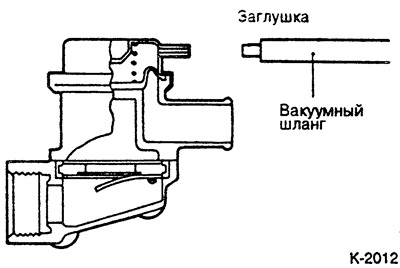
Disconnect the hose from the secondary air control valve and close the hose opening with a plug.
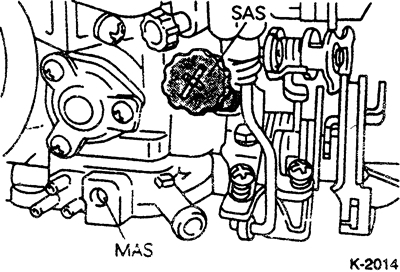
Remove the seal from the "MAS" adjustment screw, see Fig. K-2014, CO content adjustment. To do this, pierce the plastic seal in the center, screw in a suitable screw or self-tapping screw and pull it out together with the seal. If necessary, remove the air filter and then put it back.
Start the engine and let it idle for at least 5 minutes.
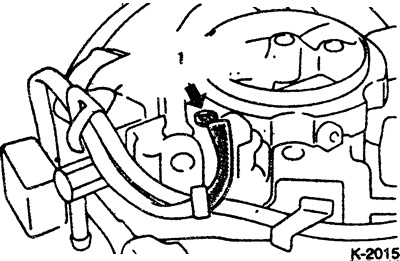
1 - Lambda control electromagnetic valve
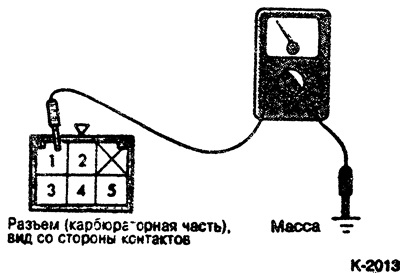
Connect the voltmeter, as shown in Fig. K-2013, to the lambda valve connector. You do not need to disconnect the connector for this.
Measure the voltage at idle speed and write it down under index "V".
Connect the lambda probe connector.
Raise the revs to 2000-3000 rpm for about 10 seconds.
Take the voltmeter reading and write it down under index "X". Half of the "X" value should be equal to "V" x 0.5 V, otherwise turn the adjusting screw-MAS-, achieving the required "X" value. Then repeat the test.
Note: If the idle speed changes, set the desired speed using the "SAS" screw.
Leave the engine running at idle speed. Press the gas pedal sharply (full throttle) until the engine reaches 3000 rpm, then release the gas again. The voltmeter needle should move as the engine speed increases, and then return to the reading corresponding to the idle speed as soon as the engine switches to idle speed.
Connect the vacuum hose to the secondary air control valve, after removing the plug
Install a new seal on the CO content adjustment screw "MAS".