



Examination
Test condition: The coolant temperature must not be higher than 10°C.
Remove the air filter, see p. 6.6.
Manually operate the starting (air) damper. The starting damper is the topmost one in the carburetor. The damper should rotate evenly in both directions without any play. If there is increased play, replace the carburetor cover. If the damper sticks, clean and lubricate the rods and the damper shaft.
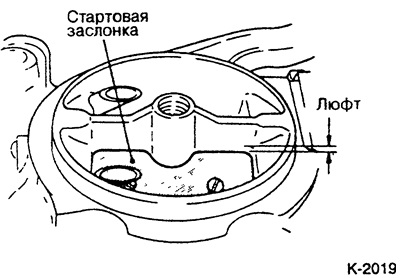
With the engine off, the starting damper must be completely closed.
Start the engine and let it idle. After about 6 seconds, the starting valve should open by 1.7-1.9 mm.
Remove the vacuum hose from the vacuum release device ("Pulldown"). When the coolant temperature is less than 20°C, the starting valve should close.
Check for vacuum on the Pulldown hose by placing your finger on the removed vacuum hose.
Connect the vacuum hose and warm up the engine. The starting choke should be fully open.
Adjusting the starting valve clearance
With the engine idling, close the starting flap with light pressure with your fingers. Check the gap as shown in the figure. For the required value, see item 7.10.
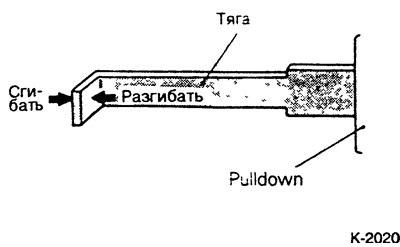
If there are any deviations from the required value, turn off the engine and bend the bent end of the rod as follows:
If the throttle gap is large, the cold engine starts poorly, often stalls: bend the rod in the "Bend" direction. If the throttle gap is too small and the spark plugs are sooty: bend the rod in the "Unbend" direction.
Start the engine and repeat the check.
Checking/adjusting automatic starting (FBC carburetor)
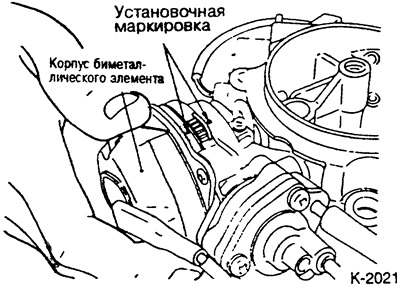
Check the position of the markings on the body and on the cover of the bimetallic element. Both marks must match.
Otherwise, loosen the screws securing the bimetallic element cover and turn until the marks match.
When the bimetallic element mark is moved to the right (clockwise), the cold engine starts better, but the spark plugs become sooty faster.
When the bimetallic element mark is moved to the left (counterclockwise), the cold engine starts worse and tends to stall.
[Original material on the website: MitsubishiMan.ru]
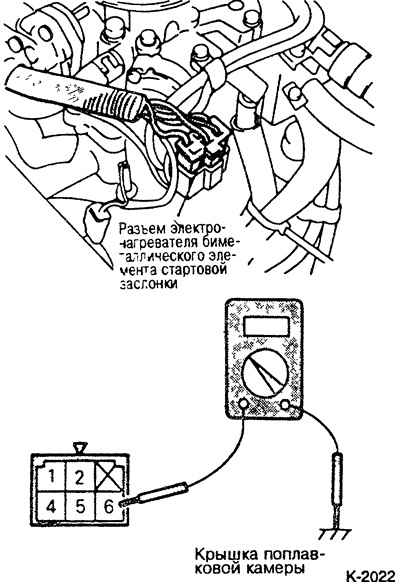
Remove the cable portion of the automatic start connector.
Measure the resistance between the automatic starter connection contact and ground with an ohmmeter. For the required value, see item 7.10.
Start the engine and let it idle.
Check whether the automatic starter unit housing is heating up. At the same time, the starting flap should slowly open.
If the case is not warm, check the automatic start relay, see item 23.3.
If the relay is OK, test the wiring.
Install the air filter.