



Removal
Before you begin removing parts, perform the following operations.
a) Remove the decorative engine cover.
b) Release the residual pressure from the high-pressure line (see chapter "Fuel injection system (GDI)").
c) Remove the engine crankcase protective cover.
d) Drain the coolant.
d) Remove the air filter.
e) Remove the battery and battery tray.
g) Remove the hood.
c) Disconnect the exhaust pipe from the exhaust manifold.
The parts are removed in the order of the numbers shown in the figure ("Removing the engine assembly")
When removing parts, pay attention to the following operations:
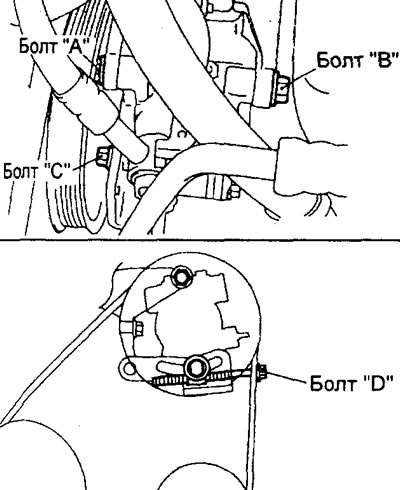
1. (Engine 4G15) Removing belt 1 of the power steering pump and air conditioning compressor drive.
a) Loosen bolts "A", "B" and "C" of the power steering pump.
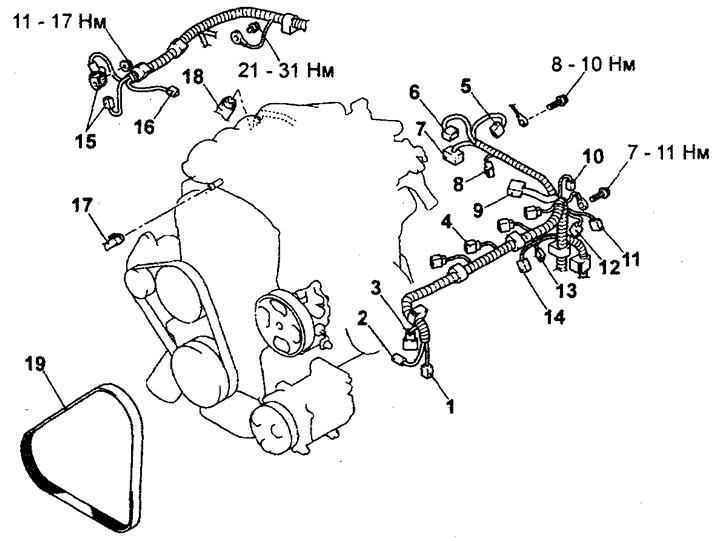
Removal the engine assembly (engine 4G15). 1 - Air conditioning compressor electromagnetic clutch connector, 2 - Power steering hydraulic fluid pressure switch connector, 3 - Crankshaft position sensor connector, 4 - Ignition coil connector, 5 - Throttle position sensor connector, 6 - Throttle servo connector, 7 - EGR valve servo connector, 8 - Canister purge electromagnetic valve connector, 9 - Engine management system and injector wiring harness connector, 10 - Interference suppression capacitor connector, 11 - Oxygen sensor connector, 12 - Camshaft position sensor connector, 13 - Coolant temperature sensor connector, 14 - Knock sensor connector, 15 - Generator connectors, 16 - Engine oil pressure sensor connector, 17 - Brake booster vacuum hose connection, 18 - Emission control system vacuum hose connection fuel vapors, 19 - power steering pump and air conditioning compressor drive belt.
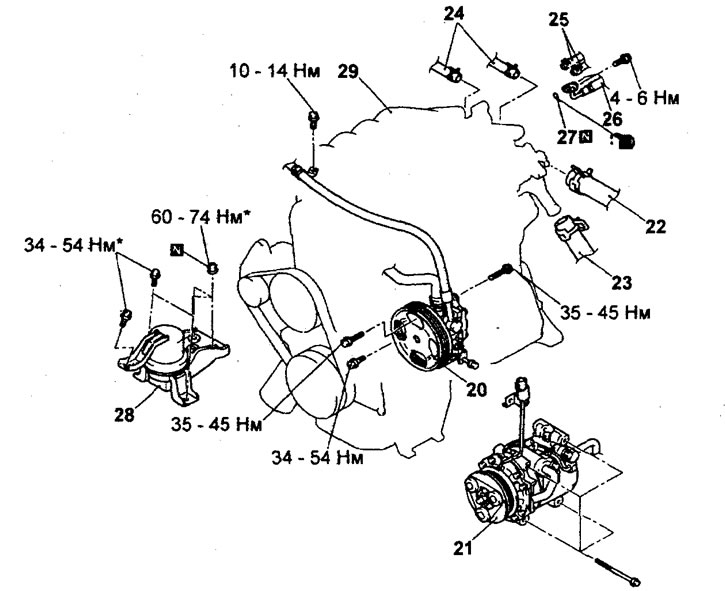
Removal the engine assembly (engine 4G15, continued). 20 - Power steering pump, 21 - Air conditioning compressor, 22 - Upper radiator hose connection, 23 - Lower radiator hose connection, 24 - Heater hose connection, 25 - Fuel return hose connection, 26 - Fuel inlet hose connection, 27 - O-ring (remove the transmission (2WD models) or transmission and transfer case (4WD models), 28 - Engine mount assembly, 29 - Engine assembly.
Note: connections marked with the symbol should first be tightened only preliminarily, and the final tightening to the specified torque should be carried out after the engine has been completely lowered onto the supports.
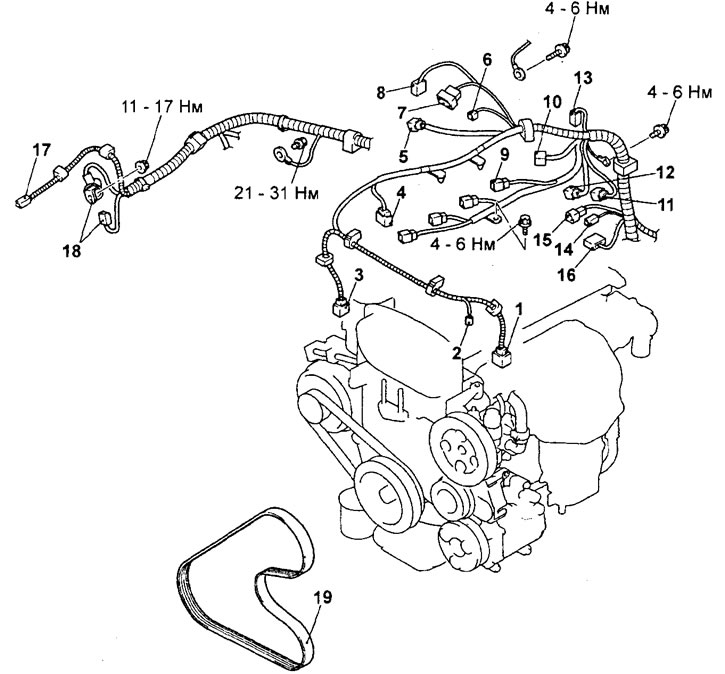
Removal the engine assembly (engine 4G93). 1 - Air conditioning compressor electromagnetic clutch connector, 2 - Power steering hydraulic system fluid pressure switch connector, 3 - Crankshaft position sensor connector, 4 - Fuel pressure sensor, 5 - EGR valve servo connector, 6 - Evaporative canister purge solenoid valve connector, 7 - Throttle position sensor connector, 8 - Throttle servo connector, 9 - Ignition coil connector, 10 - Engine management system wiring harness connector and injector intermediate connector, 11 - Oxygen sensor connector, 12 - Camshaft position sensor connector, 13 - Noise suppression capacitor connector, 14 - Coolant temperature gauge sensor connector, 15 - Coolant temperature sensor connector, 16 - Knock sensor connector, 17 - Engine oil pressure emergency sensor connector, 18 - Generator connectors, 19 - drive belt for the power steering pump and air conditioning compressor.
b) Loosen the adjusting bolt "D" to release the belt tension, then remove the belt.
Caution: If the power steering pump and air conditioning compressor drive belt is reused, an arrow indicating the direction of rotation (clockwise) must be chalked on the reverse (non-working) surface of the belt.
2. (Engine 4G93) Removing the power steering pump and air conditioning compressor drive belt.
a) Loosen the lock nut of the power steering pump and air conditioning compressor drive belt tensioner roller.
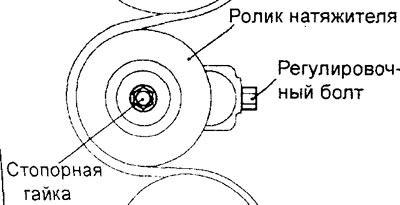
b) Loosen the adjusting bolt to release the belt tension, then remove the belt.
Caution: If the power steering pump and air conditioning compressor drive belt is reused, an arrow indicating the direction of rotation (clockwise) must be chalked on the reverse (non-working) surface of the belt.
3. Removing the power steering pump.
Remove the power steering pump from the engine along with the hoses connected to it.
Note: After removal, secure the power steering pump together with the hoses with wire in a place where it will not interfere with or be damaged when removing and installing the engine assembly.
4. Removing the air conditioning compressor.
Disconnect the air conditioner compressor wire connector and remove the compressor from its bracket along with the attached hoses.
Note: After removal, use a wire to hang the air conditioning compressor assembly together with the hoses on the body in a place where it will not interfere with the removal and installation of the engine assembly.
5. Removing the upper and lower radiator hoses.
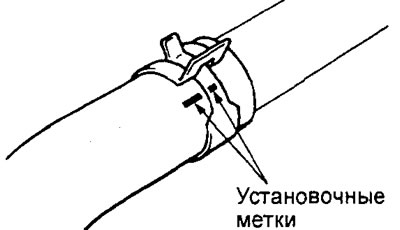
Before disconnecting the upper and lower radiator hoses, place relative position alignment marks on the hose and hose clamps.
6. Removing the engine support.
a) Place a hydraulic jack under the engine.
b) Remove the special tools used to remove the gearbox.
c) Secure the engine to the crossbar and hang it on a hoist or similar device (special device).
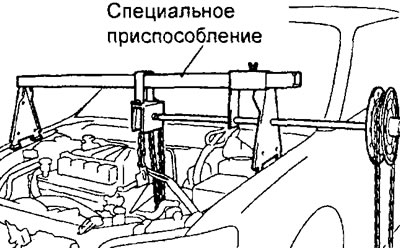
d) Insert a wooden block between the jack support foot and the engine oil pan, lift the engine slightly to relieve the support from the weight of the engine,
d) Loosen the bracket mounting nuts and bolts and remove the engine mount assembly with the bracket.
7. Removing the engine assembly.
a) Check that all cables, wires (electrical connectors), hoses and other connections are disconnected from the engine.
b) Install special devices on the engine (engine lift and crossbar or any other similar tool).
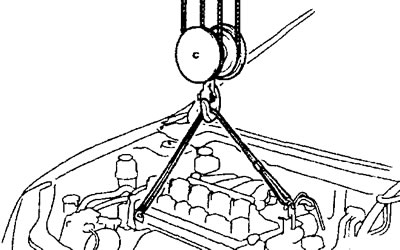
c) Using special tools, slowly lift the engine assembly up out of the engine compartment so that it does not move to the side.
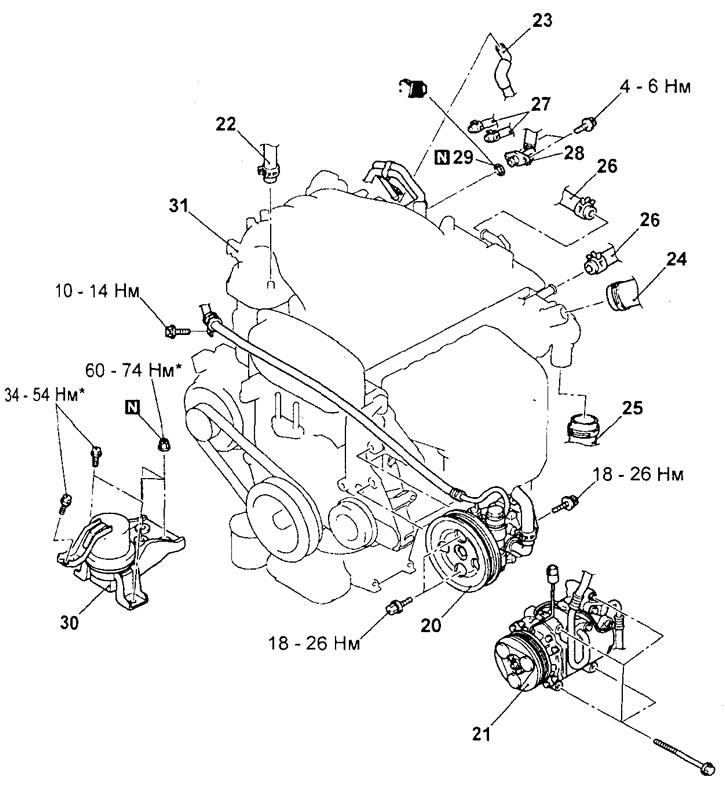
Removal the engine assembly (engine 4G93, continued).20 - Power steering pump, 21 - Air conditioning compressor, 22 - Brake booster vacuum hose connection, 23 - Fuel vapor recovery system vacuum hose connection, 24 - Upper radiator hose connection, 25 - Lower radiator hose connection, 26 - Heater hose connection, 27 - Fuel return hose connection, 28 - Fuel inlet hose connection, 29 - O-ring (remove the transmission (2WD models) or the transmission and transfer case (4WD models)), 30 - Engine mount assembly, 31 - Engine assembly.
Installation is carried out in the reverse order of removal.
When installing parts, please pay attention to the following operations:
Installing the engine assembly.
a) Using special tools (engine lift and crossbar), slowly lower and install the engine assembly into the engine compartment so that it does not move to the side.
b) Remove the special devices (engine lift and crossmember) from the engine.
c) When installing the engine, carefully check that the wires, tubes, hoses and wire connectors are connected correctly, that they are not pinched, twisted, damaged, etc.
Installing the engine support.
a) Place a hydraulic trolley jack under the engine (inserting a wooden block between the jack support foot and the engine oil pan) and install the engine support, adjusting the engine position using the jack
b) Support the engine with a jack
c) Supporting the engine with a special tool (jack), disconnect the hoist.
3. Installing the O-ring and fuel inlet hose.
a) Apply a small amount of clean engine oil to the O-ring of the fuel inlet hose.
Caution: Do not allow engine oil to enter the injection pump.
b) Be careful not to damage the O-ring when installing. Connect the fuel hose flange to the high-pressure fuel pump by turning it from side to side. After connecting, check that the flange rotates freely without jamming.
c) If the fuel hose flange does not rotate smoothly, the O-ring may be pinched. In this case, disconnect the fuel hose, check the condition of the gasket, and replace it if necessary. Reconnect the fuel hose and check the flange for smooth rotation again.
d) Tighten the hose mounting bolts to the specified torque.
Tightening torque: 5±1 Nm
4. Installing the fuel return hose Install the fuel return hose so that the identification mark is facing as shown in the figure.
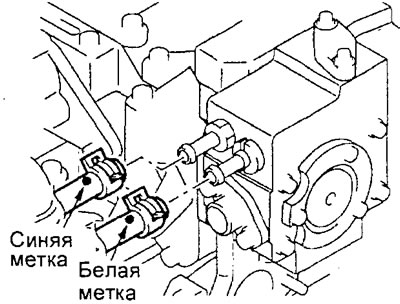
Engine 4G15.
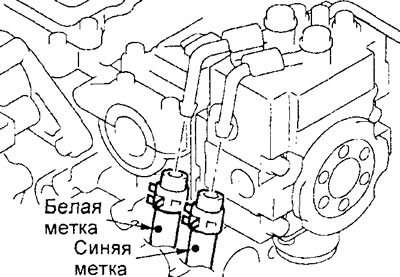
Engine 4G93.
5. Installing the lower and upper radiator hoses.
a) When connecting the radiator hose, push the hose onto the pipe until it stops against the protrusion of the pipe, then tighten the clamp.
b) The hose clamp should always be installed in the position in which the clamp was previously installed. Therefore, before installing the clamp, align the installation marks on the hose clamp and the radiator hose, then connect the hose.
After completing the installation of the parts, perform the following operations:
- a) Connect the exhaust pipe to the exhaust manifold.
- b) Install the hood.
- c) Adjust the tension of the drive belts of the attachments (see the relevant section of the chapter "Maintenance and general check and adjustment procedures").
- d) Install the battery tray and battery.
- d) Install the air filter.
- e) Fill with coolant.
- g) Install the engine crankcase protective cover.
- h) Perform the procedure for bleeding air from the high-pressure fuel line (see the corresponding procedure when installing the injection pump in the chapter "Fuel injection system (GDI)").
- i) Check for fuel leaks.
- k) Install the decorative engine cover.