



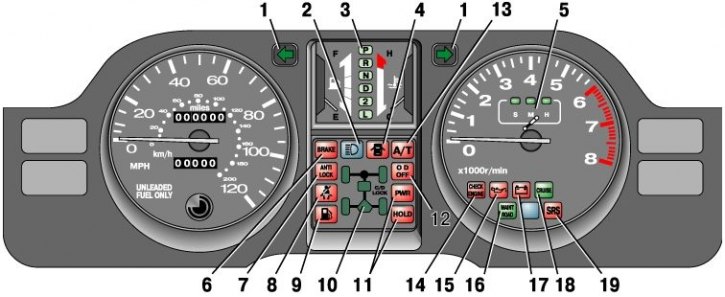
1. Direction indicator/hazard warning lights; 2. High beam indicator light; 3. Automatic transmission gear indicator*; 4. Warning light for open door; 5. Shock absorber operating mode indicator (may be absent); 6. Brake system warning light; 7. Anti-lock brake system warning light (may be absent); 8. Warning light and sound signal to remind you to fasten your seat belts; 9. Low fuel level warning light; 10. Wheel drive indicator/rear differential lock indicator (may be absent); 11. Gearbox shift indicator to automatic mode (may be absent); 12. Indicator warning about overdrive disengagement; 13. Automatic transmission fluid overheating warning light*; 14. Engine operation indicator lamp/engine malfunction warning lamp; 15. Low oil pressure warning light (may be absent); 16. Warning light that warns about the need for maintenance; 17. Battery charging system indicator light; 18. Cruise control system indicator (may be absent); 19. Airbag warning light
* Cars with automatic transmission
Direction indicator/hazard warning light arrows
When the turn signals are turned on, the turn signal arrow will operate in unison with the outer turn signals. When the hazard warning lights are switched on, both signal arrows will start flashing.
High beam indicator light
The blue lamp comes on when the high beam headlights are turned on.
Automatic transmission gear engaged indicator (for models with automatic transmission)
When the ignition key is turned to the ON position, the indicator light comes on and the indicator shows which gear is engaged on the automatic transmission.
Warning light for an open door
This warning light comes on if any of the doors are open or not closed properly.
Before starting your journey, check that this warning light is off.
Brake system warning light
This indicator light comes on when the ignition key is turned to the ON position (engine off).
After starting the engine, the lamp should go out. If the vehicle is put on the parking brake or if the brake fluid level drops below a certain level, the lamp will light.
Before driving off, release the parking brake and check that the warning light has gone out. If the warning light does not go out after the vehicle has been released from the parking brake, this indicates a faulty lamp switch or that the brake fluid level in the reservoir has dropped below a certain level.
Check the brake fluid level in the reservoir. If it is too low, it is necessary to find and eliminate the cause of the drop in brake fluid level. Before this, driving a car is dangerous.
Caution: If you turn off the engine after releasing the parking brake, the warning light will come on, this is normal. the lamp will go out after the engine starts.
Anti-lock brake system warning light (if installed)
The warning light comes on if there is a malfunction in the anti-lock brake system. It also lights up when you turn the ignition key to the ON position, and should go out after the engine starts.
Always check that the light is off before setting off on a trip.
If the light comes on while you are driving, stop the vehicle and turn off the engine. Check the ABS system by starting the engine and driving the vehicle at approximately 10 km/h or higher for 20 seconds or more. If the indicator light goes out, everything is fine. If the light does not go out or comes on again, there is a malfunction in the anti-lock brake system and only the normal brake system is functioning.
In this case, contact specialists to check and repair the ABS system.
Attention! If the lamp does not go out after starting the engine, this means that only the regular braking system is functioning, without the ABS system (see subsection 11.16).
A warning light and sound signal to remind you to fasten your seat belt
When the ignition key is turned to the ON position, the indicator lamp will light for 4–8 seconds, even if the driver has fastened his seat belt.
If the driver is not wearing a seat belt when the ignition key is turned to the ON position, the chime will sound for approximately 4 to 8 seconds to remind the driver to fasten the seat belt.
If you fasten your seat belt within this period of time, the sound will stop.
Low fuel level warning light
The warning light comes on when the fuel level in the fuel tank drops to approximately 11 litres.
It is recommended to fill the fuel tank as soon as possible after the warning light comes on.
Warning: Do not drive your vehicle with very low fuel levels: if you run out of fuel, the catalytic converter may be damaged.
Cruise control system indicator
This indicator will illuminate when the cruise control system is activated.
Gearbox operating mode indicator (if installed)
When the ignition key is turned to the ON position, one of the PWR or HOLD indicators will light.
When the transmission is in normal operation, both indicators should go out.
Overdrive off indicator (models with automatic transmission)
This indicator will illuminate when the overdrive switch is turned to the OFF position.
Automatic transmission fluid overheat warning light (models with automatic transmission)
The automatic transmission fluid overheat warning light comes on when the automatic transmission fluid temperature rises too much.
Excessive automatic transmission fluid temperature is usually caused by severe engine and transmission operating conditions. Typically, reducing engine speed and driving more calmly with less acceleration will allow the coolant to return to normal temperature, after which the warning light should go out. If it does not go out, reduce engine speed and stop the car. Then put the transmission in park and let the engine idle. Wait until the indicator light goes out. Once the warning light goes out, you can continue driving. If the warning light does not go out, contact specialists to check the engine and gearbox.
Caution: If the transmission fluid level is low, this may cause the transmission to overheat and wear out prematurely.
Caution! On vehicles equipped with an automatic transmission with the ability to switch its operating modes, the coolant overheating warning light may start flashing if there is a malfunction in the transmission control system. When the warning light flashes, a safety mechanism is activated that maintains a constant driving speed but does not allow the engine to operate at full power when accelerating or climbing. If the overheating warning light is flashing, you should contact specialists to check the gearbox and engine (see subsection 1.16.8).
Check engine light/malfunction warning light
This warning light comes on if any component of the emission control system fails, the system is not operating normally and the CO level is higher than normal.
This warning light also comes on when the ignition key is turned to the ON position and then goes out after a few seconds.
If it comes on while driving or does not come on when the ignition key is turned to the ON position, have the emission control system checked by a qualified technician.
A lamp that warns of the need for maintenance
In order for the exhaust emission control system to function properly, it must be checked periodically. The warning light comes on after 80,000 km, 130,000 km and 160,000 km to warn you that the emission control system needs to be checked.
If the warning light comes on, have the emission control system checked and serviced by a qualified technician.
Warning: Continuing to drive the vehicle with the warning light on may adversely affect the operation of the emission control system.
For more detailed information on vehicle maintenance intervals, see the subsection 2.1.
Low oil pressure warning light (if installed)
The warning light comes on when the oil pressure drops below the normal level.
If the light comes on while driving, stop and turn off the engine as soon as possible and do not drive the vehicle until the cause of the low oil pressure has been corrected. The warning light does not show the oil level in the engine crankcase. The oil level must be checked using the dipstick with the engine not running.
Caution: If the oil level is too low, it may cause engine damage.
Battery charging system warning light
The indicator light comes on when the ignition key is turned to the ON position (engine off). After starting the engine, the lamp should go out. If it remains on after the engine is started, there is likely a fault in the battery charging system. In this case, contact specialists to check the system.
Air bag warning light
The warning light comes on if the airbag system is faulty. It also lights up approximately 7 seconds later after turning the ignition key to the ON position or after starting the engine. After 7 seconds the lamp goes out.
Check the operation of the lamp every time you start the engine.
If it does not come on, or comes on for more than 7 seconds after turning the ignition key to the ON position or after starting the engine, or if it comes on while driving, have the air bag system checked by a qualified technician (see subsection 1.9.2).
Lever for switching on headlights, switching between low/high beam headlights and turning on direction indicators
Headlights
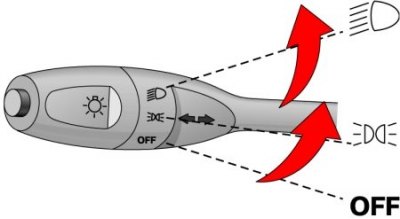
 OFF – all headlights are off
 Parking light, front and rear side lights, rear number plate light or instrument panel lights are on
 – headlights are on
Turn the lever to turn on the headlights.
Sound signal warning about turning on headlights
If the driver's door is opened when the ignition key is in the LOCK or ACC position, or if the ignition key is removed when the headlight switch is in the $ position, an audible signal will sound to remind the driver to turn off the headlights.
Move the lever to the OFF position, the sound signal will stop.