



Contents: Automatic transmission lever shifting ⤓ Gear shift lever positions ⤓ Rocking the car ⤓ Stopping a car on an incline ⤓ Overdrive switch ⤓ Automatic transmission mode switch ⤓ Normal operation of automatic…⤓ Automatic transmission operating mode ⤓
Automatic transmission lever shifting
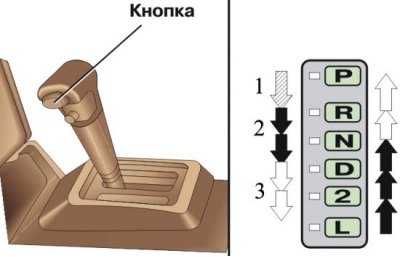
1. To move the lever, you need to depress the brake pedal, press the button on the lever and move the lever to the desired position.
2. You don't need to press the button to move the lever.
3. To move the lever, you need to press the button on the lever.
As an additional safety measure, models with automatic transmission have a device that locks the automatic transmission lever in the park position.
To move the lever to another position, you must perform the following steps:
1. Press and hold the brake pedal.
2. Move the automatic transmission lever to the desired position.
Caution! The automatic transmission lever cannot be shifted to another position if the key in the ignition switch is in the LOCK position, or is removed from the ignition switch, or if the brake pedal is not depressed.
The indicator panel, located on the console on the driver's right side, is illuminated at night.
Gear shift lever positions
 – parking gear
The park gear complements the parking brake by locking the automatic transmission when the vehicle needs to be parked.
When the automatic transmission lever is in this position, the engine can be started.
When parking the car, in addition to engaging the parking gear, also set the car on the parking brake.
Caution: If the brake pedal is not depressed, the locking device will not allow the automatic transmission lever to be shifted from the Park position to another position.
Warning: Never engage the parking gear while the vehicle is moving.
 – reverse gear
Shift the automatic transmission lever to this position only after the vehicle has come to a complete stop.
 – neutral gear
With the automatic transmission lever in this position, the engine can be started.
Caution: Always depress the brake pedal when shifting the automatic transmission lever from position N (neutral gear) into another gear position. When starting off, do not shift the automatic transmission lever from position N (neutral gear) into another gear position while simultaneously pressing the brake pedal. This is dangerous because the car may jerk forward or backward suddenly.
Caution! If the vehicle is parked on a slope, it must be started with the automatic transmission lever in position P (parking gear), and not in position N (neutral gear).
 – forward motion transmission
Engage this gear when driving on the highway or in the city.
 – second gear
Engage this gear when driving at low speeds in city traffic or on mountain roads when greater control of the vehicle is required.
Also engage this gear when climbing long, steep hills or for engine braking on less steep descents.
 – low gear
Engage this gear when negotiating very steep climbs and for engine braking on steep descents at speeds of 40 km/h or less.
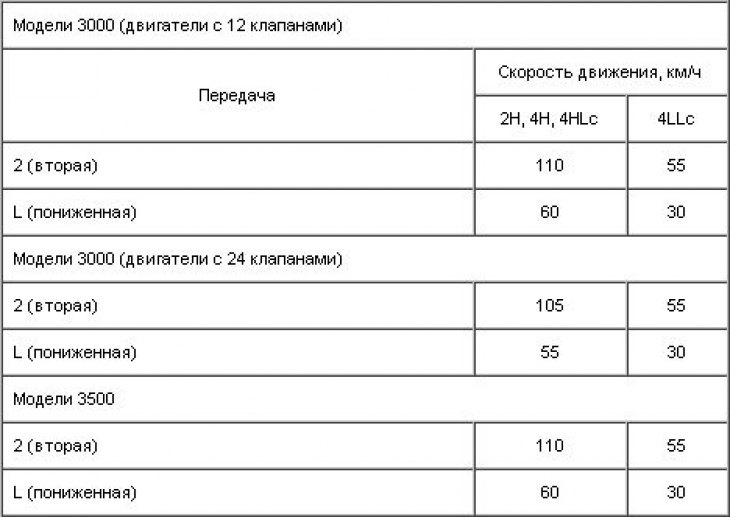
Maximum speed of movement (cars with automatic transmission)
To avoid engine damage when running at very high speeds, do not exceed maximum speed when driving in 2 (second) or L (reduced) transmission.
Rocking the car
If the car gets stuck in snow, sand or mud, etc., it can be freed by rocking the car back and forth. To do this, shift the automatic transmission lever between the L positions (low gear) и R (reverse gear), pressing the accelerator pedal slightly.
Do not press the pedal too hard and make sure that the wheels do not slip.
If you try to free the vehicle for an extended period of time, the transmission may overheat and fail. Allow a few minutes between rocking attempts to allow the automatic transmission fluid to cool while the engine is idling.
If you are unable to free the car after several attempts to rock the car, you will need to seek help.
Caution: When attempting to free a stuck vehicle by rocking it, make sure there are no people or large objects around the vehicle. The car may suddenly jump out of captivity and hit people or objects standing in front or behind.
Stopping a car on an incline
Never stop the vehicle on an incline by leaving the gear engaged and holding the vehicle in place by pressing the accelerator pedal. This may cause the automatic transmission to overheat.
Use the foot brake.
Overdrive switch
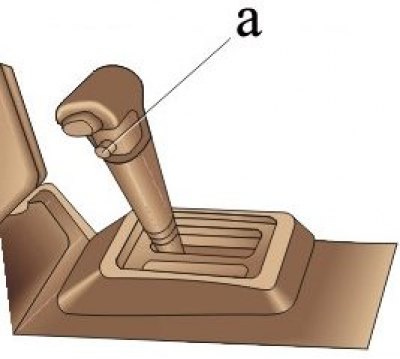
a – switch
During normal driving, the overdrive switch should be on (button pressed). The upshift warning light on the instrument cluster will go out.
When the button is pressed, the transmission will automatically shift from 1st to 4th gear when the automatic transmission lever is in position D.
If you need to quickly accelerate or use engine braking when driving downhill or if you are driving on a steep slope, the button on the automatic transmission lever must be pressed again to disengage it.
A warning light will come on on the instrument panel to indicate that the upshift has been disengaged, and the gearbox will automatically shift from 1st to 3rd gear only.
Automatic transmission mode switch
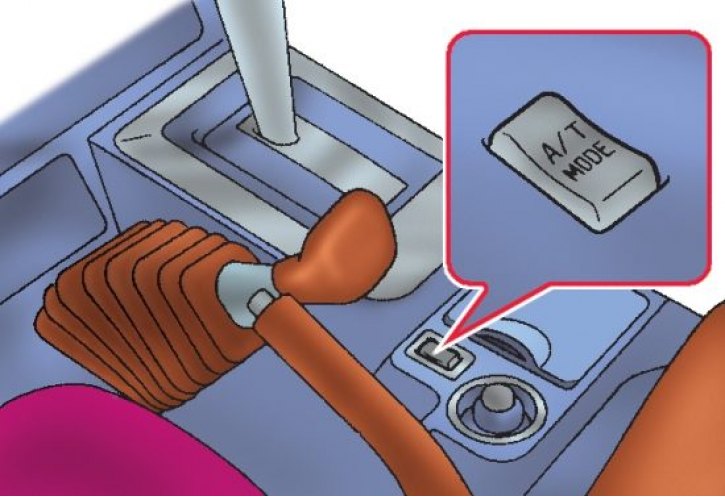
Depending on road conditions, the switch can be set to NORMAL, PWR or HOLD mode for driving in normal conditions, for driving when increased engine power is required, or for driving without automatic gear shifting, respectively.
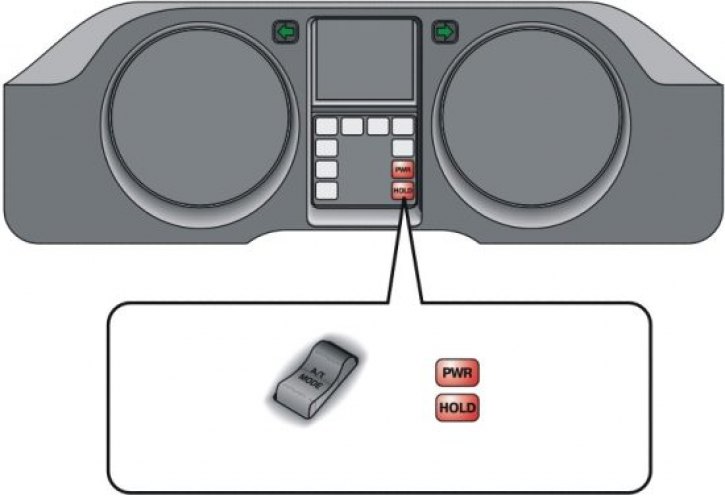
Each time the switch button is pressed, the transmission operating mode switches between NORMAL, PWR or HOLD mode in turn.
The PWR and HOLD mode indicator lights will turn on and off respectively.
Under normal conditions, the transmission should operate in NORMAL mode when the shift button is not pressed. The PWR and HOLD mode indicator lights will be off.
Normal operation of automatic transmission
Select this mode for driving in normal conditions. In this mode, the gearbox and engine operate quietly and smoothly with good fuel economy.
Automatic transmission operating mode
Automatic transmission operating mode PWR (POWER)
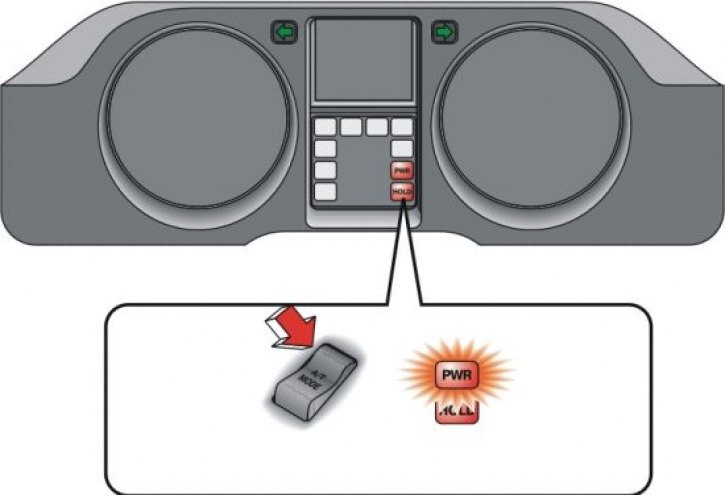
Use this mode if you need more engine power when driving in mountains or when overtaking other vehicles at high speed. When this mode is turned on, a signal lamp on the instrument panel lights up.
Automatic transmission operating mode HOLD
[The original material is here: MITSUBISHIMAN]
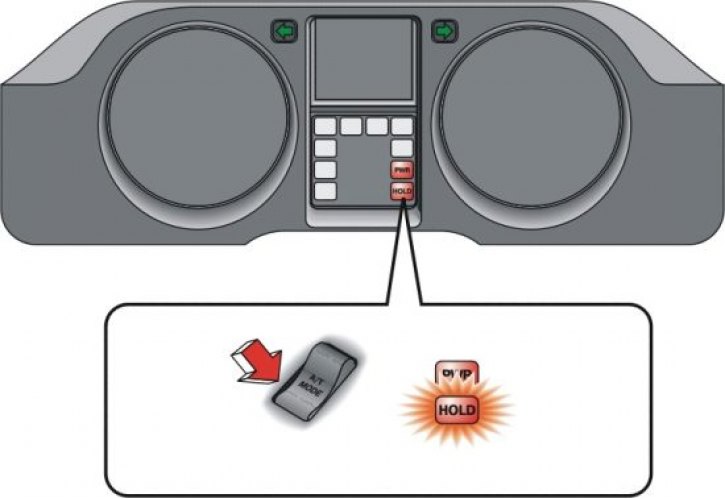
Select the HOLD mode of the automatic transmission when you start off on a slippery road, and the car will move off smoothly in second gear.
If the automatic transmission does not shift gears vehicles with the automatic transmission mode switch are not equipped with the automatic transmission mode switch)
If you are driving and the gears do not change or the car cannot pick up speed when starting off on an incline, then there is a malfunction in the gearbox and the car's automatic transmission safety mechanism has been activated. Contact a specialist as soon as possible to check the automatic transmission.
If you need to start off on an incline, turn on L (reduced) transmission.
In this gear, the car will be able to move downhill more easily.
When the vehicle reaches a level road, shift the automatic transmission lever to position D.
Attention! If the automatic transmission fails, the automatic transmission fluid overheating indicator light will start to flash.