



Each fuse protects its own circuit and the fuse panel has a designation of the circuit protected by that fuse.
There are three types of miniature fuses used in the fuse box. These compact fuses have blade-shaped contacts that can be removed and installed with your fingers. If any of the electrical equipment stops working, always check the fuse first. A blown fuse can be easily identified by looking at the connecting wire through the clear plastic housing. Inspect the fuse housing for damage. If you need to check whether a type A fuse is blown, its contact blades will protrude from the fuse housing.
When replacing a blown fuse, always use a new fuse of the same rating as the old one. Fuses of different ratings are physically interchangeable, but only fuses of the required rating should be used. Replacing a fuse with a fuse of higher or lower rating is not recommended. Different electrical circuits require different protection. The fuse rating is indicated on the fuse itself. If the new fuse blows immediately, it is necessary to find the cause before installing the new fuse. The most likely cause of a blown fuse is a short circuit in the circuit caused by a broken or frayed wire.
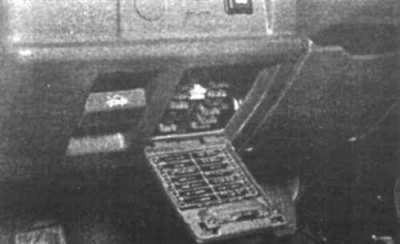
3.1a The fuse box is located on the left side of the instrument panel - some fuses are installed under a hinged cover
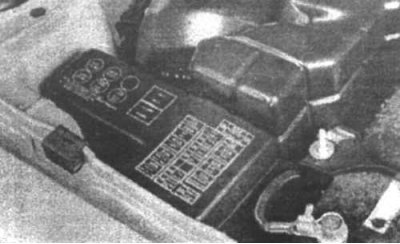
3.1b On later year models, another fuse box is installed in the engine compartment near the battery
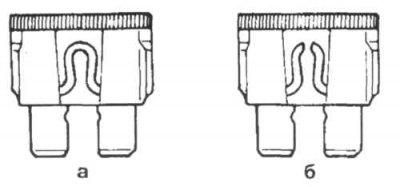
3.1v A blown fuse can be identified visually
A. Good; B. Burnt Out