
English Русский
Български
Беларускі
Український
Српски
Hrvatski
Română
Polski
Slovenský
Magyar
Articles Bookmark Contacts Sitemap   
Company Audi Company Ford Company Hyundai Company Kia Company Mazda Company Mercedes-Benz Company Nissan
MitsubishiMan.ru


Home Colt Lancer Galant L200 Outlander Pajero Others
Galant 6 and 7 (1987-1998) Galant 5 (1983-1989, petrol)

Braking a car (Mitsubishi Galant 6)

  • Home
  • Galant
  • 6 (1987-1998)
  • General information
  • Driving and operation
  • Braking a car
0
Contents: Safety recommendations for operating…⤓ ABS malfunction indicator light ⤓
The operating principle and design of the brake system components are discussed in detail in Chapter Brake system of this Guide.

All components of the braking system are of the utmost importance in terms of ensuring driving safety. Regularly, in accordance with the Schedule (see Chapter Settings and ongoing maintenance), perform vehicle maintenance procedures. Try to use only Mitsubishi branded service stations. For the first 200 km (125 miles) after replacing the brake pads, try to avoid sudden braking if possible.

When driving downhill, to avoid overheating the brakes, try to brake the car with the engine, including a lower gear for this purpose.

After heavy rain or driving through water, before starting to drive at full speed, check the efficiency of the brakes - wet pads and discs can be quickly dried out by several braking applications while driving at low speed.

Safety recommendations for operating models equipped with ABS


ABS does not reduce the braking distance of the car and can only ensure that the car remains under control during braking. In view of the above, it is necessary to constantly maintain a safe distance from the vehicle in front, based on the speed of the car and specific traffic conditions.

ABS does not prevent lateral skidding when the vehicle changes direction abruptly. For example, the vehicle may skid when taking a turn at too high a speed or when the steering wheel is jerked when changing lanes. Always maintain a safe vehicle speed, taking into account the road surface and traffic conditions.


ABS does not prevent the vehicle from losing directional stability. Avoid sharp jerks of the steering wheel during emergency braking.

The braking distance of a car equipped with ABS may be slightly longer than that of a model with a conventional braking system. This is especially noticeable when driving on unstable and uneven road surfaces (gravel, snow). When driving in such road conditions, reduce speed and increase the distance to the vehicle in front.

ABS malfunction indicator light


The anti-lock system includes a self-diagnostic unit. Externally, the self-diagnostic procedure of the system is manifested by small pulsations of the foot brake immediately after starting the engine. ABS failure diagnostics are also performed each time the car is braked.
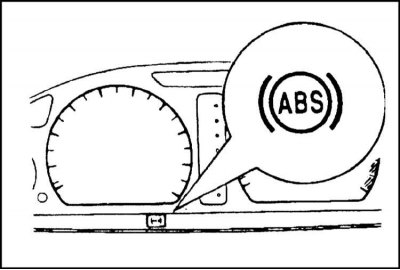


If the system detects any fault, the corresponding indicator lamp lights up on the instrument panel. When the indicator lamp lights up, it means that the ABS is disabled. The service brake system remains fully functional, except for the automatic brake force regulation function performed by the ABS. If the ABS indicator lamp does not go out after starting the engine or lights up while driving, you should contact your nearest service station as soon as possible.

When the ABS and brake system failure/parking brake warning lights come on together, the brake force regulation function is also disabled, indicating that there is a fault in both the ABS and the brake system. The vehicle's brake system will continue to provide adequate braking, but avoid abruptly depressing the foot brake pedal. Contact your nearest service station without delay.
This article is available at: russian, bulgarian, belarusian, ukrainian, serbian, croatian, romanian, polish, slovak, hungarian
This article was reviewed by: Dmitry Vasiliev
Share with friends:
◀ Previous
Galant 6 and 7: Driving and operation
Next ▶

Speed control system (tempostat)
Peculiarities of driving a car with automatic transmission
Peculiarities of driving a car with a manual transmission
Starting the engine
Transportation of goods by car
Car parking
Recommendations for driving in adverse weather conditions
Peculiarities of driving a car in adverse road conditions
Tire grip on the road surface
Towing a trailer
Similar materials for other Mitsubishi models

➤ Anti-lock braking system Mitsubishi Colt 4 and 5 (1991-2003)
➤ Anti-lock braking system (ABS) Mitsubishi Lancer 9 (2000-2007, petrol)
➤ General description of the braking system Mitsubishi L200 4 (2005-2014, diesel)
➤ General information about the braking system Mitsubishi Outlander 1 (2003-2008)
➤ Anti-lock braking system (ABS) — general information Mitsubishi Pajero 1 and 2 (1982-1999)
➤ Anti-lock braking system Mitsubishi Carisma (1995-2004)
Link in different formats to this article
Comments and feedback from visitors
No comments yet


Add up two numbers 14 + 29


Galant 6 and 7 (1987-1998) 
  • General information
  • Introduction to guide
  • User manual
  • Driving and operation
  • Maintenance
  • Power unit
  • Dismantling the engine
  • Engine overhaul
  • Cooling and heating
  • Power and exhaust systems
  • Engine electrical equipment
  • Engine management systems
  • Transmission
  • Mechanical gearbox
  • Automatic gearbox
  • Clutch
  • Drive shafts and transfer case
  • Chassis and running gear
  • Brake system
  • Car suspension
  • Steering
  • Body and interior
  • Exterior (external elements)
  • Interior (internal elements)
  • Doors, locks and windows
  • Electrical equipment
  • Equipment and devices
  • Wiring diagrams Galant
  • Wiring diagrams Mirage
  • Wiring diagrams Diamante
Galant 5 (1983-1989, petrol) 
  • General information
  • Troubleshooting
  • Maintenance
  • Power unit
  • Engine repair
  • Engine overhaul
  • Cooling and heating
  • Fuel and exhaust system
  • Engine electrical equipment
  • Reducing exhaust toxicity
  • Transmission
  • Manual gearbox
  • Automatic gearbox
  • Clutch and drive shafts
  • Chassis and running gear
  • Brake system
  • Car suspension
  • Steering
  • Body and interior
  • Exterior (external elements)
  • Interior (internal elements)
  • Doors, locks and windows
  • Electrical equipment
  • Equipment and devices
  • Electrical diagrams
MitsubishiMan.ru © 2018–2026 • Mobile version • Articles about Mitsubishi • Contacts • Sitemap: EN BG BY UA RS HR RO PL SK HU • Site search • Bookmark
Colt 2 and 3 (1983-1993) · Colt 4 and 5 (1991-2003) · Colt 5 (1995-2003) · Lancer 3 and 5 (1984-1992) · Lancer 9 (2000-2007) · Galant 5 (1983-1989) · Galant 6 and 7 (1987-1998) · L200 4 (2005-2014) · Outlander 1 (2003-2008) · Pajero 1 and 2 (1982-1999) · Pajero 4 (2006-2021) · Carisma (1995-2004) · Space Star (1998-2005) ·
This resource sets cookies 🍪 to avoid bothering you with repeated data entry.