Slip is minimal (0%) when the wheel rolls freely and maximal (100%) when the wheel is locked. Braking efficiency is greatest when the slip coefficient is 15%, which allows the vehicle to maintain good stability and control.
The role of the anti-lock braking system is to limit the pressure in the brake system so that the slip coefficient value is approximately equal to the recommended value.
The action of this system must be immediate and independent for each wheel. The system must react immediately to every change in the road surface and the load on the vehicle.
To prevent rear wheel locking, vehicles with anti-lock braking systems are equipped with a pressure regulator in the rear brake drive depending on the load on the rear axle of the vehicle. As the load increases, it ensures the passage of fluid to the rear brake wheel cylinders, which increases the pressure in their circuit and improves the efficiency of the rear brake mechanisms. As the load decreases, the regulator reduces the supply of fluid to the brake mechanisms until it is completely cut off, which reduces the pressure in the rear brake drive and the likelihood of rear wheel locking before the front wheels lock. As a result, rear wheel slip and skidding are prevented.
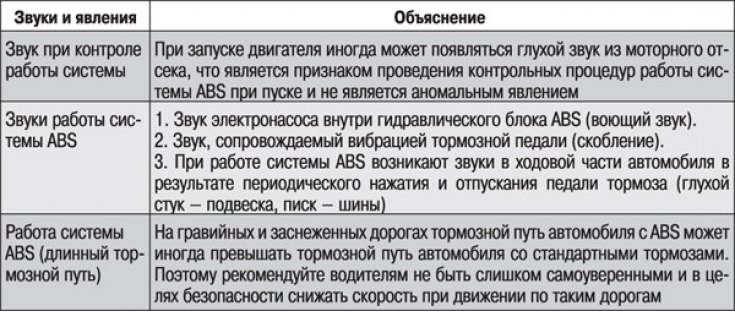
Sounds and phenomena that appear during testing and operation of brake system components, but are not abnormal, are listed in Table 14.1.
Table 14.1. Sounds and phenomena that appear during testing and operation of brake system components, but are not abnormal