
English Русский
Български
Беларускі
Український
Српски
Hrvatski
Română
Polski
Slovenský
Magyar
Articles Bookmark Contacts Sitemap   
Company Audi Company Ford Company Hyundai Company Kia Company Mazda Company Mercedes-Benz Company Nissan
MitsubishiMan.ru


Home Colt Lancer Galant L200 Outlander Pajero Others
Carisma (1995-2004) Space Star (1998-2005)

Hydraulic block — removal and installation (Mitsubishi Carisma)

  • Home
  • Mitsubishi
  • Carisma (1995-2004)
  • Chassis and running gear
  • Brake system
  • Hydraulic block — removal and installation
0
Contents: Removal ⤓ Installation ⤓

Removal


To remove the hydraulic unit, perform the following operations.

1. Drain the brake fluid.

2. Remove the air conditioner relay box.
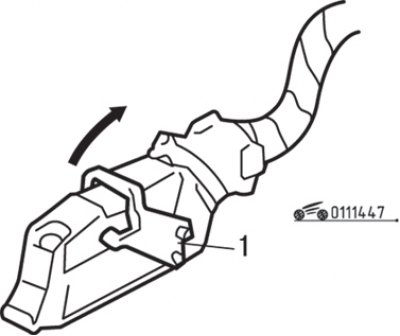


Fig. 14.47. Direction of rotation of the lever (1) of the locking device when disconnecting the connector from the electronic control unit


3. Disconnect the connector from the ABS electronic control unit. Turn the lock lever in the direction of the arrow as shown in Fig. 14.47 to unlock the lock, then disconnect the connector.
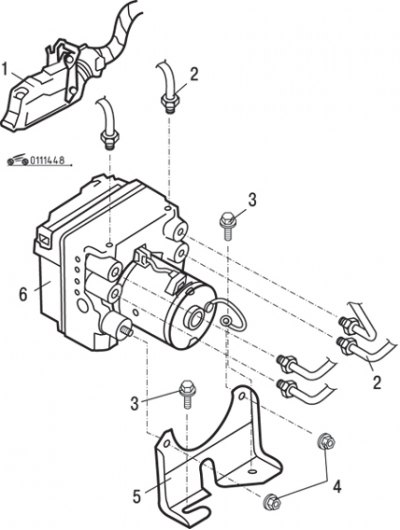


Fig. 14.48. Hydraulic unit of the ABS system: 1 – ABS electronic control unit connector; 2 – connection of brake system pipes (15 Nm); 3 – bolt (25 Nm); 4 – nut (25 Nm); 5 – hydraulic block bracket; 6 – hydraulic block assembly


4. Unscrew the nuts and disconnect the pipes 2 (Fig. 14.48) of the brake system.

5. Unscrew the two bolts and remove the bracket 5 of the hydraulic unit.

6. Remove the hydraulic unit 6 as an assembly.

Caution! The hydraulic unit assembly is heavy, so be careful when removing it.


Attention! The hydraulic unit assembly is a non-disassemblable structure, therefore it is prohibited to loosen any bolts and nuts.


Caution! Do not drop or hit the hydraulic unit.


Caution! Do not turn the hydraulic unit over or lay it on its side.


Installation


Installation is carried out in the reverse order of removal, taking into account the following.
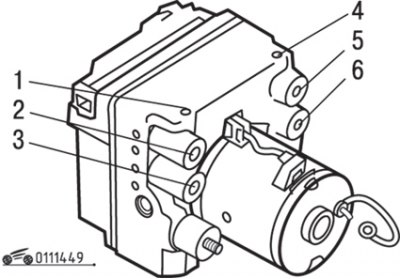


Fig. 14.49. Connecting the brake pipes to the hydraulic unit: 1 – from the main brake cylinder (primary chamber); 2 – to the pressure regulator (right wheel); 3 – to the front right brake mechanism (left wheel); 4 – from the main brake cylinder (secondary chamber); 5 – to the pressure regulator (left wheel); 6 – to the front right brake mechanism (right wheel)


1. Connect the brake pipes to the hydraulic unit as shown in Fig. 14.49.

2. Install the air conditioner relay box.


3. Fill with brake fluid.

4. Remove air from the hydraulic drive of the brake system.

[The original article was published on: MITSUBISHIMAN.ru]

5. Adjust the brake pedal.
This article is available at: russian, bulgarian, belarusian, ukrainian, serbian, croatian, romanian, polish, slovak, hungarian
This article was reviewed by: Dmitry Vasiliev
Share with friends:
◀ Previous
Carisma: Brake system
Next ▶

Starting the engine with a completely discharged battery
Resistance between ABS connector contacts on the wiring harness side
Checking and clearing ABS fault codes
Anti-lock braking system
Connecting the brake pipes to the pressure regulator
Wheel speed sensor — removal, inspection and installation
Checking the Wheel Speed Sensor Insulation
Checking the travel of the parking brake lever
Checking the Parking Brake Indicator Light Switch
Parking brake lever — removal and installation
Similar materials for other Mitsubishi models

➤ Rocker arms and hydraulic tappets of 12-valve engine —… Mitsubishi Colt 4 and 5 (1991-2003)
➤ Hydraulic clutch — device Mitsubishi Lancer 3 and 5 (1984-1992)
➤ Restorative repair of the cylinder block Mitsubishi Galant 6 and 7 (1987-1998)
➤ Replacing brake fluid and bleeding air from the hydraulic… Mitsubishi L200 4 (2005-2014, diesel)
➤ Cylinder block, crankshaft and flywheel Mitsubishi Outlander 1 (2003-2008)
➤ Hydraulic power steering system Mitsubishi Pajero 1 and 2 (1982-1999)
Link in different formats to this article
Comments and feedback from visitors
No comments yet


Add up two numbers 13 + 25


Carisma (1995-2004) 
  • General information
  • User manual
  • Maintenance
  • Power unit
  • Petrol engines 4G9
  • Diesel engines FBQT
  • Diesel engines F9Q
  • Cooling system
  • Injection system (MPI)
  • Injection system (GDI)
  • Engine electrical equipment
  • Transmission
  • Clutch
  • Mechanical gearbox
  • Automatic gearbox
  • Chassis and running gear
  • Steering
  • Brake system
  • Front suspension and shafts
  • Rear suspension
  • Body and interior
  • Exterior (external elements)
  • Interior (internal elements)
  • Doors, locks and windows
  • Air conditioner
  • Electrical equipment
  • Equipment and devices
  • Headlights and lighting
  • Electrical circuits
Space Star (1998-2005) 
  • General information
  • User manual
  • Maintenance
  • Power unit
  • Petrol engines 4G9
  • Petrol engines 4G1
  • Diesel engines F9Q1
  • Cooling system
  • Fuel injection system GDI
  • Fuel injection system MPI
  • Diesel supply system F9Q1
  • Ignition system
  • Diesel preheating
  • Transmission
  • Clutch
  • Mechanical gearbox
  • Automatic gearbox
  • Chassis and running gear
  • Suspension and drive shafts
  • Brake system
  • Steering
  • Body and interior
  • Exterior (external elements)
  • Interior (internal elements)
  • Doors, locks and windows
  • Heating and air conditioning
  • Electrical equipment
  • Power devices
  • Equipment and devices
MitsubishiMan.ru © 2018–2026 • Mobile version • Articles about Mitsubishi • Contacts • Sitemap: EN BG BY UA RS HR RO PL SK HU • Site search • Bookmark
Colt 2 and 3 (1983-1993) · Colt 4 and 5 (1991-2003) · Colt 5 (1995-2003) · Lancer 3 and 5 (1984-1992) · Lancer 9 (2000-2007) · Galant 5 (1983-1989) · Galant 6 and 7 (1987-1998) · L200 4 (2005-2014) · Outlander 1 (2003-2008) · Pajero 1 and 2 (1982-1999) · Pajero 4 (2006-2021) · Carisma (1995-2004) · Space Star (1998-2005) ·
This resource sets cookies 🍪 to avoid bothering you with repeated data entry.