



Contents: Diamante Models ⤓ Galant and Mirage models ⤓
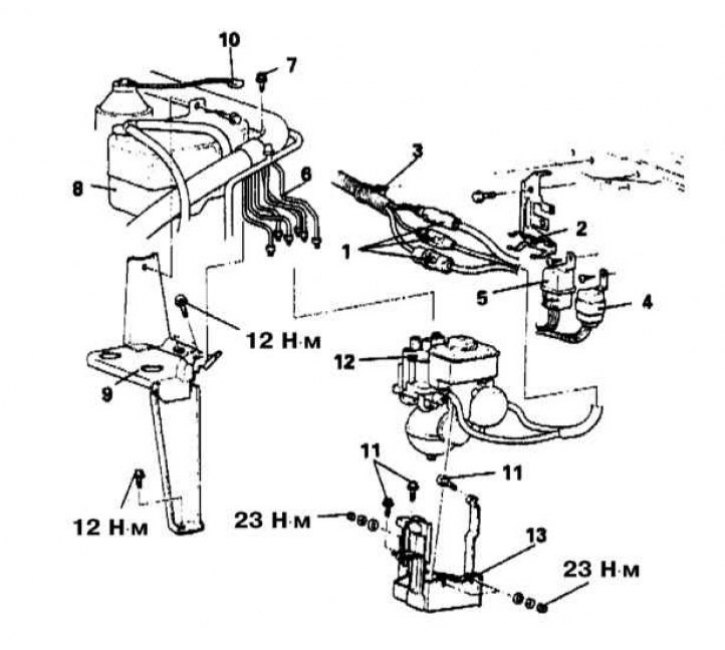
Installation details of the hydraulic modulator assembly on Diamante models
1 - Electrical wiring connectors; 2 - Wiring harness support bracket; 3 - Bandage; 4 - Electric motor relay; 5 - Valve relay; 6 - Brake pipe; 7 - Clamp bolt for fastening the K/V line; 8 - Condenser tank; 9 - Tank support bracket; 10 - 4WS hydraulic fluid level sensor wiring connector; 11 - Bolt; 12 - Hydraulic modulator; 13 - Modulator support bracket
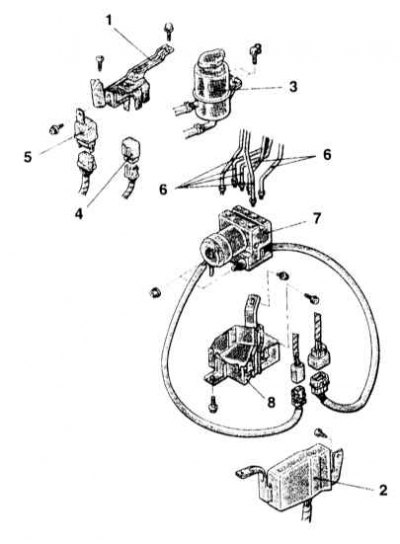
Hydraulic Modulator Assembly Installation Details on Mirage Models
1 - Support bracket; 2 - K/V relay mounting block; 3 - Oil reservoir; 4 - Electric motor relay; 5 - Valve relay; 6 - Brake pipe; 7 - Hydraulic Modulator (HCU); 8 - HCU support bracket
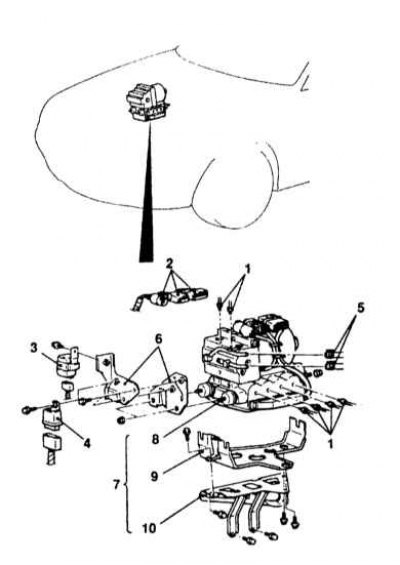
Hydraulic Modulator Assembly Installation Details on Galant Models
1 - Brake pipe connection nipples; 2 - Electrical wiring connectors; 3 - Electric motor relay; 4 - Valve relay; 5 - Brake hoses; 6 - Support brackets; 7 - HCU Assembly; 8 - Modulator; 9 - Support bracket A; 10 - Support bracket B
Warning! Brake fluid is an aggressive chemical compound and when in contact with body panels it destroys the paintwork. Before starting the procedure, cover the fenders and front panel of the car with special covers or just old blankets.
The hydraulic modulator (HCU) is located in the engine compartment of the car and includes a set of electromagnetic valves and an electric pump (with a built-in motor). The pump provides the necessary pressure increase in the hydraulic system. The modulator is not subject to repair and in case of failure must be replaced as a whole.
Diamante Models
Removal
1. The hydraulic modulator assembly installation details on Diamante models are shown in the illustration.
2. Disconnect the negative cable from the battery.
Warning! If the car stereo system is equipped with a security code, make sure you have the correct combination to activate the audio system before disconnecting the battery!
3. Remove the lower engine compartment splash shield.
4. Using a syringe or rubber bulb, pump out as much hydraulic fluid as possible from the master cylinder reservoir.
5. Remove and, without disconnecting the electrical wiring, move the relay mounting block to the side.
6. Remove the air intake sleeve.
7. After marking, disconnect the brake lines from the hydraulic modulator - be prepared to collect any spilled fluid. Immediately plug the open ends of the tubes to prevent dirt and moisture from entering the system.
Note: When loosening the union nuts, the relay mounting block will have to be moved as far to the side as possible.
8. Disconnect the electrical wiring from the hydraulic modulator.
9. Disconnect the modulator ground bus from the chassis.
10. Remove the three mounting bolts and remove the modulator assembly with the support bracket.
Note. The modulator is quite heavy and it would be wise to have an assistant at this stage. Place the removed assembly on the workbench in a vertical position. Do not subject the modulator to shock loads!
11. Loosen the mounting nut and remove the support bracket from the modulator assembly.
12. Disconnect the ground bus from the bracket.
Installation
1. If removed, install the support bracket onto the hydraulic modulator assembly.
2. Connect the ground bus to the bracket.
3. Install the modulator assembly in its regular place - try to keep it vertical at all times.
4. Screw on the mounting nuts and tighten them securely.
5. Connect the electrical wiring to the modulator.
6. Loosely connect the hydraulic lines to their fittings on the modulator assembly (pay attention to the markings applied during disassembly). Tighten the fitting connectors of each line to the required torque (15 N·m).
7. Fill the reservoir with fresh brake fluid, bringing its level to the MAX mark.
8. Bleed the brake system (first the brake master cylinder, then each circuit in turn, - see Section Bleeding the brake system).
9. Reinstall the relay mounting block and air intake hose.
10. Install splash guards.
Galant and Mirage models
Removal
1. The hydraulic modulator assembly installation details on Galant and Mirage models are shown in the illustrations.
Article reprinted from the website: www.mitsubishiman.ru
2. Using a syringe or rubber bulb, pump out as much hydraulic fluid as possible from the master cylinder reservoir.
3. Remove the left front wheel arch protection liner.
4. Remove the expansion tank of the cooling system (see Chapter Cooling and heating systems).
5. Remove the expansion tank support bracket.
6. Remove the dust shield installed under the hydraulic modulator assembly.
7. After labeling, disconnect the hydraulic hoses and tubes from the HCU. Immediately plug the open ends of the lines to prevent dirt and moisture from entering the system.
8. Remove the cover from the relay mounting block and disconnect the wiring from the modulator assembly.
9. Remove the bolts securing the three support brackets, lower the HCU assembly down and remove it from the vehicle.
Note. The modulator is quite heavy and it would be wise to have an assistant at this stage. Place the removed assembly on the workbench in a vertical position. Do not subject the modulator to shock loads!
10. If necessary, remove the relay and support brackets from the modulator assembly.
Installation
1. If removed, install the support brackets and relay onto the hydraulic modulator assembly. Tighten the mounting bolts to the required torque (22 N·m).
2. Install the HCU in its regular place - try to keep the assembly vertical at all times.
3. Screw in the mounting bolts and tighten them to the required torque (22 Nm).
4. Connect the electrical wiring to the modulator.
5. Install the cover onto the relay mounting block.
6. Connect the hydraulic lines to their fittings on the modulator assembly (pay attention to the markings applied during disassembly). Tighten the fitting connectors of each line to the required torque (13 N·m).
7. Fill the reservoir with fresh brake fluid, bringing its level to the MAX mark.
8. Bleed the brake system (see Section Bleeding the brake system).
9. Reinstall the dust shield and coolant expansion tank with its bracket.
10. Install the wheel arch protection liner.
11. Turn on the ignition and make sure that the ABS indicator lamp on the instrument panel is working properly.
12. Conduct road tests of the vehicle.