
English Русский
Български
Беларускі
Український
Српски
Hrvatski
Română
Polski
Slovenský
Magyar
Articles Bookmark Contacts Sitemap   
Company Audi Company Ford Company Hyundai Company Kia Company Mazda Company Mercedes-Benz Company Nissan
MitsubishiMan.ru


Home Colt Lancer Galant L200 Outlander Pajero Others
Carisma (1995-2004) Space Star (1998-2005)

Checking the travel of the parking brake lever (Mitsubishi Carisma)

  • Home
  • Mitsubishi
  • Carisma (1995-2004)
  • Chassis and running gear
  • Brake system
  • Checking the travel of the parking brake lever
0
1. Pull the parking brake lever with a force of approximately 196 N and count the number of clicks, which should be 5-7.

Attention! It is necessary to strictly observe the force on the parking brake lever, equal to 196 N.


2. If the travel value of the parking brake lever does not correspond to the nominal value, then adjust it in the following sequence:
  • to loosen the parking brake cable, loosen the adjusting nut by unscrewing it to the end of the cable rod;
  • with the engine idling, press the brake pedal firmly five or six times, making sure that the pedal travel does not change.

Caution! If the pedal travel value stops changing, this indicates that the automatic clearance adjustment mechanism is functioning normally and the required clearance between the brake shoes and the drum has been set.
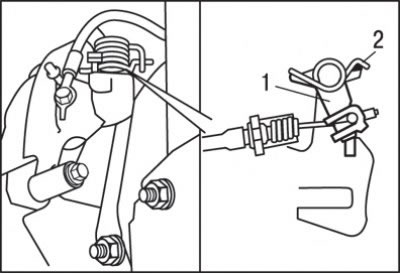


Fig. 14.54. The parking brake lever (1) on the caliper side must touch the pin (2)


For vehicles with rear disc brakes with an integrated drum parking brake mechanism, make sure that the parking brake lever on the caliper side touches the pin (Fig. 14.54).

Caution! If the parking brake lever does not touch the pin, the parking brake cable may be pinched or incorrectly routed, or the automatic clearance adjustment mechanism inside the brake calipers may be faulty. Therefore, it is necessary to check the parking brake cable, disassemble and check the rear brake calipers:


Caution! – Adjust the nominal stroke of the parking brake lever by turning the adjusting nut. After adjustment, make sure there is no gap between the adjusting nut and the parking brake lever;
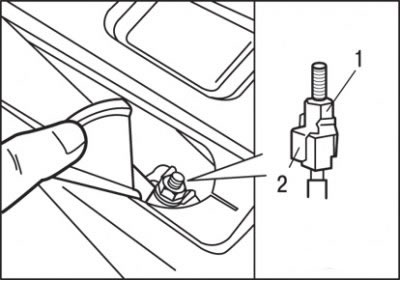


Fig. 14.55. Correct positioning of the adjusting nut (1) in the holder (2)


Make sure the adjusting nut is securely held in the holder (see Fig. 14.55).

Caution! If the parking brake lever travel is less than the nominal value and braking is very strong, the rear brakes may grab (slowly slow down).


3. After adjusting the parking brake lever travel, jack up the rear of the vehicle. Lower the parking brake lever all the way down and, by rotating the rear wheels, make sure that the rear brakes do not grab. For vehicles with rear disc brakes with an integrated drum parking brake mechanism, it is also necessary to check that the parking brake lever on the caliper touches the pin.
This article is available at: russian, bulgarian, belarusian, ukrainian, serbian, croatian, romanian, polish, slovak, hungarian
This article was reviewed by: Dmitry Vasiliev
Share with friends:
◀ Previous
Carisma: Brake system
Next ▶

Checking the Wheel Speed Sensor Insulation
Wheel speed sensor — removal, inspection and installation
Hydraulic block — removal and installation
Starting the engine with a completely discharged battery
Resistance between ABS connector contacts on the wiring harness side
Checking the Parking Brake Indicator Light Switch
Parking brake lever — removal and installation
Parking brake cable — removal and installation
Similar materials for other Mitsubishi models

➤ Checking the travel of the parking brake lever Mitsubishi Colt 5 (1995-2003, petrol)
➤ Parking brake lever Mitsubishi Lancer 9 (2000-2007, petrol)
➤ Checking the proper functioning of the parking brake Mitsubishi Galant 6 and 7 (1987-1998)
➤ Checking and adjusting the travel of the parking brake… Mitsubishi L200 4 (2005-2014, diesel)
➤ Checking the free and working travel of the parking brake… Mitsubishi Outlander 1 (2003-2008)
➤ Checking and adjusting the travel of the parking brake lever Mitsubishi Pajero 4 (2006-2021)
Link in different formats to this article
Comments and feedback from visitors
No comments yet


Add up two numbers 50 + 37


Carisma (1995-2004) 
  • General information
  • User manual
  • Maintenance
  • Power unit
  • Petrol engines 4G9
  • Diesel engines FBQT
  • Diesel engines F9Q
  • Cooling system
  • Injection system (MPI)
  • Injection system (GDI)
  • Engine electrical equipment
  • Transmission
  • Clutch
  • Mechanical gearbox
  • Automatic gearbox
  • Chassis and running gear
  • Steering
  • Brake system
  • Front suspension and shafts
  • Rear suspension
  • Body and interior
  • Exterior (external elements)
  • Interior (internal elements)
  • Doors, locks and windows
  • Air conditioner
  • Electrical equipment
  • Equipment and devices
  • Headlights and lighting
  • Electrical circuits
Space Star (1998-2005) 
  • General information
  • User manual
  • Maintenance
  • Power unit
  • Petrol engines 4G9
  • Petrol engines 4G1
  • Diesel engines F9Q1
  • Cooling system
  • Fuel injection system GDI
  • Fuel injection system MPI
  • Diesel supply system F9Q1
  • Ignition system
  • Diesel preheating
  • Transmission
  • Clutch
  • Mechanical gearbox
  • Automatic gearbox
  • Chassis and running gear
  • Suspension and drive shafts
  • Brake system
  • Steering
  • Body and interior
  • Exterior (external elements)
  • Interior (internal elements)
  • Doors, locks and windows
  • Heating and air conditioning
  • Electrical equipment
  • Power devices
  • Equipment and devices
MitsubishiMan.ru © 2018–2026 • Mobile version • Articles about Mitsubishi • Contacts • Sitemap: EN BG BY UA RS HR RO PL SK HU • Site search • Bookmark
Colt 2 and 3 (1983-1993) · Colt 4 and 5 (1991-2003) · Colt 5 (1995-2003) · Lancer 3 and 5 (1984-1992) · Lancer 9 (2000-2007) · Galant 5 (1983-1989) · Galant 6 and 7 (1987-1998) · L200 4 (2005-2014) · Outlander 1 (2003-2008) · Pajero 1 and 2 (1982-1999) · Pajero 4 (2006-2021) · Carisma (1995-2004) · Space Star (1998-2005) ·
This resource sets cookies 🍪 to avoid bothering you with repeated data entry.