



Warning: Accidental deployment of the airbag could result in serious injury, so perform only the operations and use only the tools specified in this chapter.
1. To avoid injury due to accidental air bag deployment and accidental seat belt pretensioner deployment, be sure to read and follow all safety precautions in this chapter when servicing these systems.
2. Do not use any electrical testing equipment when servicing the SRS components or the area around them, except as specified in this chapter.
3. When servicing SRS components, be sure to pay attention to the warning labels.
4. Never attempt to repair the following components of the SRS system: SRS control unit, coil wire, front air bag module (driver or front passenger), seat belt with pretensioner.
Attention: if a malfunction is detected in any of the system elements, they must be replaced exclusively in accordance with the procedure given in this chapter.
5. Do not repair the SRS wiring harness connectors. If a connector is found to be faulty, the entire wiring harness must be replaced. If a wire is found to be faulty, replace or repair the wiring harness in accordance with the "SRS ECU Wiring Harness Check" table.
SRS Electronic Control Unit Wiring Harness Test Chart.

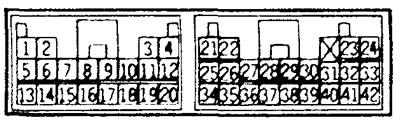
SRS electronic control unit connector (rear view).
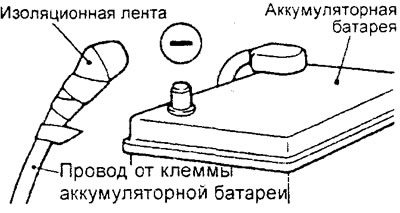
6. After disconnecting the negative battery cable, wait at least 60 seconds before performing any further work. The SRS is designed so that sufficient voltage remains for a short time after the battery is disconnected to deploy the airbag. Therefore, performing repair work on the SRS immediately after disconnecting the battery may result in accidental deployment of the airbags and serious injury to service personnel.
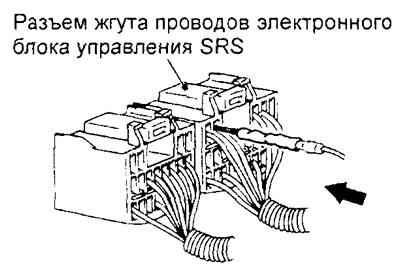
7. Features of checking the wiring harness of the SRS electronic control unit:
To check, insert a thin probe into the back of the connector as shown in the figure.
The connector pins have a special conductive coating that can be damaged if the front of the pins comes into direct contact with the probe.
8. When performing work in areas where SRS system components are installed (even if this work is not directly related to the SRS airbag), the following requirements must be observed:
- a) When removing or installing parts, do not subject the SRS system components to any impact or shock.
Attention:
- The SRS system components cannot withstand temperatures above 93° (SRS electronic control unit, airbag modules and coil wire), seat belts with pretensioners cannot withstand temperatures above 90°, so before hot drying the car after painting, it is necessary to remove the above elements.
- Store SRS components removed from the vehicle in a clean, dry place. The air bag module should be stored on a flat surface with the pad (soft side) facing up. Do not place any foreign objects on these parts.
- b) After reinstalling the SRS components, check the operation of the SRS indicator and make sure that the system is operating normally.
9. When connecting or disconnecting the diagnostic tool, make sure the ignition switch is in the OFF position.