



Contents: Installing the oil scraper ring ⤓ Installation of compression rings…⤓ Selection of connecting rod bearing…⤓ Installing the piston and connecting…⤓ Installing the connecting rod cap…⤓ Tightening the connecting rod cap…⤓
Installing the oil scraper ring
Install the oil ring expander into the ring groove in the piston.
Note: Make sure the gaps in the scraper and spreader locks are positioned as shown in the figure.
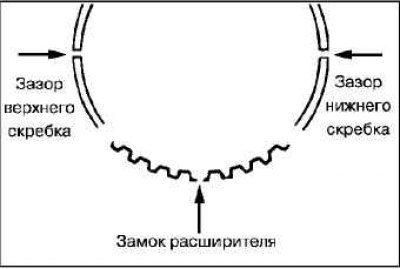
New parts (expander and scrapers) are color coded according to their dimensions (see corresponding table).
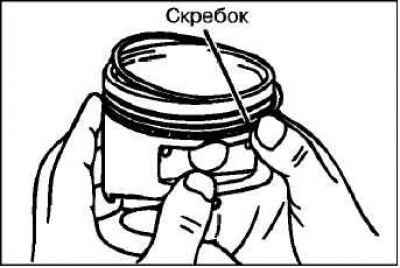
Install the upper oil scraper ring. To install the upper scraper, first insert one end of the scraper into the piston groove, then insert the rest of the scraper with your finger as shown in the figure.
Caution! Do not use a piston ring expander. Unlike other piston ring parts, the oil ring scraper can break when expanded with an expander.
Install the lower oil scraper ring in the same manner as the upper one.
Check that the three-piece oil scraper ring is installed correctly. When installed correctly, the oil scraper ring should rotate smoothly in either direction.
Oil scraper ring size color marking chart

Installation of compression rings No.1 and No.2
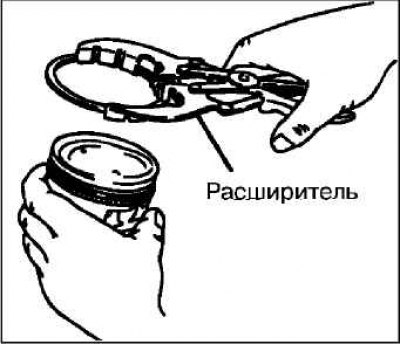 | 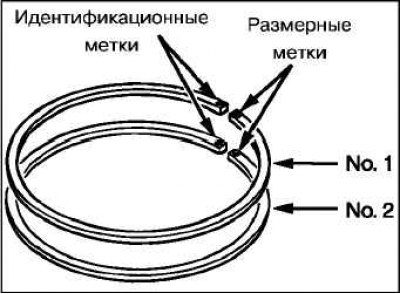 |
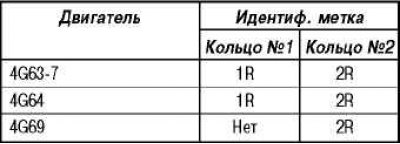
Using a compression ring expander, install compression rings #1 and #2 with the identification marking facing up.
Note: Each compression ring has a size and identification mark stamped on the ends of the ring. When installing, position the ring so that the mark is on top (see table).
Selection of connecting rod bearing liners
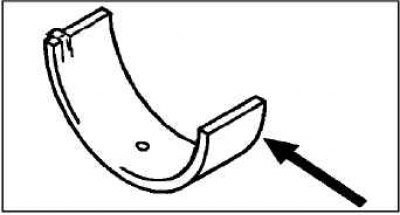 | 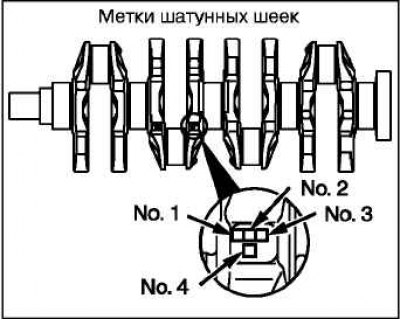 |
When replacing connecting rod bearing shells, select them according to the tables below in accordance with the size group (symbolic or color marks) of the crankshaft and the size group (symbolic or color marks) of the connecting rod bearing shells.
Nominal diameter of connecting rod lower head bore: 48.000–48.015 mm.
Table for selection of connecting rod bearing shells (engine 4G63-7)
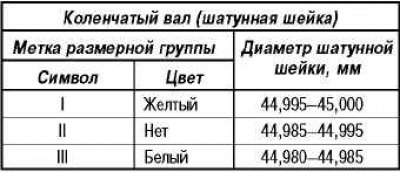
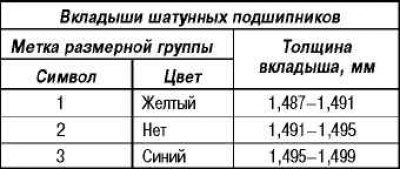
Table for selection of connecting rod bearing shells (engine 4G64)
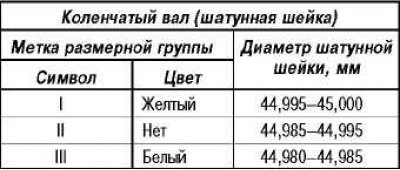
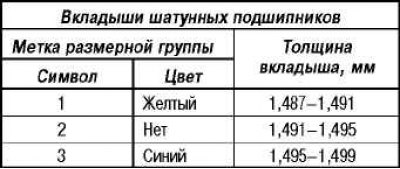
Table for selection of connecting rod bearing shells (engine 4G69)
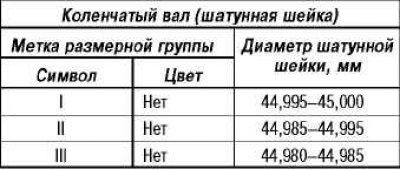
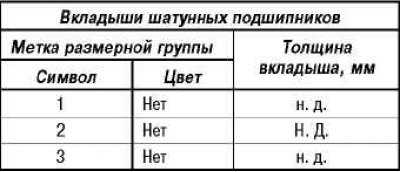
Attention! The crankshaft connecting rod journal size group mark is applied only to the part supplied as a spare part.
Installing the piston and connecting rod assembly
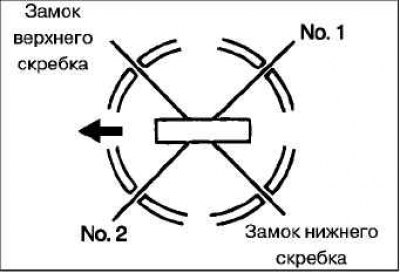
Lubricate the piston and piston ring surfaces with a thin layer of motor oil.
Position the compression ring and oil scraper ring (expander and scrapers) locks as shown in the figure.
Turn the crankshaft so that the crankpin is in the middle of the cylinder bore.
Use suitable protectors for the connecting rod bolt threads before installing the piston and connecting rod assembly into the cylinder bore. This will prevent damage to the working area of the crankshaft journals.
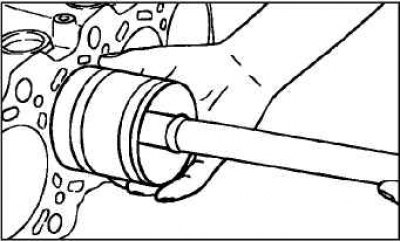
Using a special device for ring compression, install the piston with the connecting rod assembly into the cylinder bore of the block.
Attention! The piston with connecting rod assembly must be installed in the cylinder block so that the mark on the piston is directed towards the front of the engine (timing drive flint).
Installing the connecting rod cap and checking the axial clearance of the lower connecting rod head
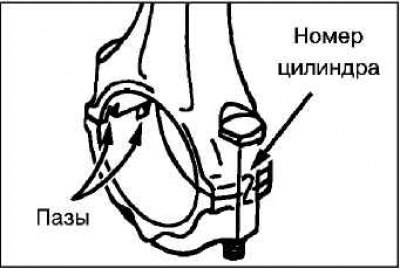
Align the corresponding caps with the corresponding connecting rods, taking into account the applied marks (cylinder number) and the method of fixing the bearings (bearing grooves). If a new connecting rod is installed without alignment marks, then locate the bearing grooves on the connecting rod and cap on the same side.
Using a feeler gauge, measure the axial clearance of the lower connecting rod head.
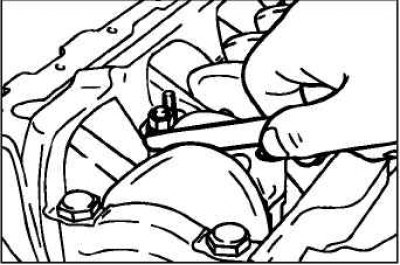
- Nominal axial clearance: 0.10–0.25 mm.
- Maximum permissible axial clearance: 0.40 mm.
Tightening the connecting rod cap mounting nuts
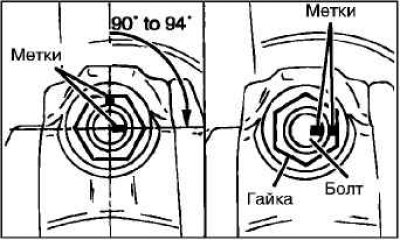
The connecting rod cap bolt and nut are tightened to the "yield point". Before installing the bolt, make sure that the bolt/nut thread is not deformed. The presence of deformation of the bolt-nut connection is checked by screwing the nut onto the bolt manually to the end of the thread. If the nut is screwed onto the bolt manually with difficulty, then the bolt thread is deformed and the bolt must be replaced.
Before installing the nut, lubricate the threaded parts of the nut and bolt with a thin layer of engine oil.
Thread the nuts onto the appropriate bolts by hand. Then tighten each nut individually to ensure the connecting rod cap is seated correctly.
Tighten the cover mounting nuts alternately to the specified torque.
- Tightening torque: 20±2 Nm.
- Tighten the cover mounting nuts to an angle of 90–94°.
Caution! If the nut is turned at an angle less than 90°, the tightening of the cover fastening nuts will be insufficient.
Attention! If the nut is turned to an angle of more than 94°, then unscrew the nut and repeat the tightening procedure.