



Contents: Tire pressure ⤓ Wheel condition ⤓ Replacement of tires and rims ⤓ Wheel rotation ⤓ Winter tires ⤓ Anti-skid chains ⤓
Warning: Driving on worn or improperly inflated tires can cause an accident resulting in serious injury or even death.
Tire pressure
| Tire size | With a load of up to 5 passengers | At maximum load | When towing a trailer | |||
| Front tires | Rear tires | Front tires | Rear tires | Front tires | Rear tires | |
| 235/80 R16 109S | 2.0 bar (200 kPa) 2.0 bar (200 kPa)* | 2.0 bar (200 kPa) 2.1 bar (210 kPa)* | 2.0 bar (200 kPa) 2.0 bar (200 kPa)* | 2.2 bar (220 kPa) 2.4 bar (240 kPa)* | 2.0 bar (200 kPa) | 2.4 bar (240 kPa) |
| 265/70 R16 112S | 2.0 bar (200 kPa) 2.0 bar (200 kPa)* | 2.0 bar (200 kPa) 2.0 bar (200 kPa)* | 2.0 bar (200 kPa) 2.0 bar (200 kPa)* | 2.0 bar (200 kPa) 2.2 bar (220 kPa)* | 2.0 bar (200 kPa) | 2.4 bar (240 kPa) |
| 265/70 R16112H 265/65 R17 112H | 2.0 bar (200 kPa) 2.0 bar (200 kPa)* | 2.0 bar (200 kPa) 2.0 bar (200 kPa)* | 2.0 bar (200 kPa) 2.0 bar (200 kPa)* | 2.0 bar (200 kPa) 2.3 bar (230 kPa)* | 2.0 bar (200 kPa) | 2.4 bar (240 kPa) |
Note: *: When driving speed exceeds 160 km/h.
Check the pressure in all tires, the tires must be cold during the check; in case of excess or insufficient pressure, bring it up to normal. After checking the pressure, check the condition and tightness of the tires. Place protective rubber caps on the nipples.
Wheel condition
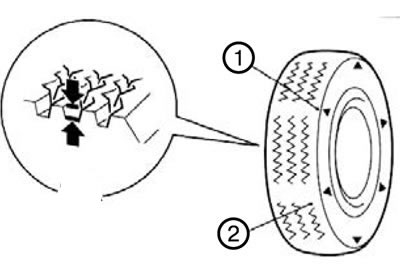
1. Location of the tread wear indicator. 2. Tread wear indicator
Make sure the tires are free of cuts, cracks, or other damage. If there are deep cuts or cracks, replace the tires. Also check for small metal objects or debris stuck in the tires.
Driving on worn tires is very dangerous, as it greatly increases the risk of skidding or hydroplaning. It is permitted to use tires with a tread depth of at least 1.6 mm.
If a tire has a wear indicator, as the tire wears, it will appear in six spots on the tread surface, indicating that the tire should no longer be used. If the tread surface shows wear indicators, the tire should be replaced with a new one.
Make sure the wheel nuts are securely tightened.
Note:
- The appearance and location of tread wear indicators on tires varies from manufacturer to manufacturer.
- If wear requires replacement of one of the tires, all tires should be replaced at once.
Please note: Tires of the same size, type and manufacturer with the same degree of wear must be installed. It is prohibited to install tires of different sizes, different types, from different manufacturers or with different degrees of wear. In this case, the oil temperature in the differential increases, which can lead to transmission failure. In addition, increased loads occur in the transmission, which can lead to oil leaks, jamming of parts and other serious malfunctions.
Replacement of tires and rims
Attention:
- It is prohibited to install tires of sizes different from those specified above, as well as to install tires of different models together, as this has a negative impact on traffic safety.
- Even if the wheel rim has the same seat diameter and offset as the original, its shape may prevent proper installation. Before purchasing new wheels, it is recommended to consult a specialist.
Wheel rotation
Tire wear depends on the condition of the vehicle, road surface conditions and driving style. To equalize wear and extend the life of your tires, it is recommended that you rotate your tires immediately after detecting increased wear or when there is a noticeable difference in wear between the front and rear tires.
When rotating wheels, check for uneven wear or damage to the tires. Excessive wear is usually associated with incorrect tire pressure, improper wheel alignment, wheel imbalance, or harsh braking. It is recommended to check these parameters to identify the causes of uneven tread wear.
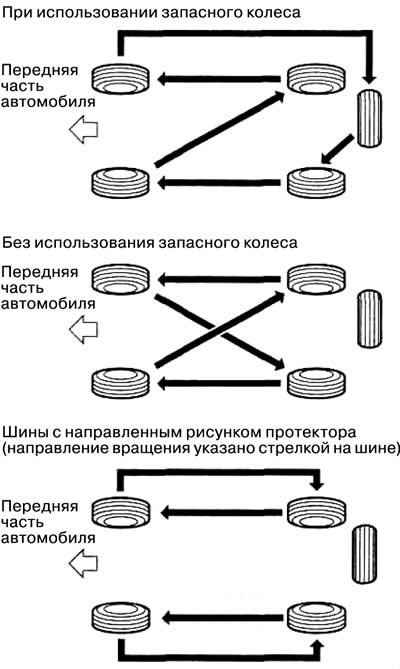
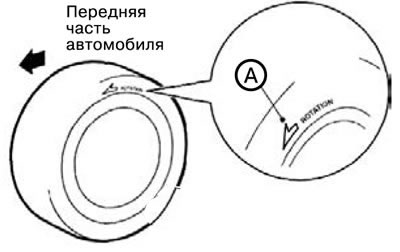
Caution: If the tires have arrows (A) indicating the direction of rotation, rotate the front and rear wheels on the left side of the vehicle and the front and rear wheels on the right side of the vehicle separately. You should not move such wheels from one side of the car to the other. When mounting tires, make sure that the arrows on the tires point forward. If the arrows on the tires point in the opposite direction, the tire performance will be impaired.
Caution: Avoid installing different models of tires on your vehicle. This may reduce traffic safety.
Winter tires
For driving on snow and ice, it is recommended to use winter tires. To maintain the vehicle's directional stability, tires of the same size and with the same tread pattern should be installed on all wheels.
If the wear of winter tires exceeds 50%, they should not be used as winter tires.
It is not permitted to install winter tires that are not recommended for use on the vehicle.
Caution: Observe the maximum speed limit for winter tires and local speed limits.
Note:
- Using winter tires (speed of movement, need for installation, type, etc.) is regulated by the rules in force in different regions. Observe the rules in force in the area where the vehicle is operated.
- If the wheels are secured with flange nuts, then when installing wheels with steel rims, replace them with conical nuts.
Anti-skid chains
On all-wheel drive vehicles, where most of the torque is transmitted to the rear wheels, snow chains should be installed on the rear wheels.
Use only snow chains that are designed for the wheels fitted to your vehicle: chains of the wrong type or size may damage the vehicle body. Before installing snow chains, it is recommended to consult with specialists from an authorized Mitsubishi service center. The maximum height of the snow chain is indicated in the table.
| Tire size | Wheel rim size | Maximum chain height, mm |
| 235/80 R16 109S | 16X6JJ | 22 |
| 265/70 R16 112S 265/70 R16112H | 16X7JJ | |
| 265/65 R17 112H | 17x7½ JJ |
When driving with anti-skid chains, the speed should not exceed 50 km/h. Immediately after driving onto a road free of snow, anti-skid chains should be removed.
Attention:
- Do not jack up the vehicle after installing the chains, as this may cause the wheel to slip on the icy road and the vehicle to fall off the jack.
- If your vehicle is equipped with an anti-lock braking system (ABS), to ensure that it operates correctly when installing anti-skid chains, you should select 4H, 4HLc or 4LLc mode.
- Practice installing snow chains in advance; do not rely on outside help in cold weather.
- To install chains, choose a clearly visible straight section of the road where you can pull over and remain visible to other drivers.
- Do not install snow chains until absolutely necessary. This leads to wear and tear on tires and road surfaces.
- After driving 100-300 meters, stop and tighten the chains.
- Care should be taken when turning the steering wheel to extreme positions to prevent possible contact between the chains and the vehicle body.
- Drive carefully, at a speed of no more than 50 km/h. Remember that installing snow chains is not a guarantee of preventing an accident.
- When installing anti-skid chains, do not allow them to damage the wheel rim or the car body.
- The alloy wheel may be damaged by the snow chain. When installing an anti-skid chain on a wheel with an alloy rim, do not allow the chain parts and fasteners to come into contact with the wheel rim.
- When installing or removing the snow chain, take precautions to avoid injuring your hands and other body parts on the vehicle body.
- Install snow chains on the rear wheels only; pull them as tight as possible, securing the ends securely.
[Original material on the website: mitsubishiman.ru]
Note:
- The use of anti-skid chains is regulated by the rules in force in each region. Observe the rules in force in the area where the vehicle is operated.
- In most countries, traffic regulations prohibit the use of snow chains on roads without snow cover.