



Contents: General ⤓ New tires ⤓ Tire wear ⤓ Sign of wear ⤓ Wheel replacement ⤓ Tire replacement ⤓ Wheel balancing ⤓ Characteristic appearance of the…⤓ Wheel rotation ⤓ Installation of winter tires and…⤓ Installation of winter tires ⤓ Rules for using chains ⤓
Tires and wheels are important design elements. Therefore, the tires and wheels approved by us are precisely matched to the vehicle type and thus contribute significantly to maintaining the roads in good condition and ensure reliable dynamic properties.
If the vehicle is subsequently equipped with tires or wheels that differ from the tires or wheels installed at the factory, the following must be taken into account:
For technical reasons, not in every case can wheels from other cars be used - under certain conditions, also not wheels from a car of the same type!
The discs and wheel bolts are structurally aligned with each other!
Therefore, with each conversion to other wheels (e.g. light alloy wheels or wheels with a set of winter tyres), it is necessary to use the appropriate wheel bolts of the corresponding length and hemisphere shape. The stable fit of the wheels and the functioning of the braking system depend on this!
The use of tires and/or wheels that have not been approved by us for use on your vehicle type may result in road safety being compromised.
If wheel covers are subsequently installed, care must be taken to ensure that there is sufficient air supply to cool the brake system.
General
Check the tires from time to time for damage and remove foreign objects from the tire profile.
To prevent damage to tires and wheels, drive over curbs or other similar obstacles slowly and, if possible, at an obtuse angle
Protect tires from contact with oil, grease and fuel.
Replace lost valve dust caps immediately.
If wheels are to be removed, they must be marked beforehand so that the original direction of rotation can be maintained when re-installed.
Store removed wheels or tires in a cool, dry and, if possible, dark place. Tires that are not mounted on a rim should be stored in an upright position.
New tires
New tires do not have optimal grip at first and therefore should be "run in" for about 100 km at moderate speed. This also increases the service life of the tires.
Tire wear
The service life of a set of tires mainly depends on the following factors:
Tire pressure
Too little or too much inflation pressure reduces the life of the tire set and has an adverse effect on the vehicle's handling.
At high speeds over a long period of time, a tire with low pressure must create more lateral deformation work, and it will become excessively hot. This can lead to tread removal and even tire failure. In addition, too little pressure increases fuel consumption.
Therefore, the pressure should be checked twice a month, as well as before each long trip, and do not forget about the spare wheel. Always check the air pressure on cold tires. Increased air pressure in hot tires should not be reduced. The tire inflation parameters are given below in the text, as well as on the sticker and on the left longitudinal part of the door between the door hinges.
On the move
Fast cornering, rapid acceleration and rapid braking increase the wear of tires.
Wheel installation error
Incorrectly installed chassis not only causes increased, mostly one-sided wear of the tires, but also has a negative impact on driving safety.
Sign of wear
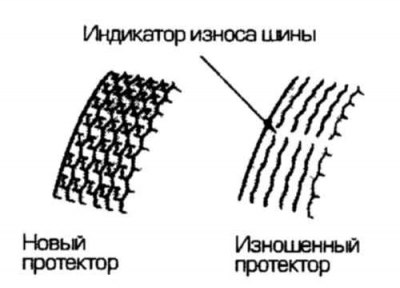
At the base of the profile of the branded set of tires, across the direction of rotation, there are "wear indicators" 1.6 mm high - see the figure. Depending on the product, these wear indicators are located 6-8 times
equal intervals around the circumference of the tire. Markings on the sidewalls of the tire (for example, the letters "TWI" or triangular symbols) indicate the location of the wear indicators.
With a residual profile of 1 mm - measured at any point on the tread - the permissible minimum profile depth will be reached.
Since worn tires at high speeds on wet roads no longer provide the required grip on the road surface and are more likely to cause the car to "float up". It is recommended not to expose tires to such high wear.
Wheel replacement
If the tire set has different degrees of wear, it is recommended to replace the front wheels with the rear ones. This will ensure that the service life of all tires is approximately the same.
Under certain conditions, after replacing the wheels, it is necessary to perform a new balancing of the front wheels - see below.
Tire replacement
For reasons of traffic safety, tires should be replaced, if possible, not individually, but at least alternately by axle. Tires with a greater tread depth should always be installed on the front wheels.
Combine only radial tires of the same design, size and, if possible, the same tread pattern.
For safety reasons, use a new valve with a rubberized body each time a new tubeless tire is installed.
The use of a tube in "tubeless" tires should be limited to exceptional cases, and it should be ensured that any air trapped between the tube and the tire can escape through the valve.
Tyre repair requires a great deal of specialist knowledge and should be performed by a specialist.
Wheel balancing
The front wheels of a new car are balanced. However, during the operation of the car, under the influence of various factors, an imbalance may appear, which becomes noticeable when driving the car.
Since imbalance also causes increased wear on the steering system, wheel suspension and tires, the wheels should be rebalanced. In addition, the wheel should be rebalanced after mounting a new tire and after each tire repair.
Characteristic appearance of the tread pattern when tires are abnormally worn
1. Double-sided tread wear
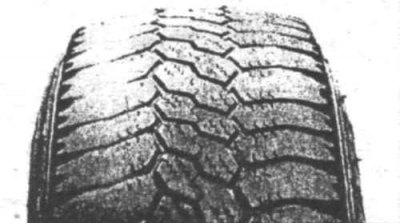
Insufficient pressure causes the tires to overheat due to strong tire deflection. In this case, the tread engages the road surface only at the edges, which reduces the grip of the wheels on the road and the edges of the tire wear out heavily. This type of wear is dangerous due to the possibility of a tire rupture due to overheating. Check the pressure and restore it to normal. Incorrect camber angle (increased one-sided wear). Repair or replace suspension parts. Severe angular wear. Drive at a moderate speed!
2. Too high pressure
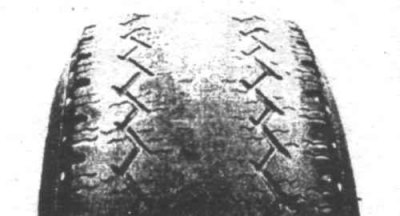
Excessive tire pressure leads to increased wear in the central part of the tread pattern, where the traction of the wheels with the road surface is reduced. When driving with such tires, the impact loads on the wheel increase and there is a risk of sudden destruction of the tire. Check the pressure and restore it to normal. If you had to pump up the tires to the maximum pressure due to upcoming high-speed driving or transporting a large load, do not forget to reduce the pressure to normal afterwards.
3. Uneven wear.
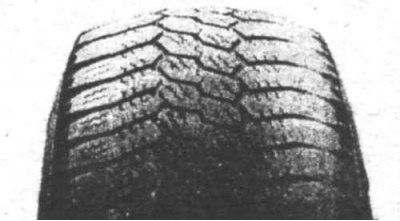
Uneven wear on the front wheels may be due to improper wheel alignment. Wheel alignment can be checked and adjusted at almost any auto repair shop or garage for a reasonable fee. Incorrect wheel alignment. Repair or replace front suspension components. Abnormal front suspension operation.
Repair or replace front suspension components. Increased wheel imbalance. Balance the wheels. Incorrect wheel alignment. Adjust the wheel alignment.
Attention! One-sided oblique tread wear, which indicates incorrect wheel installation, is best detected by touch.
Wheel rotation
Rotation is necessary to ensure uniform wear of the tires. The manufacturer recommends the following intervals between rotations:
- On 4x4 vehicles - every 5000 km.
- On other vehicles - every 10,000 km.
When changing wheels, check the uniformity of tire wear. Uneven wear is usually caused by incorrect wheel alignment angles, differences in tire pressure, wheel imbalance, and sudden braking.
Installation of winter tires and chains
When driving on snow and ice, it is recommended to install winter tires and chains.
When driving on wet or dry roads, winter tires have worse grip than regular tires.
The type and design of the winter tires installed must match the type and design of the tires installed on the vehicle. When installing studded tires, follow the regulations adopted in the given region.
Installation of winter tires
To avoid uneven traction and loss of vehicle control, winter tires should be installed on all wheels. Store removed tires in a cool, dry place. When installing tires, maintain the previously adopted rotation order. Warning: Tire pressure must be correct. Do not exceed the maximum speed limit for winter tires.
Rules for using chains
Install chains of the correct size according to local regulations.
The chains on the front wheels should fit as tightly as possible to the tire.
It is forbidden to put chains on the rear wheels. After moving 0.5-1 km, tighten the chains.
When putting on chains, follow the manufacturer's instructions. If there are decorative pads on the wheels, remove them to avoid damage by the chains.
Security measures
The maximum speed with chains is 50 km/h (or must correspond to the speed set by the chain manufacturer, whichever is lower).
When driving, avoid sharp turns and driving over bumps, otherwise the car may be thrown out of the rut.