



Contents: Tire tread depth ⤓ Tire pressure ⤓ Wheel rotation ⤓ Winter tires ⤓ Air pressure in tires, kPa ⤓
Regularly checking the condition of your tires will allow you to promptly detect intense wear and eliminate its cause, which will help avoid more serious consequences.
Check your tires for cuts, cracks, and other damage. Replace any tires that have deep cuts or cracks. Also, periodically inspect all tires and remove any metal objects or stones that may be stuck in them. Driving on tires with worn treads is very dangerous due to the high risk of skidding or hydroplaning (tire(s) floating above the road surface filled with water). For tires to meet the minimum roadworthiness requirements, the tread depth must be at least 1.6 mm.
Tire tread depth
The grooves of the tire tread pattern contain "tire wear indicators" 1.6 mm high, located at right angles to the direction of the tire's forward movement. These indicators, in a quantity of six to eight (depending on the manufacturer), are placed at equal distances around the tire's circumference. Markers on the sidewall of the tire (for example, the letters "TWI" or a pictogram in the form of a triangle) show the location of the tire wear indicators (Fig. 1.9).
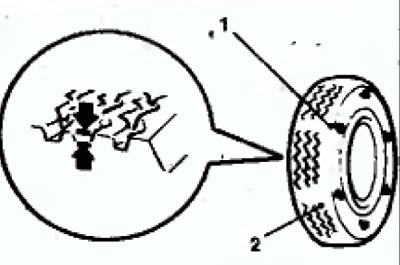
Fig. 1.9. Locations (1) of tire wear indicators (2)
The tires can be used until the profile depth reaches 1.6 mm, i.e. the profile grooves must have a depth of at least 1.6 mm over the entire surface of the tire. However, for safety reasons, it is recommended to change the tires at a profile depth of 2 mm.
M+S tyres have sufficient grip on snow with a tread depth of at least 4 mm.
Tire pressure
Use a tire pressure gauge to check the tire pressure monthly, including the spare tire.
To maintain optimum tire performance, check tire pressure only when tires are cold. Under- or over-inflated tires can cause uneven tread wear.
Wheel rotation
In order for the front and rear tires to wear out at the same time and to be able to change the tires as a set, it is necessary to constantly pay attention to the uniformity of their wear and to rearrange them in a timely manner. The wheels must be rearranged not diagonally across the car, but so that they retain their original direction of rotation (Fig. 1.10. 1.11). When rearranging the wheels, check the degree of tire wear and the presence of damage. Uneven wear is usually caused by incorrect tire pressure, improper wheel alignment, imbalance, or as a result of emergency braking.
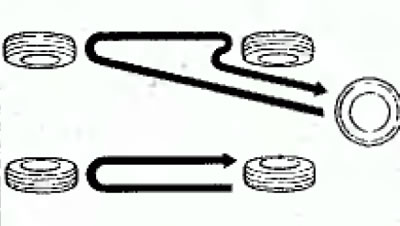
Fig. 1.10. Wheel rotation diagram
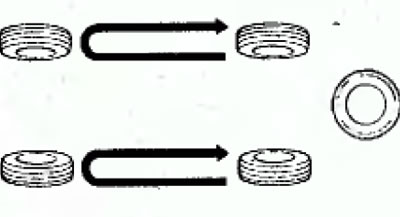
Fig. 1.11. Wheel rotation diagram
Winter tires
When driving on snow and ice, it is recommended to use winter tires. To ensure vehicle stability, install winter tires of the same size and tread pattern on all four wheels. Winter tires with tread wear of more than 50% are not suitable for use as winter tires. Winter tires that do not meet technical requirements and characteristics must not be used.
Air pressure in tires, kPa
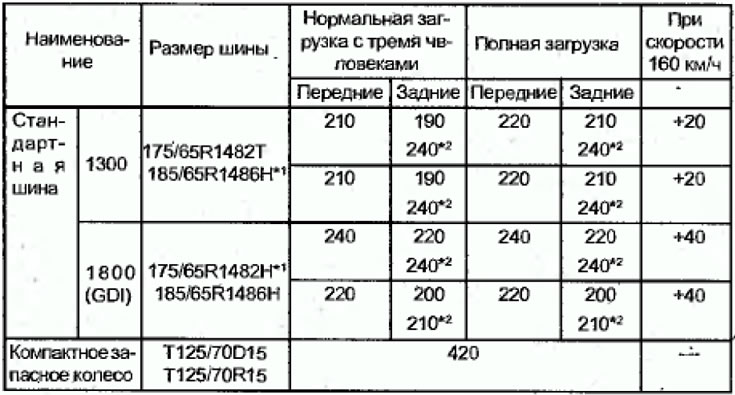
*1 Additional equipment, *2 Air pressure when towing the scope.