



Checking the tread depth
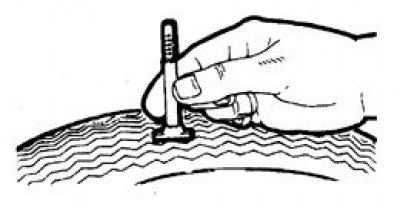
Checking tire wear and damage
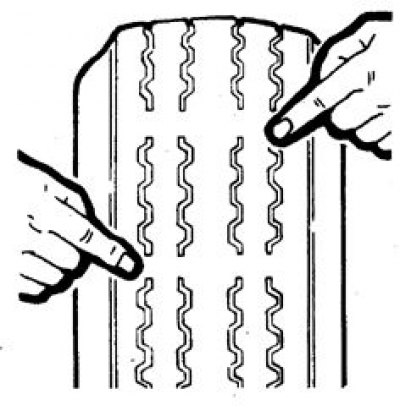
Tire maintenance consists of checking the tread depth and tire pressure (tested on cold tires), identifying signs of abnormal wear and damage that can be used to determine the condition of the front suspension and steering components.
Regularly remove any stones or sharp objects stuck in the tread. Periodically remove the wheels and clean the outer and inner surfaces of the disc from dirt.
If you have any doubts about the consequences of any damage found, please contact a tire repair shop for advice. Rotate your wheels at regular intervals. When installing a new tire on a rim, consider the following.
The width of the tire tread should differ from the distance between the inner sides of the tire by no more than 25 mm. On radial tires, the width between the inner sides should be no more than 80% of the tire width.
The height of the tire when installed has a significant impact on the accuracy of the speedometer readings, acceleration dynamics and vehicle clearance. The necessary corrections are specified by the tire manufacturer. Speedometer reducers with adjusted gear ratios are supplied as spare parts.
(The text of the article was obtained from the website: MitsubishiMan)
When installing new tires, there should be no abnormal body tilt when driving on bumpy roads or when turning.
Wheel rotation
Wheel rotation diagram
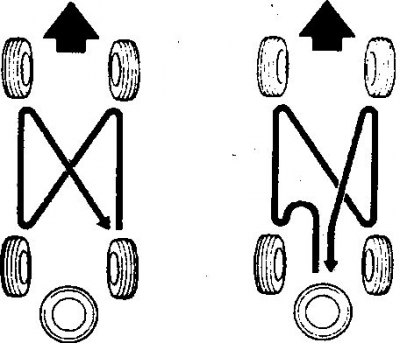
Wheels are rotated to improve uniformity of tire wear after 12,000 km.
When removing winter studded tires, mark the position of the wheel being removed and the direction of the studs. It is not permitted to rearrange wheels whose tires are designed for different loads and are installed separately on the front and rear axles.
The manufacturer recommends installing radial tires in a single set (5 wheels). In extreme cases, it is permissible to install radial tires of the same design on the rear axle.