
English Русский
Български
Беларускі
Український
Српски
Hrvatski
Română
Polski
Slovenský
Magyar
Articles Bookmark Contacts Sitemap   
Company Audi Company Ford Company Hyundai Company Kia Company Mazda Company Mercedes-Benz Company Nissan
MitsubishiMan.ru


Home Colt Lancer Galant L200 Outlander Pajero Others
Pajero 4 (2006-2021) Pajero 1 and 2 (1982-1999)

Brake fluid (Mitsubishi Pajero 4)

  • Home
  • Pajero
  • 4 (2006-2021)
  • General information
  • Maintenance
  • Brake fluid
0
Contents: Checking the fluid level ⤓ Cars not equipped with ABS ⤓ Vehicles equipped with ABS ⤓ Recommended type of liquid ⤓

Checking the fluid level


The brake fluid level is controlled by a float sensor. If the brake fluid level drops below the MIN mark, the brake fluid level indicator lamp comes on.

Cars not equipped with ABS


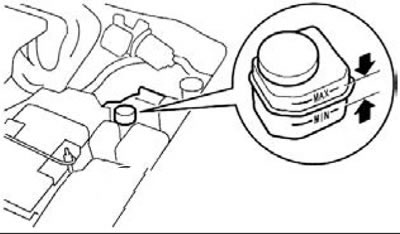
Check the brake fluid level in the reservoir.

The brake fluid level should be between the MAX and MlN marks on the tank wall.

(The text of the article was obtained from the website mitsubishiman.ru)


Vehicles equipped with ABS


Check the brake fluid level in the reservoir.

The brake fluid level should be between the MAX and MlN marks on the tank wall.
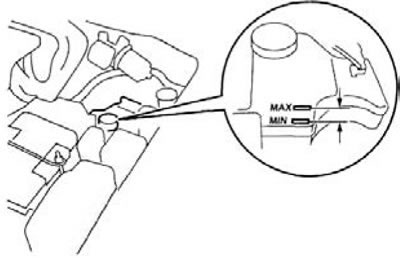


If the fluid level is below the MIN mark, perform the following check procedure:


  • 1. Turn the ignition key to the LOCK or ACC position.
  • 2. Press the brake pedal until you feel strong resistance (typically you need to press the pedal about 40 times).
  • 3. Check the brake fluid level in the reservoir.

The brake fluid level should be between the MAX and MlN marks on the tank wall.

As the brake pads and clutch disc wear, the fluid level will gradually decrease, but this is not a sign of a malfunction.

If the fluid level drops noticeably over a short period of time, this indicates a leak in the brake system. In this case, it is recommended to have the vehicle inspected.

Recommended type of liquid


Brake fluid that meets DOT3 or DOT4 standards should be used. Brake fluid is hygroscopic. High moisture content in brake fluid negatively affects the efficiency of the braking system.

In addition, the brake fluid reservoir has a special cap that prevents air from entering. This cover should not be removed.

Attention:
  • When working with brake fluid, be careful not to let it get into your eyes or on the paintwork.
  • Only the recommended type of brake fluid should be used.
  • In addition, additives contained in brake fluids from different manufacturers can cause a chemical reaction when mixed. If possible, do not mix brake fluids from different manufacturers.
  • Under normal operating conditions, the reservoir cap should be kept closed to prevent deterioration of the brake fluid performance.
This article is available at: russian, bulgarian, belarusian, ukrainian, serbian, croatian, romanian, polish, slovak, hungarian
This article was reviewed by: Miroslav Rakov
Share with friends:
◀ Previous
Pajero 4: Maintenance
Next ▶

Washer fluid
Automatic transmission fluid (optional)
Cooling liquid
Motor oil
Maintenance — Hood
Clutch fluid (optional)
Power steering fluid
Rechargeable battery
Maintenance — Tires
Windscreen wiper blades
Similar materials for other Mitsubishi models

➤ Checking the brake fluid level Mitsubishi Colt 4 and 5 (1991-2003)
➤ Checking the brake fluid level Mitsubishi Lancer 3 and 5 (1984-1992)
➤ Changing brake fluid (Precis models only) Mitsubishi Galant 5 (1983-1989, petrol)
➤ Checking the brake fluid levels in the master cylinder… Mitsubishi L200 4 (2005-2014, diesel)
➤ Checking the level of working fluid in the brake hydraulic… Mitsubishi Outlander 1 (2003-2008)
➤ Brake fluid Mitsubishi Carisma (1995-2004)
Link in different formats to this article
Comments and feedback from visitors
No comments yet


Add up two numbers 22 + 11


Pajero 4 (2006-2021) 
  • General information
  • User manual
  • Troubleshooting
  • Maintenance
  • Technical specifications
  • Power unit
  • Engine repair
  • Cooling system
  • Lubrication system
  • Fuel system
  • Engine management system
  • Intake and exhaust system
  • Engine electrical equipment
  • Transmission
  • Clutch
  • Manual gearbox
  • Automatic gearbox
  • Drive shafts
  • Chassis and running gear
  • Front suspension
  • Rear suspension
  • Brake system
  • Steering
  • Body and interior
  • Exterior (external elements)
  • Interior (internal elements)
  • Doors, locks and windows
  • Body dimensions
  • Electrical equipment
  • Safety system (SRS)
  • Air conditioner
  • Equipment and devices
  • Electrical diagrams
Pajero 1 and 2 (1982-1999) 
  • General information
  • User manual
  • Seats and seat belts
  • Instruments and controls
  • Driving and operation
  • Maintenance
  • Power unit
  • Gasoline engines
  • Diesel engines
  • Ignition system
  • Engine electrical equipment
  • Cooling and lubrication system
  • Power and exhaust system
  • Fuel system (gasoline)
  • Fuel system (diesel)
  • Transmission
  • Clutch
  • Mechanical gearbox
  • Automatic gearbox
  • Drive shafts and axles
  • Chassis and running gear
  • Front suspension
  • Rear suspension
  • Steering
  • Brake system
  • Body and interior
  • Exterior (external elements)
  • Interior (internal elements)
  • Doors, locks and windows
  • Electrical equipment
  • Equipment and devices
  • Heater and air conditioner
  • Cruise control
  • Headlights and lighting
  • Electrical circuits
MitsubishiMan.ru © 2018–2026 • Mobile version • Articles about Mitsubishi • Contacts • Sitemap: EN BG BY UA RS HR RO PL SK HU • Site search • Bookmark
Colt 2 and 3 (1983-1993) · Colt 4 and 5 (1991-2003) · Colt 5 (1995-2003) · Lancer 3 and 5 (1984-1992) · Lancer 9 (2000-2007) · Galant 5 (1983-1989) · Galant 6 and 7 (1987-1998) · L200 4 (2005-2014) · Outlander 1 (2003-2008) · Pajero 1 and 2 (1982-1999) · Pajero 4 (2006-2021) · Carisma (1995-2004) · Space Star (1998-2005) ·
This resource sets cookies 🍪 to avoid bothering you with repeated data entry.