
English Русский
Български
Беларускі
Український
Српски
Hrvatski
Română
Polski
Slovenský
Magyar
Articles Bookmark Contacts Sitemap   
Company Audi Company Ford Company Hyundai Company Kia Company Mazda Company Mercedes-Benz Company Nissan
MitsubishiMan.ru


Home Colt Lancer Galant L200 Outlander Pajero Others
Pajero 4 (2006-2021) Pajero 1 and 2 (1982-1999)

Cooling liquid (Mitsubishi Pajero 4)

  • Home
  • Pajero
  • 4 (2006-2021)
  • General information
  • Maintenance
  • Cooling liquid
0
Contents: Checking the coolant level ⤓ Adding coolant ⤓ In cold weather ⤓

Checking the coolant level


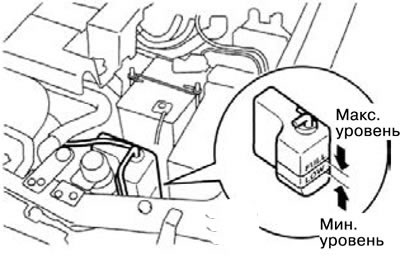
The translucent expansion tank of the cooling system is located in the engine compartment.

When the engine is cold, the coolant level in this reservoir should be between the LOW and FULL marks.


Adding coolant


The cooling system is sealed and under normal operating conditions, coolant loss is insignificant. A significant drop in coolant level may indicate a leak. In this case, it is recommended to check the cooling system as soon as possible.

If the level in the expansion tank drops below the LOW mark, open the cap and add coolant. If the expansion tank is completely empty, open the radiator cap and add coolant until its level reaches the filler neck.

Caution: Do not open the radiator cap when the engine is hot. The cooling system is under pressure and escaping hot coolant can cause serious burns.


Antifreeze


The coolant contains an ethylene glycol-based anti-corrosion agent. The cylinder head and coolant pump housing are made of aluminum alloy, and to prevent corrosion of these parts, the coolant should be replaced periodically.


Use coolant Dia queen super long life coolant or similar.

Original coolant Mitsubishi has excellent anti-corrosion properties for any metals, including aluminum, and prevents clogging of the radiator, heater, cylinder head and cylinder block channels, etc. with corrosion products.

The coolant must contain an anti-corrosion agent, so do not replace the coolant with clean water, even in summer. The concentration of antifreeze in the coolant depends on the expected outside air temperature.

Air temperature (minimal),°C-15-20-25-30-35-50
Antifreeze concentration, %303540455060

Attention:
  • Do not use alcohol or methanol based antifreeze or coolants mixed with alcohol or methanol based antifreeze. Using the recommended type of antifreeze may cause corrosion of aluminum parts.
  • For antifreeze and anticorrosive additives to work effectively, the concentration of antifreeze in the coolant should be between 30 and 60%.
  • When the concentration of antifreeze increases to a value above 60%, the freezing temperature of the coolant increases and the heat transfer capacity decreases, which negatively affects the operation of the engine.
  • It is prohibited to add water to the coolant.
  • Water reduces the anti-corrosion properties and leads to an increase in the freezing point of the coolant, in addition, it has a lower boiling point. When frozen, it can damage parts of the cooling system. Do not use tap water as it will cause corrosion.


In cold weather


If the ambient temperature in the area where the vehicle is operated falls below the freezing point of the coolant, the coolant in the radiator and engine may freeze, causing serious damage to the engine and/or radiator. To prevent the coolant from freezing, add the appropriate amount of antifreeze to it.


[The text of the article was obtained from the website mitsubishiman.ru]

The antifreeze composition poured into the engine at the factory provides protection against freezing at temperatures down to approximately -30°C. Before the start of the winter season, the concentration of the antifreeze should be checked and, if necessary, antifreeze should be added to the system.
This article is available at: russian, bulgarian, belarusian, ukrainian, serbian, croatian, romanian, polish, slovak, hungarian
This article was reviewed by: Miroslav Rakov
Share with friends:
◀ Previous
Pajero 4: Maintenance
Next ▶

Motor oil
Maintenance — Hood
Safety rules for maintenance
Automatic transmission fluid (optional)
Washer fluid
Brake fluid
Clutch fluid (optional)
Power steering fluid
Similar materials for other Mitsubishi models

➤ Checking the tightness of the cooling system Mitsubishi Colt 4 and 5 (1991-2003)
➤ Checking the tightness of the cooling system Mitsubishi Lancer 3 and 5 (1984-1992)
➤ Checking the condition of the cooling system components Mitsubishi Galant 6 and 7 (1987-1998)
➤ Flushing the automatic transmission fluid cooling lines Mitsubishi L200 4 (2005-2014, diesel)
➤ Checking for leaks in the cooling system Mitsubishi Outlander 1 (2003-2008)
➤ Cooling liquid Mitsubishi Carisma (1995-2004)
Link in different formats to this article
Comments and feedback from visitors
No comments yet


Add up two numbers 30 + 42


Pajero 4 (2006-2021) 
  • General information
  • User manual
  • Troubleshooting
  • Maintenance
  • Technical specifications
  • Power unit
  • Engine repair
  • Cooling system
  • Lubrication system
  • Fuel system
  • Engine management system
  • Intake and exhaust system
  • Engine electrical equipment
  • Transmission
  • Clutch
  • Manual gearbox
  • Automatic gearbox
  • Drive shafts
  • Chassis and running gear
  • Front suspension
  • Rear suspension
  • Brake system
  • Steering
  • Body and interior
  • Exterior (external elements)
  • Interior (internal elements)
  • Doors, locks and windows
  • Body dimensions
  • Electrical equipment
  • Safety system (SRS)
  • Air conditioner
  • Equipment and devices
  • Electrical diagrams
Pajero 1 and 2 (1982-1999) 
  • General information
  • User manual
  • Seats and seat belts
  • Instruments and controls
  • Driving and operation
  • Maintenance
  • Power unit
  • Gasoline engines
  • Diesel engines
  • Ignition system
  • Engine electrical equipment
  • Cooling and lubrication system
  • Power and exhaust system
  • Fuel system (gasoline)
  • Fuel system (diesel)
  • Transmission
  • Clutch
  • Mechanical gearbox
  • Automatic gearbox
  • Drive shafts and axles
  • Chassis and running gear
  • Front suspension
  • Rear suspension
  • Steering
  • Brake system
  • Body and interior
  • Exterior (external elements)
  • Interior (internal elements)
  • Doors, locks and windows
  • Electrical equipment
  • Equipment and devices
  • Heater and air conditioner
  • Cruise control
  • Headlights and lighting
  • Electrical circuits
MitsubishiMan.ru © 2018–2026 • Mobile version • Articles about Mitsubishi • Contacts • Sitemap: EN BG BY UA RS HR RO PL SK HU • Site search • Bookmark
Colt 2 and 3 (1983-1993) · Colt 4 and 5 (1991-2003) · Colt 5 (1995-2003) · Lancer 3 and 5 (1984-1992) · Lancer 9 (2000-2007) · Galant 5 (1983-1989) · Galant 6 and 7 (1987-1998) · L200 4 (2005-2014) · Outlander 1 (2003-2008) · Pajero 1 and 2 (1982-1999) · Pajero 4 (2006-2021) · Carisma (1995-2004) · Space Star (1998-2005) ·
This resource sets cookies 🍪 to avoid bothering you with repeated data entry.