



- 1. The auxiliary battery for starting the engine must have a voltage of 12 V, otherwise damage to the electrical equipment of the car may occur.
- 2. Park the vehicles next to each other at a distance that allows the connection of the jumper wires, but does not allow the vehicles to touch. If the vehicles touch, unwanted grounding may occur. In this case, you will not be able to start the engine of your vehicle, and the electrical systems of both vehicles may be damaged.
Warning: Moving vehicles may cause injury. Apply the parking brake on both vehicles. Place the gearshift lever in neutral.
- 3. Turn off all electrical consumers on both vehicles. This will prevent sparks and prevent discharge and damage to the batteries.
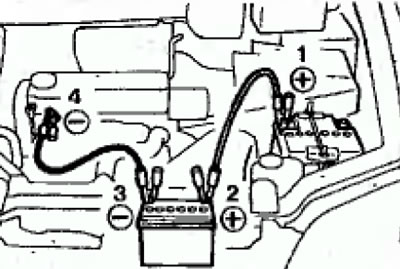
- 4. Connect one end of the jumper cables to the positive (+) terminal of the dead battery, and the other end of the jumper cable to the positive (+) terminal of the battery on the other vehicle (used as a booster source).
- 5. Connect the other end of the jumper cable to the negative (-) terminal of the other vehicle's battery (used as an additional source), and the other end of this cable to the engine block of the vehicle with the dead battery at a point that is as far away from the battery as possible.
- 6. Start the engine of the car with the battery that is used as an additional source and let the engine idle for a few minutes, and then start the engine of the car with the discharged battery.
- 7. After the engine has started, disconnect the connecting wires in the reverse order of their connection.
The text of the article was taken from the website: MITSUBISHIMAN