



Contents: Checking the correct functioning ⤓ Checking for leaks ⤓ Removal ⤓ Installation and adjustment ⤓
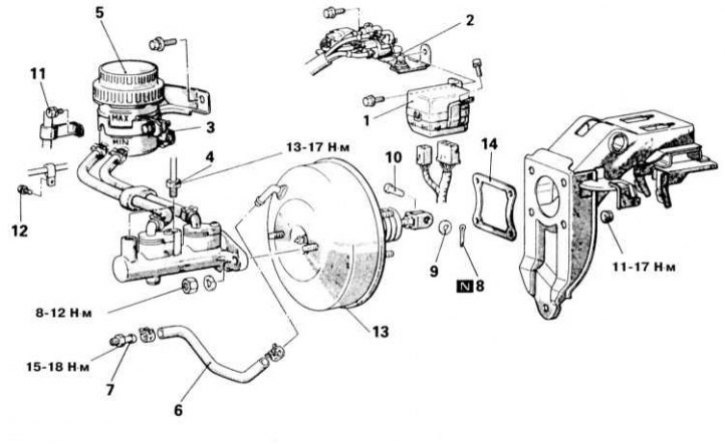
Brake booster assembly installation details
1 - Air conditioning relay mounting block; 2 - Solenoid valve; 3 - Brake fluid level sensor wiring connector; 4 - Brake pipe; 5 - Assembling the master cylinder with the reservoir; 6 - Vacuum hose with built-in check valve; 7 - Fitting; 8 - Cotter pin; 9 - Washer; 10 - Pin; 11 - Bolt of the support bracket of the return hydraulic pipe; 12 - Hydraulic tube support bracket bolt; 13 - Assembling the vacuum booster; 14 - Sealing gasket; N - Replace
Note: The brake booster servo does not require regular maintenance, except for periodic checks of the vacuum hose condition.
Checking the correct functioning
Keeping the foot brake pedal depressed, start the engine. If the pedal "sinks" slightly immediately after starting, then the brake booster is working properly.
Checking for leaks
1. Run the engine for a couple of minutes, then turn it off. Slowly press the foot brake pedal several times. If the pedal travel gradually decreases with each press, stabilizing on the third or fourth pump, then the vacuum booster assembly is not leaky.
2. Press the foot brake pedal with the engine running. Keep the pedal pressed and turn off the engine. If after 30 seconds of holding the pedal pressed, its reserve travel does not change, then the vacuum booster assembly is not leaking.
Removal
1. The brake booster unit is not subject to repair and in case of failure must be replaced as an assembly. The assembly installation details are shown in the illustration.
2. Disconnect the vacuum hose connected to the booster from the engine intake manifold. Be careful not to damage the hose when removing it from the nipple on the booster assembly.
3. Loosen the mounting nuts and carefully remove the brake master cylinder from the vacuum booster assembly (see Section Removal and installation of the brake master cylinder), - try to avoid bending and twisting of hydraulic lines.
4. In the car's interior, locate the connection point of the vacuum booster pushrod to the foot brake pedal (use a flashlight if necessary). Remove the cotter pin, release the cylindrical pin and disconnect the split pushrod pin from the pedal lever.
The article is reprinted from this source www.mitsubishiman.ru
5. From the passenger compartment side, on the left under the instrument panel, loosen the four nuts securing the vacuum booster assembly to the engine compartment bulkhead - use a flashlight if necessary.
6. Go to the engine compartment and remove the vacuum booster assembly from the rear bulkhead. Pull the assembly strictly along the axis of its installation until the push rod is completely released. Remove the assembly from the engine compartment.
Installation and adjustment
1. Installation is carried out in the reverse order. Tighten all fasteners with the required force. Do not forget to replace the cotter pin of the push rod fastening pin to the pedal. Ensure that the return spring is securely fixed.
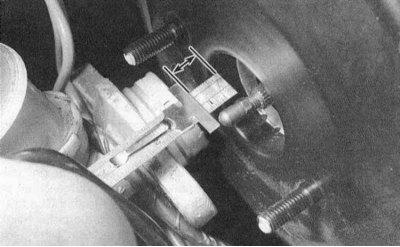
2. When replacing the vacuum booster, check/adjust the installation dimensions:
- a) Measure the amount of the tappet protrusion above the surface of the vacuum booster assembly mating with the master cylinder. Record the measurement result, designating it as dimension "A";
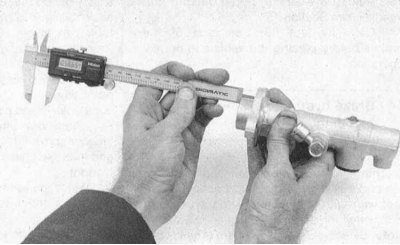
- b) Measure the distance from the mating surface of the mounting flange to the end of the master cylinder. Record the measurement result, designating it as dimension "B";
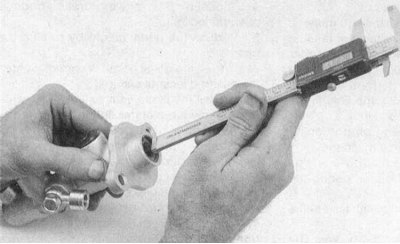
- c) Measure the distance from the end of the master cylinder to the bottom of the pocket in the piston for the push rod seat. Record the measurement result, designating it as dimension "C";
- d) To obtain the push rod seat clearance, subtract dimension B from dimension C, then subtract dimension A from the result obtained;
- e) Compare the calculation result with the requirements of the Specifications, if necessary, make the appropriate adjustment to the pushrod length (see below). If dimension A is less than the pocket depth in the master cylinder piston (C - B), the rod must be shortened, otherwise - lengthened.
 |  |
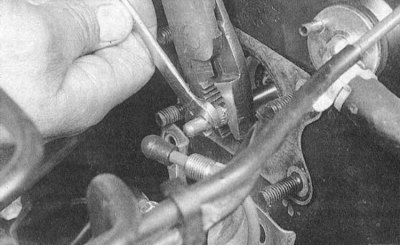 |
3. If the clearance is outside the allowable range, loosen the serrated notch on the end of the rod and rotate the adjusting rod to achieve the desired result. After completing the adjustment, tighten the lock nut firmly and repeat the check.
4. Install the vacuum hose into place in the master cylinder and connect it to the vacuum booster assembly. Make sure that the hose clamp is securely tightened on the inlet fitting.
5. Adjust the installation height and free travel of the foot brake pedal (see Section Adjusting the foot brake pedal).
6. Before operating the vehicle, make sure that the brake system is functioning properly.