



Contents: Removal ⤓ Installation ⤓
When replacing brake discs, the brake pads must also be replaced.
Removal
Mark the position of the wheel disk on the wheel hub with paint. This ensures that the balanced wheel can be reinstalled in its original position.
Raise the front of the car, see item 29.
Remove the wheel.
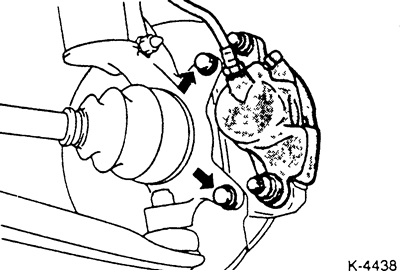
For rear disc brakes only: Release the handbrake completely and disconnect the handbrake cable from the brake caliper.
Disconnect the brake caliper and hang it with wire on the body or on a stand together with the installed brake pads.
Caution: Suspend the brake caliper without allowing tension or twisting of the brake hose.
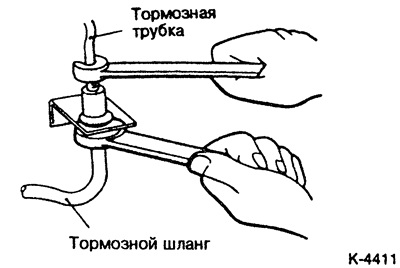
If it is necessary to completely remove the caliper, disconnect the brake hose. To do this, unscrew the union nut while simultaneously holding the Allen key on the brake hose with an open-end wrench. Pull back the clamp of the brake hose holder and remove the brake hose from the holder.
Caution: Brake fluid will leak out. Collect the brake fluid in a bottle intended exclusively for brake fluid. After installation, the brake system must be bleed of air.
Installation
To ensure uniform braking on both sides, both brake discs must have the same working surface in terms of grinding and micro-roughness height. Therefore, the brake discs on one axle should be replaced simultaneously.
Check the bearing starting moment. To do this, attach the cord, as shown in Figure K-4439, to the hub studs. Attach a spring balance to the other end of the cord and pull at an angle of 90° to the studs until the hub starts to rotate. Record the reading of the spring balance (spring balance).
Attach the brake bracket to the steering knuckle with 2 bolts. Tighten the front caliper mounting bolts with a torque of 100 Nm. Tighten the rear wheel caliper with a torque of 60 Nm.
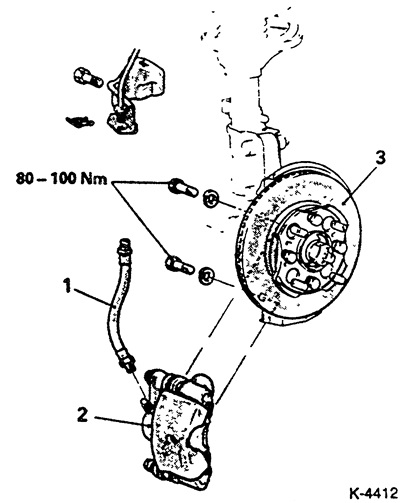
If the brake hose was removed, insert the brake hose into the holder and secure with a clamp. Screw on the union nut of the brake pipe. Do not twist the hose when installing. Tighten the union nut with a force of about 15 Nm.
If the brake system was opened, bleed the air from the brake system, see item 18.11.
Loosen the wheel nuts.
For rear disc brakes only: Connect the handbrake cable.
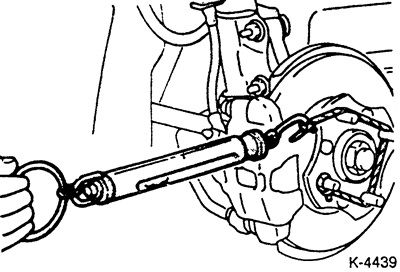
Measure the breakaway torque with the brake pads installed as follows:
Start the engine and let it idle.
Caution: The gearbox must be in neutral position.
Press and hold the brake pedal for approximately 5 seconds.
Turn off the engine.
Turn the wheel hub forward 10 revolutions.
Measure the wheel hub breakaway torque as shown in the figure. Compare the measured value with the breakaway torque measured with the brake pads removed. If the difference exceeds the required value, the brake caliper must be disassembled and repaired (workshop work).
Required value:
- with a standard brake disc 35 N (3.5 kg).
- with a blown brake disc 70 N (7.0 kg).
If the required value is exceeded, the brake caliper should be disassembled, the sliding elements should be cleaned and the wear of the piston cuff should be checked (work in a workshop).
Position the wheels according to the markings, screw in the wheel nuts. Lower the car and tighten the nuts crosswise. Tightening force see item 19.4.
Caution: Press the brake pedal hard several times until you feel strong resistance.
Check the fluid level in the tank and top up to the MAX mark if necessary.
Rear disc brakes: Adjust the handbrake, see item 18.15.