
English Русский
Български
Беларускі
Український
Српски
Hrvatski
Română
Polski
Slovenský
Magyar
Articles Bookmark Contacts Sitemap   
Company Audi Company Ford Company Hyundai Company Kia Company Mazda Company Mercedes-Benz Company Nissan
MitsubishiMan.ru


Home Colt Lancer Galant L200 Outlander Pajero Others
Pajero 4 (2006-2021) Pajero 1 and 2 (1982-1999)

Positive Crankcase Ventilation (PCV) System (Mitsubishi Pajero 4)

  • Home
  • Pajero
  • 4 (2006-2021)
  • Power unit
  • Engine management system
  • Positive Crankcase Ventilation (PCV) System
0
Contents: General information ⤓ Checking the crankcase ventilation…⤓ Checking the Positive Crankcase…⤓

General information


The forced crankcase ventilation system serves to prevent exhaust gases from escaping into the crankcase (crankcase gases) into the atmosphere. Clean air, after passing through the air filter, is directed through the forced crankcase ventilation hose and is directed to the cylinder head cover, (communicating with the crankcase), where it mixes with crankcase gases. The latter are sucked through the positive crankcase ventilation (PCV) valve into the intake manifold and then enter the combustion chambers. The position of the valve plunger depends on the vacuum in the intake manifold to ensure optimal crankcase gas flow. In other words, at low engine loads, the flow of crankcase gases is limited to ensure stable engine operation, and as the load increases, the flow of crankcase gases through the PCV valve increases to increase the efficiency of crankcase ventilation.

Checking the crankcase ventilation system


1. Remove the ventilation hose from the PCV valve.

2. Remove the PCV valve from the cylinder head cover.

3. Reinsert the PCV valve into the ventilation hose.

The original was published on the website: www.MitsubishiMan.ru

4. Start the engine and let it idle.

5. Place your finger over the PCV valve hole and check if you feel a vacuum in the intake manifold.

Note: At this point, the PCV valve plunger moves back and forth.


6. If the vacuum is not felt, clean the PCV valve or replace it.
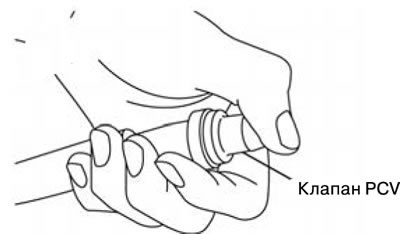


Checking the Positive Crankcase Ventilation Valve


1. Insert into the PCV valve hole from the side shown in the figure (from the side where the valve is installed in the cylinder head cover) thin rod and move it back and forth to check the ease of movement of the valve plunger.

2. If the PCV valve plunger does not move, the valve is clogged. In this case, clean the PCV valve or replace it.
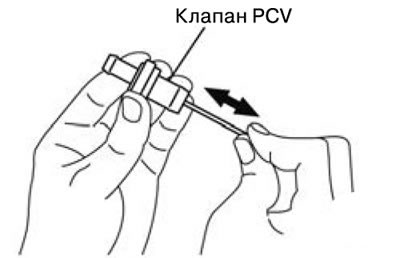
This article is available at: russian, bulgarian, belarusian, ukrainian, serbian, croatian, romanian, polish, slovak, hungarian
This article was reviewed by: Miroslav Rakov
Share with friends:
◀ Previous
Pajero 4: Engine management system
Next ▶

Fuel vapor recovery system
Vacuum hoses
Basic data for adjustments and control
Toxicity Reduction Systems — General Information
Engine Management System — Special Tool
Exhaust Gas Recirculation (EGR) System
Exhaust gas recirculation valve
Catalytic Converter — General Information
Fuel vapor recovery system adsorber
Accelerator pedal
Similar materials for other Mitsubishi models

➤ Forced crankcase ventilation system (PCV) — device and… Mitsubishi Colt 4 and 5 (1991-2003)
➤ Forced crankcase ventilation system Mitsubishi Lancer 9 (2000-2007, petrol)
➤ Positive Crankcase Ventilation (PCV) System Mitsubishi Galant 5 (1983-1989, petrol)
➤ Ventilation, heating and air conditioning system Mitsubishi L200 4 (2005-2014, diesel)
➤ Ventilation system deflectors Mitsubishi Outlander 1 (2003-2008)
➤ Ventilation system air ducts — removal and installation Mitsubishi Carisma (1995-2004)
Link in different formats to this article
Comments and feedback from visitors
No comments yet


Add up two numbers 39 + 46


Pajero 4 (2006-2021) 
  • General information
  • User manual
  • Troubleshooting
  • Maintenance
  • Technical specifications
  • Power unit
  • Engine repair
  • Cooling system
  • Lubrication system
  • Fuel system
  • Engine management system
  • Intake and exhaust system
  • Engine electrical equipment
  • Transmission
  • Clutch
  • Manual gearbox
  • Automatic gearbox
  • Drive shafts
  • Chassis and running gear
  • Front suspension
  • Rear suspension
  • Brake system
  • Steering
  • Body and interior
  • Exterior (external elements)
  • Interior (internal elements)
  • Doors, locks and windows
  • Body dimensions
  • Electrical equipment
  • Safety system (SRS)
  • Air conditioner
  • Equipment and devices
  • Electrical diagrams
Pajero 1 and 2 (1982-1999) 
  • General information
  • User manual
  • Seats and seat belts
  • Instruments and controls
  • Driving and operation
  • Maintenance
  • Power unit
  • Gasoline engines
  • Diesel engines
  • Ignition system
  • Engine electrical equipment
  • Cooling and lubrication system
  • Power and exhaust system
  • Fuel system (gasoline)
  • Fuel system (diesel)
  • Transmission
  • Clutch
  • Mechanical gearbox
  • Automatic gearbox
  • Drive shafts and axles
  • Chassis and running gear
  • Front suspension
  • Rear suspension
  • Steering
  • Brake system
  • Body and interior
  • Exterior (external elements)
  • Interior (internal elements)
  • Doors, locks and windows
  • Electrical equipment
  • Equipment and devices
  • Heater and air conditioner
  • Cruise control
  • Headlights and lighting
  • Electrical circuits
MitsubishiMan.ru © 2018–2026 • Mobile version • Articles about Mitsubishi • Contacts • Sitemap: EN BG BY UA RS HR RO PL SK HU • Site search • Bookmark
Colt 2 and 3 (1983-1993) · Colt 4 and 5 (1991-2003) · Colt 5 (1995-2003) · Lancer 3 and 5 (1984-1992) · Lancer 9 (2000-2007) · Galant 5 (1983-1989) · Galant 6 and 7 (1987-1998) · L200 4 (2005-2014) · Outlander 1 (2003-2008) · Pajero 1 and 2 (1982-1999) · Pajero 4 (2006-2021) · Carisma (1995-2004) · Space Star (1998-2005) ·
This resource sets cookies 🍪 to avoid bothering you with repeated data entry.