
English Русский
Български
Беларускі
Український
Српски
Hrvatski
Română
Polski
Slovenský
Magyar
Articles Bookmark Contacts Sitemap   
Company Audi Company Ford Company Hyundai Company Kia Company Mazda Company Mercedes-Benz Company Nissan
MitsubishiMan.ru


Home Colt Lancer Galant L200 Outlander Pajero Others
Colt 5 (1995-2003, petrol) Colt 4 and 5 (1991-2003) Colt 2 and 3 (1983-1993)

Forced crankcase ventilation system (PCV) — device and repair (Mitsubishi Colt 4)

  • Home
  • Colt
  • 4 (1991-2003)
  • Power unit
  • Emission reduction
  • Forced crankcase ventilation system (PCV) — device and repair
0
Contents: Examination ⤓ Removal and installation ⤓
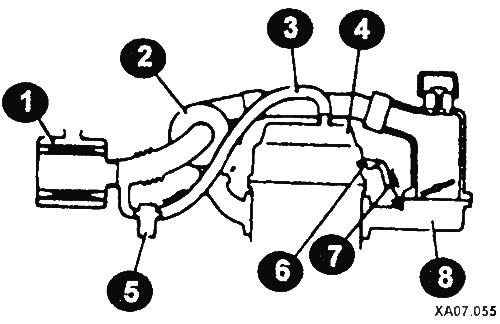

Main elements of the PVC system
1 - Air purifier; 2 - air duct; 3 - ventilation hose; 4 - cylinder head cover; 3 - oil separator, 6 - PVK valve; 7 - ventilation hose; 8 - intake manifold.


The closed crankcase forced ventilation system ensures that incompletely burned fuel (passing into the crankcase, bypassing the piston rings) is returned back to the intake manifold for re-burning with the air-fuel mixture.

A valve known as the PVK valve regulates the flow of air into the manifold according to the degree of vacuum in it. When the throttle valves are wide enough, the valve is fully open. However, at idle, when the vacuum in the manifold is at its maximum, the PVK valve reduces the flow of air so as not to unnecessarily affect the small volume of mixture passing into the engine.

When the throttle valve is fully open, with an increase in the volume of gas entering the crankcase, and with a decrease in the degree of vacuum in the collector, the flow through the PVC valve becomes insufficient. Under these conditions, excess vapors are sucked into the air purifier and enter the engine with fresh air. A clogged valve or hose can cause uneven idle speeds, engine stops or low idle speeds, oil penetration into the engine and/or clogging and oil deposits in the engine and air purifier. A leaky valve or hose may cause unstable idle speed or cause the engine to stop.


Examination


The PVK is checked with the engine idling (after warming up).

Remove the PVC valve from its sleeve without disconnecting it from the hose. (Most valves are pressed into the sleeve, but some are threaded and screw into the sleeve.).

To check for vacuum, place your thumb on the end of the valve stem.
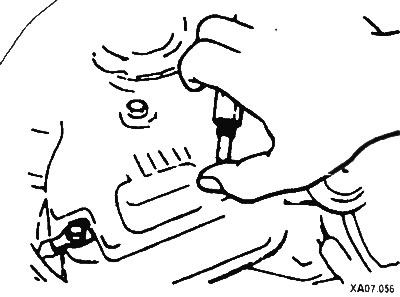


If there is no vacuum, check if the hoses or pipes are clogged. If the pipes are clean, then the valve is faulty.

Article reprinted from the website mitsubishiman.ru

With the engine off, remove the PVK valve, shake it, listening to the sound from the needle inside it. The absence of sound indicates that the needle is stuck, and the valve must be replaced.

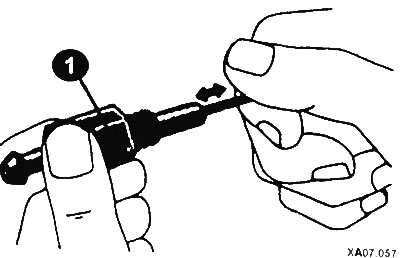
If the valve has a thread, it is recommended to use a thin wire, which is inserted into the valve (1) from the side with the thread, to check the movement of the plunger. If no movement is felt, the valve must be replaced.


CAUTION: An engine operated without crankcase ventilation can quickly fail. It is important to check and replace the PCV valve at regular intervals.


Removal and installation


Remove the PVK valve from the sleeve. Disconnect the hose from the valve. Mark which side of the valve was inserted into the manifold.

Check the hose for cracks, kinks and blockages.

Check the nipple (to which the hose is connected) for blockages.

The normal functioning of the PVS system depends on the tightness of the engine. Check the PVS system in the following cases:
  • unstable engine idling, the causes of which cannot be attributed to a normal vacuum disturbance or a problem with the fuel supply;
  • air leakage through a leaky valve sleeve, oil pan gaskets, or even through the front and rear crankcase seals;
  • excessive contamination of the air cleaner with low mileage;
  • noticeable contamination of engine oil due to dilution with fuel long before the scheduled oil change.

CAUTION: Engines with severely worn rings and/or valve seals may experience such intense blow-by that the PVS system may not be able to cope with it.
This article is available at: russian, bulgarian, belarusian, ukrainian, serbian, croatian, romanian, polish, slovak, hungarian
This article was reviewed by: Nikita Romanov
Share with friends:
◀ Previous
Colt 4 and 5: Emission reduction
Next ▶

General description of the exhaust gas toxicity reduction system
Typical diagram of a fuel evaporative emission reduction system
Fuel Evaporation Reduction System — Description
Fuel Evaporative Emissions Reduction System — Component Check
Exhaust Gas Recirculation (EGR) System — Design and Testing
Similar materials for other Mitsubishi models

➤ Forced crankcase ventilation system Mitsubishi Lancer 9 (2000-2007, petrol)
➤ Positive Crankcase Ventilation (PCV) System Mitsubishi Galant 5 (1983-1989, petrol)
➤ Ventilation, heating and air conditioning system Mitsubishi L200 4 (2005-2014, diesel)
➤ Ventilation system deflectors Mitsubishi Outlander 1 (2003-2008)
➤ Positive Crankcase Ventilation (PCV) System Mitsubishi Pajero 4 (2006-2021)
➤ Ventilation system air ducts — removal and installation Mitsubishi Carisma (1995-2004)
Link in different formats to this article
Comments and feedback from visitors
No comments yet


Add up two numbers 41 + 21


Colt 5 (1995-2003, petrol) 
  • General information
  • User manual
  • Specifications
  • Gasoline engines
  • 4G1 engines until 1995
  • 4G1 engines since 1995
  • Repair of 4G9 engines
  • Cooling system
  • Reduced exhaust gas toxicity
  • Engine electrical equipment
  • Injection system MPI
  • Carburetors
  • Transmission
  • Clutch and drive shafts
  • Manual gearbox F4M21/F5M21
  • Manual gearbox F4M41
  • Automatic gearbox F4A21
  • Automatic gearbox F4A41
  • Chassis and running gear
  • Car suspension
  • Steering
  • Brake system
  • Body
  • Exterior (external elements)
  • Electrical equipment
  • Equipment and devices
  • Electrical circuits
Colt 4 and 5 (1991-2003) 
  • General information
  • Maintenance
  • Power unit
  • Engine in a car
  • Engine repair (gasoline)
  • Engine repair (diesel)
  • Lubrication system
  • Cooling system
  • Carburetor
  • Fuel injection MPI
  • Fuel injection GDI
  • Emission reduction
  • Fuel system (diesel)
  • Ignition system
  • Exhaust system
  • Transmission
  • Clutch
  • Manual gearbox
  • Automatic gearbox
  • Drive shafts
  • Chassis and running gear
  • Chassis malfunctions
  • Front suspension
  • Rear suspension
  • Steering
  • Wheels and tires
  • Brake system
  • Body and interior
  • Body elements
  • Electrical equipment
  • Equipment and devices
  • Power devices
  • Heating and air conditioning
  • Electrical circuits
Colt 2 and 3 (1983-1993) 
  • General information
  • User manual
  • Daily care
  • Maintenance
  • Power unit
  • Engine in a car
  • Engine overhaul
  • Cooling system
  • Heater and air conditioner
  • Power and exhaust system
  • Engine electrical equipment
  • Emission reduction
  • Transmission
  • Mechanical gearbox
  • Automatic gearbox
  • Clutch and axles
  • Chassis and running gear
  • Brake system
  • Car suspension
  • Steering
  • Body and interior
  • Body and elements repair
  • Electrical equipment
  • Equipment and devices
  • Electrical circuits
MitsubishiMan.ru © 2018–2026 • Mobile version • Articles about Mitsubishi • Contacts • Sitemap: EN BG BY UA RS HR RO PL SK HU • Site search • Bookmark
Colt 2 and 3 (1983-1993) · Colt 4 and 5 (1991-2003) · Colt 5 (1995-2003) · Lancer 3 and 5 (1984-1992) · Lancer 9 (2000-2007) · Galant 5 (1983-1989) · Galant 6 and 7 (1987-1998) · L200 4 (2005-2014) · Outlander 1 (2003-2008) · Pajero 1 and 2 (1982-1999) · Pajero 4 (2006-2021) · Carisma (1995-2004) · Space Star (1998-2005) ·
This resource sets cookies 🍪 to avoid bothering you with repeated data entry.