



The next generation of the Colt/Mirage (C50), with a more solid appearance, appeared in October 1987. The station wagon was kept as an old model. In January 1988, the new Lancer arrived (in the US, it was produced under the Eagle Summit brand). Only in 1989 did the five-door hatchback Lancer appear. The three-door hatchback bodies of this series are inconvenient for entry and exit for rear passengers, since the doors are not wide enough and open at a small angle. However, with the rear seat folded down, the trunk capacity increases to 1050 liters, but loading is hampered by large taillights. The trunk of the Lancer is much more modest - only 337 liters. The interior, without sharp corners, is spacious enough, even tall people can comfortably fit in it. The steering column is adjustable, but there is no power steering, and the steering wheel may seem too slippery. The sports seats are comfortable, but hard and have low backs. The driver's view is quite satisfactory, only the electric side mirrors are a bit small in area. The noise from the oncoming air flow is not annoying. The handling of even the "old" Colt/Lancer is quite good: stability in turns and stable coasting in a straight line. The suspension is quite comfortable (with a full load) even on an uneven road. The range of C50 series engines remained the same, and the power of the "turbocharged" engine was increased to 145 hp.
In the fall of 1991, the fourth generation of Colt/Mrage (CAO) appeared with a "cute face" and rounded contours of the body. The Lancer model with a three-volume sedan body in two-door (for the USA) and four-door versions appeared in the summer of 1992 together with a new station wagon called Libero. The consumer qualities of its predecessors were carefully preserved. The body with excellent quality of assembly and fitting of all panels has sufficient rigidity and good corrosion resistance, and its repair is not so difficult.
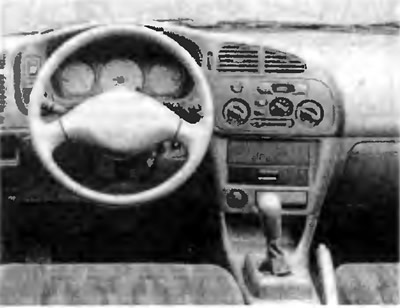
The new neat dashboard with clearly visible instruments is pleasant to look at and to the touch. All finishing materials are of excellent quality and look quite decent even on used models. The steering column (finally, with power steering) is height-adjustable. The driver's seat allows even a tall driver to sit comfortably. The view is excellent, all the necessary adjustments are at hand (electric windows, side mirrors and intermittent wiper mode). In the three-door hatchback, the rear seat remains just as cramped, and access to it is inconvenient. And only with the rear seat folded down does the trunk increase to 1070 liters. The rear seat of the Lancer is also not very spacious, but such are the standards accepted in this size class (segment C). But the Libero station wagon is more practical, especially in the all-wheel drive version.
Unfortunately, the suspension stiffness has increased, and under load and on a bad road, the Lancer can "wag its tail". Models with a 12-valve 75-horsepower 1.3-liter and 16-valve 1.6- and 1.8-liter engines were sent to the European market. The engine with a 12-valve head is still weak at low revs and provides "pickup" only after 3000 min '. The most popular was the 1.6-liter 113-horsepower 4G92, which is also considered the most reliable (rare breakdowns only due to the fault of the owner). The mechanical 5-speed gearbox has small strokes and a clear fixation. The choice of Japanese options is wide: from the same 75-horsepower to exotic 2.0-liter 260-horsepower turbo engines for such a compact car, which are also aggregated with an all-wheel drive transmission (Lancer GSR Evolution). It is better not to buy such models, especially used ones, since in case of breakdown they simply will not be repaired. But diesels and turbodiesels (68 and 88 hp) are much more practical.
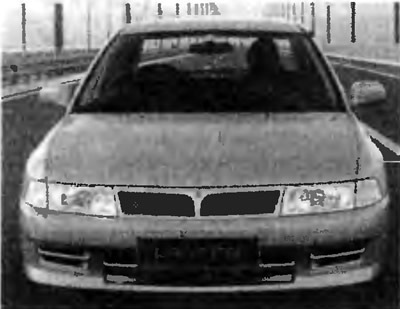
The sixth generation of the Colt/Lancer/Mirage (CJO) appeared in the fall of 1995. The Libero station wagon remained the same. All the main body types remained unchanged, only the styling changed once again. Otherwise, it is still the same familiar Colt/Lancer. Silent, convenient, comfortable.
The range of engines has changed slightly. On the all-wheel drive sports version of the Lancer Evolution V, the power of the 2.0-liter "turbocharged" engine has already risen to 280 hp (perhaps, no one except professional rally drivers can handle such a car). In 1997, a new generation INVECSII automatic transmission with electronic control of the gearbox appeared, allowing you to adjust to a specific driving style and change gears either smoothly in "economical" mode, or quickly in the "sport" style. Other design features are inherited from the previous fifth (OAO-type) Colt / Lancer / Mirage.
In 1999, a cosmetic restyling of the model produced for Europe was carried out: the front air intake and brand emblem were enlarged, the bumpers and dashboard were changed. In some markets, all-wheel drive modifications with a viscous coupling as an interaxle differential are sold. In addition to hatchbacks, the Mirage Cpupe modification is produced in the USA. Colt demonstrates excellent controllability, thanks to a fully independent suspension (McPherson in front, longitudinal and transverse levers in the rear). Versions for the CIS are adapted to local conditions: the suspension is "stiffer". Different engines are provided for different markets: in Europe, they offer a 1.3-liter, with a capacity of 82 hp and a new 1.6-liter, with a capacity of 116 hp, American coupes are equipped with a 1.5-liter (92 hp) or 1.8-liter of the previous generation (111 hp).
In 2000, in Japan, and since 2001 in the USA and Europe, the new sixth-generation Lancer sedans debuted. In the domestic market, the model is called Cedia. Formally, the car belongs to the C class, however, thanks to a wheelbase increased by 100 mm and a body extended by 190 mm, the Lancer is very close in size to the middle class D. The multi-link suspension at the rear has significantly improved the ride smoothness. Externally, the Lancer is more strict and conservative than the previous generation model, thanks to the high radiator grille and large trapezoidal headlights. The interior of expensive versions is finished with aluminum-like plastic. All-wheel drive modifications are equipped with a central viscous coupling with partial locking.
In early 2001, sales of the Wagon station wagon began, which is distinguished by elegant brake lights extended along the rear pillars. The new Lancer is equipped with a 1.5 L 101 hp or 1.8 L 130 hp engine, aggregated with a choice of a 5-speed manual or CVT. In the States, the sedan is equipped only with a 2.0 L engine - 120 hp and, upon request, an automatic sequential transmission. The top of the Lancer model range is the civilian version of the combat Evo VII, participating in the World Rally Championship, with an aerodynamic body and a large rear wing. The two-liter engine with an intermediate air cooler and a Garrett turbocharger develops 280 hp. In some countries of Southeast Asia, the production of the previous generation Lancer model with 1.6 L - 113 hp and 1.8 L - 122 hp engines continues. In Japan, Australia and Oceania, the Lancer Wagon station wagon of 1992 with a 1.8-liter engine is sold. For the domestic market, they produce a cargo-passenger two-seater station wagon-van Libero based on the fourth generation Lancer with a luggage compartment with a useful volume of 2440 liters. The engine on the Libero is 1.5-liter, with a capacity of 91 hp or a 1.9-liter turbodiesel with 88 hp, a manual 5-speed gearbox.
 |  |