



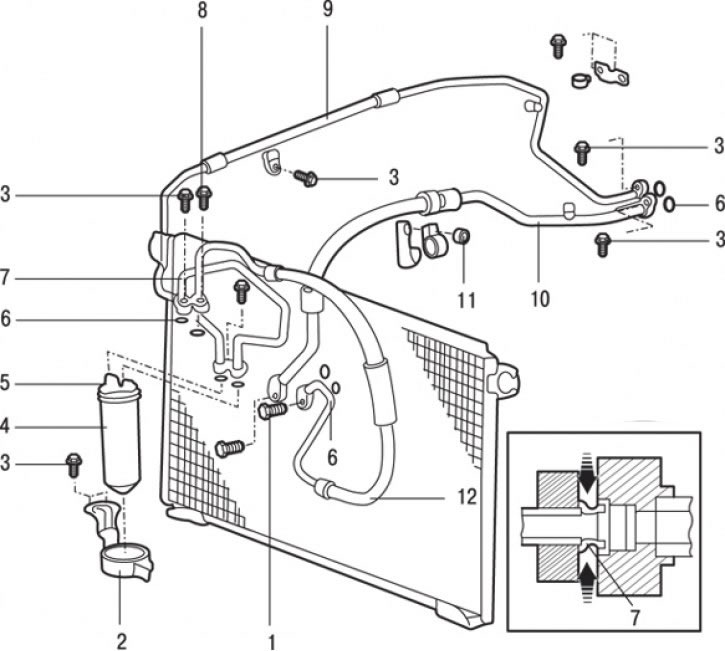
Fig. 18.2. Air conditioning system pipelines: 1 – flange bolt (25 Nm) or bolt with washer (30 Nm); 2 – receiver bracket; 3 – flange bolt (10 Nm) or bolt with washer (6 Nm); 4 – receiver assembly; 5 – dual pressure sensor; 6 – O-ring sealing gasket; 7 – high pressure pipe A; 8 – flange bolt (25 Nm) or bolt with washer (15 Nm); 9 – high pressure pipe B; 10 – low pressure hose; 11 – flange nut (10 Nm) or nut with washer (6 Nm); 12 – high pressure hose
The location of the air conditioning system pipelines is shown in Fig. 18.2.
Kinked hoses or sharp bends in the air conditioning system tubes significantly reduce the efficiency of the system. When the air conditioner is operating, high pressures are created in the system, so special attention should be paid to the reliable tightening of all connections. When the air conditioning system is depressurized (during replacement of parts and units), foreign substances and moisture can get into it.
The following precautions must be observed when servicing and repairing the air conditioning system.
1. Before disconnecting any connection of the air conditioning system (or replacing its parts), it is necessary to completely evacuate the refrigerant from the system. Loosen the connections of the air conditioning system carefully, even after evacuating the refrigerant from the system. If signs of increased pressure appear when loosening any fitting, wait and very slowly release the pressure.
The text of the article was taken from the website: MITSUBISHIMAN
2. Never attempt to bend already bent tubes again during assembly. When laying flexible hoses, follow the rule - the bending radius of the hose must be at least 10 hose diameters.
3. Sharper bends in the hoses reduce the volumetric flow of refrigerant. Flexible hoses should not be located closer than 80 mm from the outlet manifold. It is necessary to check the condition of flexible hoses and their correct placement at least once a year. All O-rings of standard air conditioning system connections are not reusable.