
English Русский
Български
Беларускі
Український
Српски
Hrvatski
Română
Polski
Slovenský
Magyar
Articles Bookmark Contacts Sitemap   
Company Audi Company Ford Company Hyundai Company Kia Company Mazda Company Mercedes-Benz Company Nissan
MitsubishiMan.ru


Home Colt Lancer Galant L200 Outlander Pajero Others
Colt 5 (1995-2003, petrol) Colt 4 and 5 (1991-2003) Colt 2 and 3 (1983-1993)

Battery — Checking the condition and precautions (Mitsubishi Colt 2)

  • Home
  • Colt
  • 2 (1983-1993)
  • General information
  • Daily care
  • Battery — Checking the condition and precautions
0
Contents: Precautions when handling the battery ⤓ First aid measures ⤓ Safety rules when working with…⤓ Precautions when charging the battery ⤓

Precautions when handling the battery


The battery produces flammable and explosive gas.
  • Avoid sparking when battery terminals come into contact with tools.
  • Avoid open flames; do not smoke near the battery.
  • Do not charge the battery indoors. The garage or suitable room must be well ventilated when charging the battery.

The battery contains poisonous and corrosive sulfuric acid.
  • Be careful not to let battery acid come into contact with your eyes, skin or clothing.
  • Wear safety glasses when working near the battery.
  • Keep children away from the battery.

First aid measures


  • If acid gets into your eyes, rinse your eyes with clean water for at least 15 minutes and seek medical attention immediately. If possible, continue to irrigate your eyes with a damp sponge or cloth on the way to the doctor.
  • If acid gets on your skin, rinse the area thoroughly with water. If you still feel a burning sensation, we recommend that you consult a doctor.
  • If acid gets on your clothes, there is a risk that the acid will penetrate your body. Remove these clothes immediately. If the acid has already seeped onto your skin, proceed as described in the previous case.
  • If acid gets into the stomach, you need to drink a large amount of water or milk. Then take magnesium with milk, a raw egg or salad oil. Then immediately consult a doctor.

Safety rules when working with batteries


  • No maintenance work or battery charging is permitted while the engine is running. Make sure all power consumers are switched off.
  • As for the grounded cable, disconnect its clamps first and connect them last.
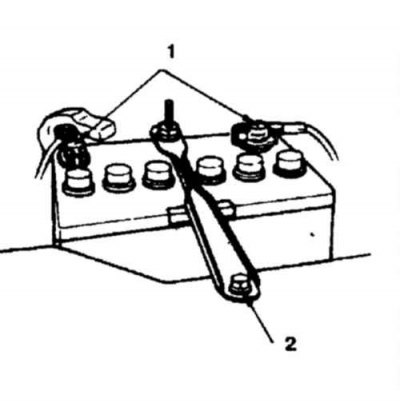


1. Battery clamps
2. Mounting bracket


1. Check: does the battery have rusty or loose butt joints, cracks and loose fastening brackets.
  • a. If the battery has rust deposits, wipe them with warm water with dissolved soda. Make sure that the solution does not penetrate the battery. Lubricate the battery terminals to prevent further corrosion.
  • b. If there are any loose fasteners, tighten them without using too much force.

Caution: Make sure that the tools do not cause short circuits.

  • c. Tighten the retaining clip only enough to hold the battery securely. Tightening it too tightly may damage the battery case.
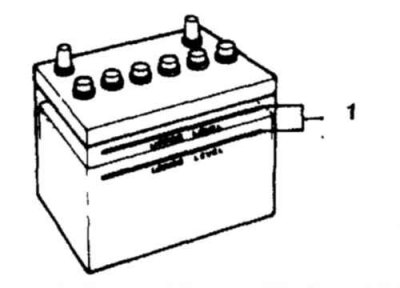


2. The acid level should be between the upper and lower filling limits.

3. Check the acid level as shown in the figure above. If the acid level is low, add distilled water.
  • a. When checking the acid level, you should look into each of the 6 cells, not just one or two.
  • b. Use only distilled water to fill the battery. Do not fill too high - acid may splash out when the battery is strongly charged and cause rust or other damage.
  • c. After filling, make sure the caps are tightly screwed on.

Precautions when charging the battery


The battery releases gas during charging.


Before charging, please pay attention to the following:

1. Remove the battery from the vehicle and, if the intermediate charge is 6A or more but maximum 15A, remove the plugs or vent cap. For normal charging less than 5A, there is no need to remove the plugs or vent cap.

2. Make sure that the charger plug is pulled out when connecting the charging cable to the battery or disconnecting the cable from the battery.

3. If charging is carried out while the battery is in the car, be sure to disconnect the ground cable clamp before charging.
This article is available at: russian, bulgarian, belarusian, ukrainian, serbian, croatian, romanian, polish, slovak, hungarian
This article was reviewed by: Arseny Pavlov
Share with friends:
◀ Previous
Colt 2 and 3: Daily care
Next ▶

If the engine is too hot — diesel engine
If the engine becomes too hot — carburetor engine
If the engine won't start — a simple check
Lubricants and fluids for engines
Car care — general information
Washing the interior of your car
Washing the car outside
Treatment of car body with protective compounds
Windscreen wiper blades and arms
Similar materials for other Mitsubishi models

➤ Checking the battery Mitsubishi Lancer 3 and 5 (1984-1992)
➤ Checking the condition and replacing battery wires Mitsubishi Galant 6 and 7 (1987-1998)
➤ Checking the level and density of battery electrolyte Mitsubishi L200 4 (2005-2014, diesel)
➤ Checking the condition of the battery and its terminals Mitsubishi Outlander 1 (2003-2008)
➤ Checking the condition of the camshaft Mitsubishi Pajero 1 and 2 (1982-1999)
➤ Turbocharger — Description, Precautions, Removal, Checking,… Mitsubishi Space Star (1998-2005)
Link in different formats to this article
Comments and feedback from visitors
No comments yet


Add up two numbers 38 + 23


Colt 5 (1995-2003, petrol) 
  • General information
  • User manual
  • Specifications
  • Gasoline engines
  • 4G1 engines until 1995
  • 4G1 engines since 1995
  • Repair of 4G9 engines
  • Cooling system
  • Reduced exhaust gas toxicity
  • Engine electrical equipment
  • Injection system MPI
  • Carburetors
  • Transmission
  • Clutch and drive shafts
  • Manual gearbox F4M21/F5M21
  • Manual gearbox F4M41
  • Automatic gearbox F4A21
  • Automatic gearbox F4A41
  • Chassis and running gear
  • Car suspension
  • Steering
  • Brake system
  • Body
  • Exterior (external elements)
  • Electrical equipment
  • Equipment and devices
  • Electrical circuits
Colt 4 and 5 (1991-2003) 
  • General information
  • Maintenance
  • Power unit
  • Engine in a car
  • Engine repair (gasoline)
  • Engine repair (diesel)
  • Lubrication system
  • Cooling system
  • Carburetor
  • Fuel injection MPI
  • Fuel injection GDI
  • Emission reduction
  • Fuel system (diesel)
  • Ignition system
  • Exhaust system
  • Transmission
  • Clutch
  • Manual gearbox
  • Automatic gearbox
  • Drive shafts
  • Chassis and running gear
  • Chassis malfunctions
  • Front suspension
  • Rear suspension
  • Steering
  • Wheels and tires
  • Brake system
  • Body and interior
  • Body elements
  • Electrical equipment
  • Equipment and devices
  • Power devices
  • Heating and air conditioning
  • Electrical circuits
Colt 2 and 3 (1983-1993) 
  • General information
  • User manual
  • Daily care
  • Maintenance
  • Power unit
  • Engine in a car
  • Engine overhaul
  • Cooling system
  • Heater and air conditioner
  • Power and exhaust system
  • Engine electrical equipment
  • Emission reduction
  • Transmission
  • Mechanical gearbox
  • Automatic gearbox
  • Clutch and axles
  • Chassis and running gear
  • Brake system
  • Car suspension
  • Steering
  • Body and interior
  • Body and elements repair
  • Electrical equipment
  • Equipment and devices
  • Electrical circuits
MitsubishiMan.ru © 2018–2026 • Mobile version • Articles about Mitsubishi • Contacts • Sitemap: EN BG BY UA RS HR RO PL SK HU • Site search • Bookmark
Colt 2 and 3 (1983-1993) · Colt 4 and 5 (1991-2003) · Colt 5 (1995-2003) · Lancer 3 and 5 (1984-1992) · Lancer 9 (2000-2007) · Galant 5 (1983-1989) · Galant 6 and 7 (1987-1998) · L200 4 (2005-2014) · Outlander 1 (2003-2008) · Pajero 1 and 2 (1982-1999) · Pajero 4 (2006-2021) · Carisma (1995-2004) · Space Star (1998-2005) ·
This resource sets cookies 🍪 to avoid bothering you with repeated data entry.