



Contents: Cars without catalyst ⤓ Cars with a catalytic converter ⤓ Only for vehicles without catalytic…⤓ Push start ⤓ Starting with an external battery ⤓ Bleeding the Fuel System - Diesel…⤓
If the motor shaft does not rotate or rotates slowly
1. If your car has an automatic transmission, make sure that the control lever is in the "N" or "P" position.
2. Check the reliability of the clamps at the battery terminals and their cleanliness.
3. Turn on the interior light. If it does not light, or only lights dimly, or goes out when the starter is engaged, the battery is dead.
Cars without catalyst
You can try to start the engine using an external battery or if the car has a manual transmission, you can start it by pushing it.
Cars with a catalytic converter
The engine can be started using an external battery, but do not tow or push the car. The catalytic converter may overheat and then there is a risk of fire.
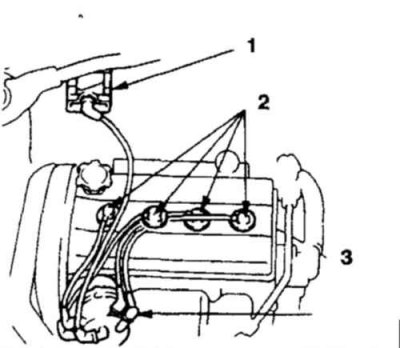
1. Ignition coil
2. Spark plugs
3. Distributor
If the engine shaft rotates at the normal speed, but does not start:
1. Check the fuel level.
2. Check: all butt joints on the ignition coil, distributor and spark plugs must be securely seated.
3. If the engine is warm or there is a smell of unburned fuel, the engine has probably received too much fuel. Read the instructions for starting the engine.
Only for vehicles without catalytic converters
The original can be found on the website [MITSUBISHIMAN.ru]
If the engine still does not start, remove the spark plugs and dry them. Crank the engine for about 20 seconds with the starter and screw the spark plugs back in.
4. If the engine still does not start, it must be adjusted or repaired. Contact a Toyota dealership or a specialized workshop.
Push start
If the car has an automatic transmission, its engine cannot be started by pushing the car. In a car with a catalytic converter, the engine also cannot be started by pushing the car.
1. Make sure that the push bar of the push machine is at the same height as the bar of your car, as this is necessary for a powerful push. If the bars are not at the same height, it may cause one bar to hit the other, which may result in damage or accidents.
2. Set the ignition key to the "ON" position and engage 2nd gear.
3. With the clutch pedal pressed all the way down, wait until the pushing vehicle gradually sets your car in motion - up to a speed of about 15 km/h. Remember that the brake pedal must be pressed significantly harder if the engine is off.
4. At 15 km/h, keep the accelerator pedal approximately half-pressed and slowly release the clutch to allow the engine to start.
5. When the engine starts, signal the driver of the pushing vehicle to stop.
At the same time, press the accelerator pedal and move away from the pushing vehicle to avoid a collision.
Never pull a car to start its engine. When the engine starts, the car may suddenly jump and cause damage to the towing car.
Starting with an external battery
To avoid injury to your body and damage to your vehicle due to battery explosion, chemical burns, electric shock, damage to electrical equipment, you must follow the instructions below as closely as possible.
If you are not confident that you can perform this process, we recommend that you contact a qualified mechanic or service center.
Warning! Batteries contain sulfuric acid, which is poisonous and corrosive. Wear protective glasses when working near the battery. Avoid splashing acid on your skin, clothing, or vehicle.
If you still cannot avoid this, immediately remove the clothing with acid splashes and rinse the affected areas of skin with water for at least 15 minutes. Seek immediate medical attention. If possible, continue applying water with a sponge or cloth on the way to the doctor.
The gas produced by the battery is explosive. Therefore, do not smoke if your car engine is started with an auxiliary battery. The auxiliary battery must have a voltage of 12 volts. Check the voltage of the auxiliary battery before connecting it to your car.
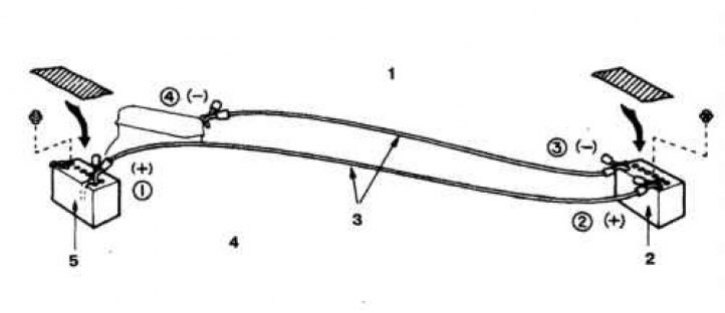
1. Unscrew all plugs and place rags over the open holes - not required for batteries with longer service intervals
2. Auxiliary battery
3. Connecting cables
4. Cables should be connected in the specified numerical sequence; after charging is complete, disconnect the cables in reverse order
5. Discharged battery
1. If the auxiliary battery is installed in another vehicle, please note: both vehicles must not touch each other. Disconnect unnecessary power consumers in both vehicles.
2. Unscrew all the plugs of both batteries. Place rags on the open holes - thanks to the atom, the risk of explosion is reduced.
3. If the engine of the vehicle from which starting assistance is provided is switched off, turn it on and let it run for a few minutes. During the process of auxiliary starting, the engine should run at a speed of about 2000 rpm.
4. Connect the cables in the correct order, as shown in the figure. Plus to plus (+). Minus - to the engine or "to ground" (-)
Please note that the cable is first connected to the positive pole of the discharged battery, and then to the auxiliary battery. Then the negative cable from the negative pole of the auxiliary battery is connected to a stationary, purely metal part, for example, to the engine repair bolt, which is somewhat removed from the battery. Do not connect to parts or near those parts that move when the engine is running. When making connections, pay attention that the connecting cables and terminals do not even accidentally come into contact with anything other than the corresponding battery pole and the "ground", for example, the engine repair bolt. When making connections, do not lean on the battery.
5. Start the engine in the usual way. After the engine has started, let it run at fast idle (2000 rpm) for 2 minutes.
6. Disconnect the connecting cables carefully and in exactly the reverse order: first the minus cable, then the plus cable.
7. Be careful when removing rags that have been placed on the batteries - they may have absorbed sulfuric acid.
8. Tighten all caps securely. If the reason for your battery discharge is unclear, such as forgotten lights, you need to find out the reason and fix it.
Bleeding the Fuel System - Diesel Engine
If the fuel tank has been completely emptied and the engine has stopped, the engine may not start after refueling. Then the hand pump must be turned on until an ever increasing resistance is reached.