



Fuel pump - check
Carburetor models
1. If you suspect insufficient fuel supply, first check all fuel lines to ensure that the problem is not due to a leak.
2. If the fuel lines are tight, check the fuel pump. The following tests will help you determine if the fuel pump is working properly.
3. Before performing any checks, disconnect the negative battery cable and, if necessary, remove the air filter (see section 8).
Checking the vent
4. Locate the fuel pump located on the side of the cylinder head. Look for fuel or oil leaks from the vent (see illustration). If there are leaks, the fuel pump seal or diaphragm is faulty. If leaks are found, replace the fuel pump (see section 8).
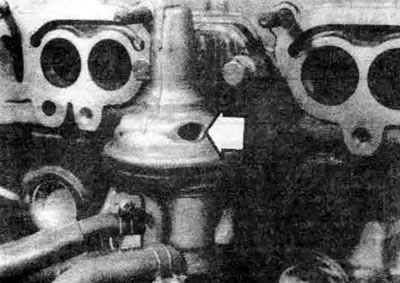
3.4 Check the fuel pump vent hole (arrow) - if fuel or oil is leaking from it, replace the pump (intake manifold removed for clarity)
Checking the fuel pump supply
5. Connect the remote starter switch according to the manufacturer's instructions. If you do not have a remote starter switch, you will need an assistant to perform the following procedure.
6. Locate the fuel outlet hose that runs from the pump to the carburetor and disconnect it from the carburetor.
7. Disconnect the cable from the negative battery terminal.
8. Disconnect the wires from the primary circuit of the ignition coil (see Chapter 5).
9. Place the canister under the open end of the fuel pump outlet hose.
10. Direct the fuel pump outlet hose into a canister and crank the engine with the starter for about ten seconds using the remote switch (or ask an assistant).
11. If the fuel comes out in well-filled pulses, the pump is working properly. If the fuel flows weakly, the pump is faulty. Replace it.
Checking the suction valve
12. Disconnect the inlet hose from the fuel pump.
13. Connect the vacuum gauge to the inlet fitting.
14. Turn the engine crankshaft with the starter using the remote switch (or ask an assistant).
15. There should be a fairly constant vacuum, not interrupted by alternating reverse pulses (sudden pressure pulses).
16. If reverse pulses are observed, the inlet valve is not tightly lapped. Replace the pump.
17. Replace the ignition coil primary wires and connect the wire to the negative battery terminal
Models with MPI
18. Release the pressure from the fuel system (see section 2).
19. Disconnect the high pressure line from the fuel supply line.
20. Using a special adapter (MD 998742 or similar), connect the fuel pressure gauge to the fuel supply line (see illustration).
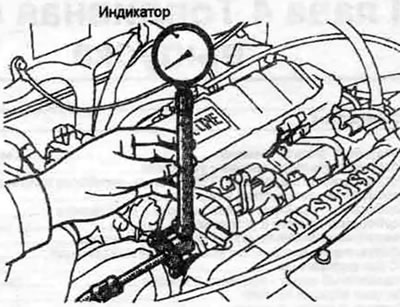
3.20. On MPI systems, you must use a special adapter (MD 998742 or similar) together with the pressure gauge to connect to the fuel supply line.
21. With the wiring connected to the fuel pump, have an assistant turn on the starter and check for leaks.
[Original version of the article on the website www.mitsubishiman.ru]
Warning: If leaks are detected, immediately have an assistant turn off the engine and repair the leak.
22. Turn on the engine and set it to idle mode.
23. At idle speed, check the fuel pressure on the gauge and compare with the specification given at the beginning of this Chapter.
24. Disconnect the vacuum hose from the pressure regulator and plug it.
25. Record the pressure gauge readings at idle speed.
26. Turn the engine crankshaft two or three times.
27. With the engine idling, record the pressure gauge readings.
28. Gently squeeze the return hose to the pressure regulator to feel the pressure. Crank the engine several times to make sure there is pressure left in the return hose.
29. If the pressure was low in both tests, the fuel filter is clogged, the supply line is blocked, or the fuel pump has failed.
30. If the pressure was high when the regulator was connected, then the regulator is faulty or there is no vacuum entering it.
31. If the pressure was low when the regulator was connected, but was normal when the regulator was disconnected, then the regulator is faulty.
Models with TBI
32. Release pressure from the fuel system.
33. Using a special adapter (MD 998742 or similar), connect the fuel pressure gauge to the fuel supply line to the throttle body (see illustration).
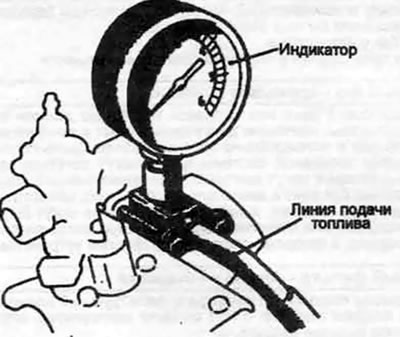
3.33. For TBI systems, the same special adapter is used to connect to the fuel supply line as for MPI systems (MD 998742 or similar).
34. With the wiring connected to the fuel pump, have an assistant turn on the starter and check for leaks.
Warning: If leaks are detected, immediately have an assistant turn off the engine and repair the leak.
35. With the engine idling, compare the pressure gauge readings with specification, given at the beginning of this Chapter.
36. If the pressure is low, check the fuel filter for patency, the regulator for patency, the fuel supply line for patency, and the pump for patency.
37. Other diagnostics should be performed by a specialist.