



Contents: 1.5L engines ⤓ Engines 1.8 l ⤓ Engines 1.6 l and 2.0 l ⤓ 2.4L engines ⤓ Engines 3.0 l ⤓ 3.5L engines ⤓
1.5L engines
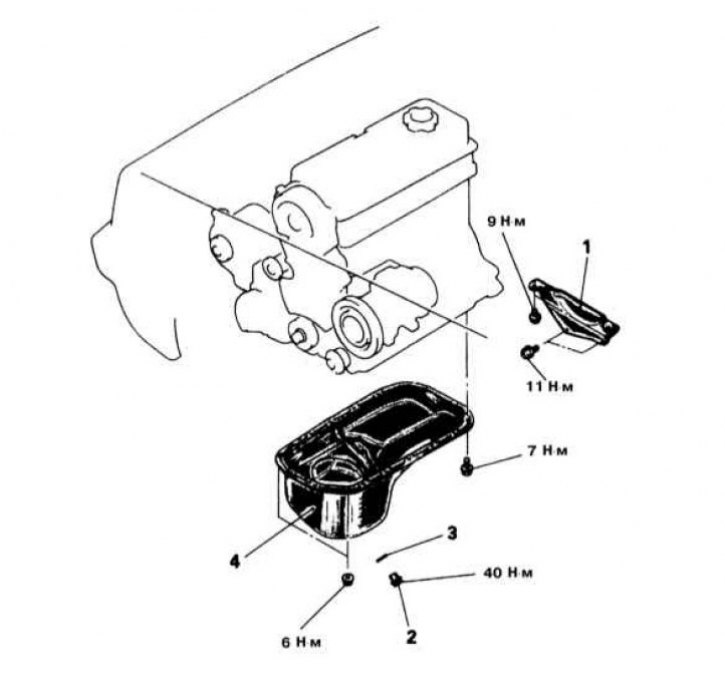
Oil pan installation details for Mirage 1.5L models (4G15 engine)
1 - Transmission dome cover; 2 - Drain plug; 3 - Sealing washer; 4 - Oil pan
Removal
1. The details of the installation of the oil pan on 1.5 l engines are shown in the illustration.
2. Disconnect the negative cable from the battery.
If your car stereo system is equipped with a security code, make sure you have the correct combination to activate the audio system before disconnecting the battery!
3. Jack up the car and place it on supports. Remove the plug and drain the engine oil.
4. Remove the lower transmission dome cover.
5. Unscrew the mounting bolts, tap the pan around the perimeter with a soft-faced hammer to break up the sealant layer, then separate it from the engine block.
Never try to pry the tray under the mating surface with a lever! If necessary, use a special device such as MD998727 to break the sealant layer.
Installation
1. Thoroughly clean the mating surfaces of the sump and cylinder block, completely removing traces of old sealant. Finally, wipe the surfaces with a rag soaked in acetone.
2. Apply sealant to the mating surface of the pan - the sealant should be applied in a continuous bead and on the inside of the bolt holes
3. No later than 15 minutes after applying the sealant, press the tray to the block. Screw in the mounting bolts and tighten them to the required torque (7 Nm).
4. Install the transmission dome cover.
5. If necessary, replace the sealing washer, screw in the drain plug of the pan and tighten it to the required torque (40 Nm).
6. Lower the vehicle to the ground and fill the engine with the required amount of fresh engine oil of the appropriate grade (see Chapter Settings and ongoing maintenance).
7. Connect the negative cable to the battery. Start the engine and check it for signs of developing leaks.
Engines 1.8 l
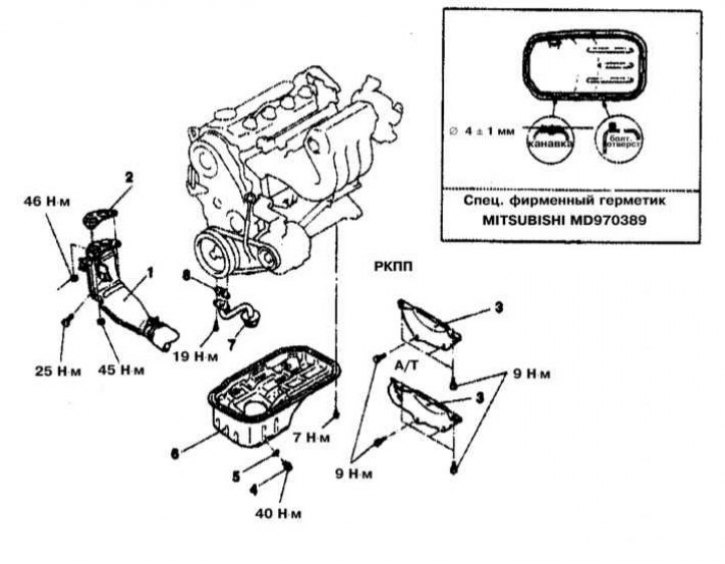
Oil pan installation details for 1.8L models
1 - Exhaust system inlet pipe; 2 - Sealing gasket; 3 - Transmission dome cover; 4 - Drain plug; 5 - Sealing washer; 6 - Oil pan; 7 - Oil intake; 8 - Sealing gasket
Removal
1. The details of the installation of the oil pan on 1.8 l engines are shown in the illustration.
2. Disconnect the negative cable from the battery.
If your car stereo system is equipped with a security code, make sure you have the correct combination to activate the audio system before disconnecting the battery!
3. Jack up the car and place it on supports.
4. Unscrew the plug and drain the engine oil.
5. Disconnect the exhaust pipe from the engine exhaust manifold.
6. Remove the lower transmission dome cover.
7. Unscrew the mounting bolts, tap the pan around the perimeter with a soft-faced hammer to break up the sealant layer, then separate it from the engine block.
Never try to pry the tray under the mating surface with a lever! If necessary, use a special device such as MD998727 to break the sealant layer.
Installation
1. Thoroughly clean the mating surfaces of the sump and cylinder block, completely removing traces of old sealant. Finally, wipe the surfaces with a rag soaked in acetone.
2. Apply sealant to the mating surface of the pan. The sealant should be applied in a continuous bead and on the inside of the bolt holes.
3. No later than 15 minutes after applying the sealant, press the tray to the block. Screw in the mounting bolts and tighten them to the required torque (7 Nm).
4. Install the transmission dome cover.
5. After replacing the gasket, connect the exhaust manifold to the exhaust pipe, - tighten the fastening nuts of the connecting flange to the required force (45 Nm). Do not forget to screw in the fastening bolt, - the required tightening force is 25 Nm.
6. If necessary, replace the sealing washer, screw in the drain plug of the pan and tighten it to the required torque (40 Nm).
7. Lower the vehicle to the ground and fill the engine with the required amount of fresh engine oil of the appropriate grade (see Chapter Settings and ongoing maintenance).
8. Connect the negative cable to the battery. Start the engine and check it for signs of developing leaks.
Engines 1.6 l and 2.0 l
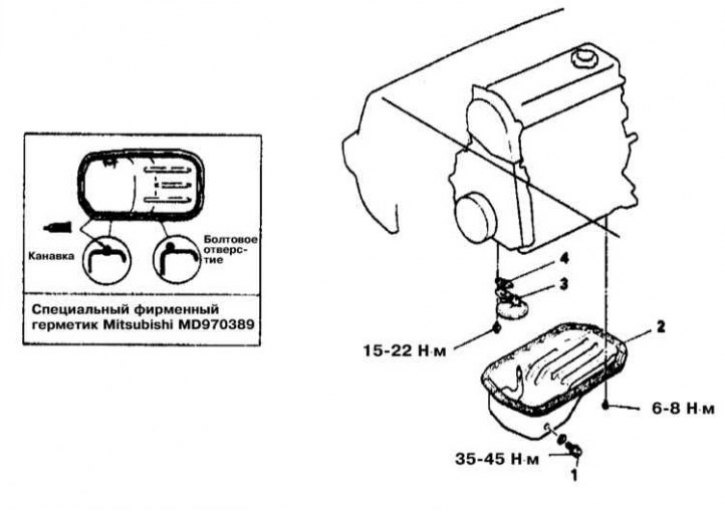
Oil Pan Installation Details for 2.0L SOHC Models
1 - Drain plug; 2 - Oil pan; 3 - Oil intake with mesh filter; 4 - Sealing gasket
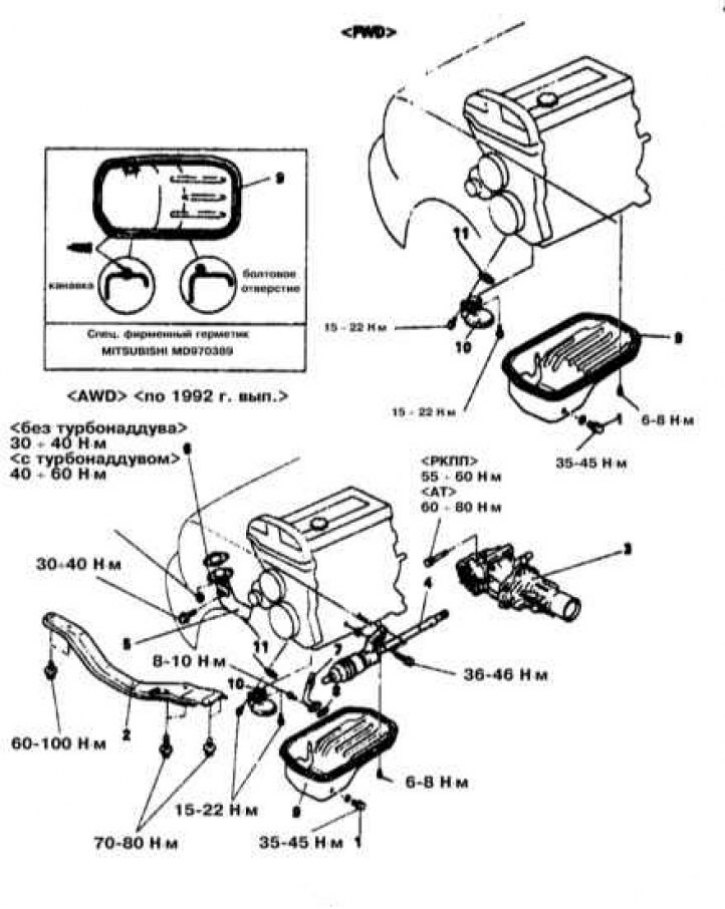
Oil pan installation details for front and all wheel drive models 1.6L and 2.0L DOHC
1 - Drain plug; 2 - Left beam; 3 - Transfer case; 4 - Drive shaft; 5 - Exhaust system inlet pipe; 6 - Sealing gasket; 7 - Turbocharger oil return pipe; 8 - Sealing gasket; 9 - Oil pan; 10 - Oil intake with mesh filter; 11 - Sealing gasket
Front-wheel drive (FWD) models
Removal
1. Oil pan installation details on FWD models equipped with 1.6L and 2.0L engines are shown in the illustrations.
2. Disconnect the negative cable from the battery.
If your car stereo system is equipped with a security code, make sure you have the correct combination to activate the audio system before disconnecting the battery!
3. Jack up the car and place it on supports.
4. Unscrew the plug and drain the engine oil.
5. Disconnect the exhaust pipe from the engine exhaust manifold.
6. Support the engine with a trolley jack, then unscrew the mounting bolts and remove the center beam.
7. Unscrew the mounting bolts, tap the pan around the perimeter with a soft-faced hammer to break up the sealant layer, then separate it from the engine block.
Never try to pry the tray under the mating surface with a lever! If necessary, use a special device such as MD998727 to break the sealant layer.
Installation
1. After wiping the pan, check it for cracks and other mechanical damage. Assess the condition of the oil intake. Replace defective components.
2. Carefully clean the mating surfaces of the sump and cylinder block, completely removing traces of old sealant from them. Finally, wipe the surfaces with a rag soaked in acetone.
3. Apply sealant to the mating surface of the tray. The sealant should be applied in a continuous bead (with a cross-section diameter of about 4 mm) and on the inside of the bolt holes.
4. No later than 15 minutes after applying the sealant, press the tray to the block. Screw in the mounting bolts and tighten them to the required torque (6÷8 N·m).
5. Install the beam. Screw in the mounting bolts and tighten them to 100 Nm.
6. Install the transmission dome cover.
7. After replacing the gasket, connect the exhaust manifold to the exhaust pipe, - tighten the fastening nuts of the connecting flange to the required torque (40 Nm).
8. If necessary, replace the sealing washer, screw in the drain plug of the pan and tighten it to the required torque (45 N·m).
9. Lower the vehicle to the ground and fill the engine with the required amount of fresh engine oil of the appropriate grade (see Chapter Settings and ongoing maintenance).
10. Connect the negative cable to the battery. Start the engine and check it for signs of developing leaks.
All-wheel drive models (AWD)
Removal
1. Oil pan installation details on AWD models equipped with 1.6L and 2.0L engines are shown in the illustration.
2. Disconnect the negative cable from the battery.
If your car stereo system is equipped with a security code, make sure you have the correct combination to activate the audio system before disconnecting the battery!
3. Jack up the car and place it on supports.
4. Unscrew the plug and drain the engine oil.
5. Disconnect the exhaust pipe from the engine exhaust manifold.
6. Remove the transfer case assembly and right [left] drive shaft.
7. Support the engine with a trolley jack, then unscrew the mounting bolts and remove the center beam.
8. Disconnect the turbocharger oil return pipe from the sump wall.
9. Unscrew the mounting bolts, tap the pan around the perimeter with a soft-faced hammer to break up the sealant layer, then separate it from the engine block.
Never try to pry the tray under the mating surface with a lever! If necessary, use a special device such as MD998727 to break the sealant layer.
Installation
1. After wiping the pan, check it for cracks and other mechanical damage. Assess the condition of the oil intake. Replace defective components.
2. Carefully clean the mating surfaces of the sump and cylinder block, completely removing traces of old sealant from them. Finally, wipe the surfaces with a rag soaked in acetone.
3. Apply sealant to the mating surface of the tray. The sealant should be applied in a continuous bead (with a cross-section diameter of about 4 mm) and on the inside of the bolt holes.
4. No later than 15 minutes after applying the sealant, press the tray to the block. Screw in the mounting bolts and tighten them to the required torque (6÷8 N·m).
5. After replacing the sealing gasket, connect the turbocharger oil return pipe to the oil pan. Tighten the fasteners with the required torque (7÷10 N·m).
6. Install the left beam. Screw in the mounting bolts and tighten them to the required torque (100 Nm - front and 80 Nm - rear).
7. Install the transfer case assembly and right [left] drive shaft.
8. After replacing the gasket, connect the exhaust manifold to the exhaust pipe, tighten the fastening nuts of the connecting flange to the required torque (40 Nm).
9. If necessary, replace the sealing washer, screw in the drain plug of the pan and tighten it to the required torque (45 Nm).
10. Lower the vehicle to the ground and fill the engine with the required amount of fresh engine oil of the appropriate grade (see Chapter Settings and ongoing maintenance).
11. Connect the negative cable to the battery. Start the engine and check it for signs of developing leaks.
2.4L engines
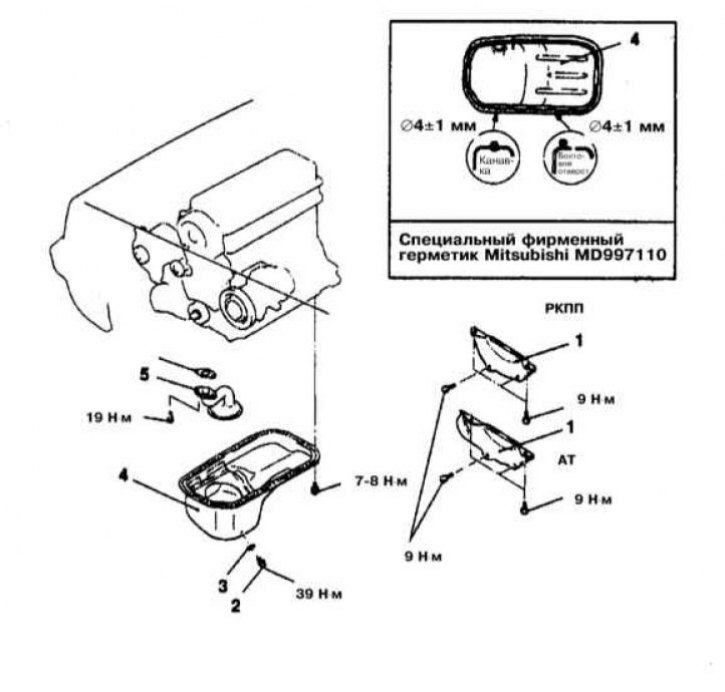
Oil pan installation details for 2.4L models
1 - Transmission dome cover; 2 - Drain plug; 3 - Sealing washer; 4 - Oil pan; 5 - Oil intake with mesh filter
Removal
1. The details of the oil pan installation on 2.4 L engines are shown in the illustration.
2. Disconnect the negative cable from the battery.
If your car stereo system is equipped with a security code, make sure you have the correct combination to activate the audio system before disconnecting the battery!
3. Jack up the car and place it on supports. Remove the plug and drain the engine oil.
4. Remove the engine oil dipstick and its guide tube.
5. Disconnect the electrical wiring from the oxygen sensor (O2).
6. Disconnect the exhaust pipe from the engine exhaust manifold.
7. Remove the lower transmission dome cover.
8. Unscrew the mounting bolts, tap the pan around the perimeter with a soft-faced hammer to break up the sealant layer, then separate it from the engine block.
Never try to pry the tray under the mating surface with a lever! If necessary, use a special device such as MD998727 to break the sealant layer.
Installation
1. Thoroughly clean the mating surfaces of the sump and cylinder block, completely removing traces of old sealant. Finally, wipe the surfaces with a rag soaked in acetone.
2. Apply sealant to the mating surface of the pan. The sealant should be applied in a continuous bead and on the inside of the bolt holes.
3. No later than 15 minutes after applying the sealant, press the tray to the block. Screw in the mounting bolts and tighten them to the required torque (8 Nm).
4. If necessary, replace the sealing washer, screw in the drain plug of the pan and tighten it to the required torque (39 N·m).
5. Install the transmission dome cover. Screw in the mounting bolts and tighten them to the required torque (9 N·m).
6. After replacing the gasket, connect the exhaust manifold to the exhaust pipe, - tighten the fastening nuts of the connecting flange to the required torque (44 N·m).
The catalytic converter mounting bolts are tightened to 49 Nm.
7. Connect the wiring to the O2 sensor.
8. Lower the vehicle to the ground and fill the engine with the required amount of fresh engine oil of the appropriate grade (see Chapter Settings and ongoing maintenance).
9. Connect the negative cable to the battery. Start the engine and check it for signs of developing leaks.
Engines 3.0 l
Removal
1. Disconnect the negative cable from the battery.
If your car stereo system is equipped with a security code, make sure you have the correct combination to activate the audio system before disconnecting the battery!
2. Jack up the car and place it on supports. Remove the plug and drain the engine oil.
3. Remove the left beam. On models equipped with 4WS, the right beam must also be removed.
4. Remove the starter.
5. Disconnect the torque strut bracket from the rear transmission strut bracket. Remove both transmission mount brackets.
6. Remove the lower transmission dome cover.
7. Unscrew the mounting bolts, tap the pan around the perimeter with a soft-faced hammer to break up the sealant layer, then separate it from the engine block.
Never try to pry the tray under the mating surface with a lever! If necessary, use a special device such as MD998727 to break the sealant layer.
Installation
1. Thoroughly clean the mating surfaces of the sump and cylinder block, completely removing traces of old sealant. Finally, wipe the surfaces with a rag soaked in acetone.
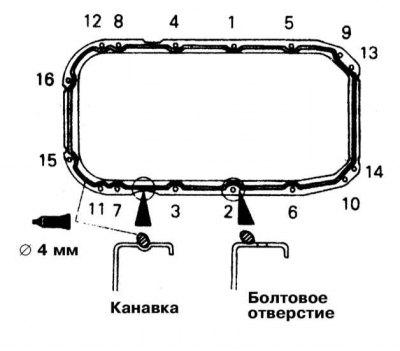
2. Apply sealant to the mating surface of the pan. The sealant should be applied in a continuous bead and on the inside of the bolt holes.
3. No later than 15 minutes after applying the sealant, press the tray to the block. Screw in the fastening bolts and, acting strictly in a specific order, tighten them with the required force (6 N·m).
4. Reinstall the transmission dome lower cover and starter assembly.
5. Install the transmission mount brackets and connect the torque strut mounting bracket.
6. Install the subframe beam(s). Screw in the mounting bolts and tighten them to the required torque (60÷70 Nm).
7. If necessary, replace the sealing washer, screw in the drain plug of the pan and tighten it to the required torque (39 N·m).
8. Lower the vehicle to the ground and fill the engine with the required amount of fresh engine oil of the appropriate grade (see Chapter Settings and ongoing maintenance).
9. Connect the negative cable to the battery. Start the engine and check it for signs of developing leaks.
3.5L engines
Removal
1. Disconnect the negative cable from the battery.
If your car stereo system is equipped with a security code, make sure you have the correct combination to activate the audio system before disconnecting the battery!
2. Jack up the car and place it on supports. Remove the plug and drain the engine oil.
3. Remove the bolts securing the lower section of the oil pan. Using a hammer and a wooden block, remove the lower section of the pan.
4. Remove the starter.
5. Remove the engine oil dipstick and its guide tube.
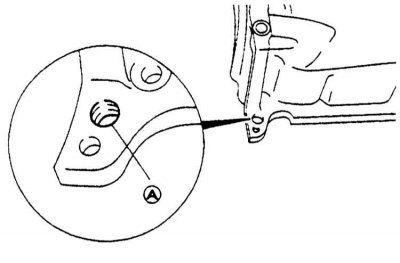
6. Unbolt the top section of the pan. To separate the top section from the engine block, screw the bolt into the specially provided threaded hole in the casting of the element.
Do not under any circumstances attempt to separate the tray by levering it under the mating surface!
7. After removing the upper section, unscrew the service bolt used during dismantling.
Installation
1. Thoroughly clean the mating surfaces of both sections of the sump and the cylinder block, completely removing traces of the old sealant. Finally, wipe the surfaces with a rag soaked in acetone.
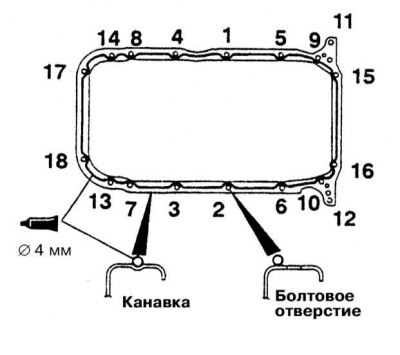
2. Apply sealant to the mating surface of the upper pan section with the block. The sealant should be applied in a continuous bead and on the inside of the bolt holes.
3. No later than 15 minutes after applying the sealant, press the tray to the block. Screw in the fastening bolts and, acting strictly in a specific order, tighten them with the required force (6 N·m).
4. After replacing the sealing ring, install the engine oil dipstick guide tube.
5. Install the starter assembly.
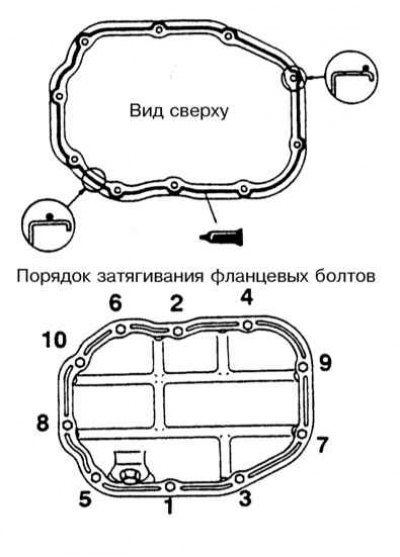
6. Apply sealant to the thoroughly cleaned mating surface of the lower pan section. The sealant should be applied in a continuous bead and on the inside of the bolt holes.
7. No later than 15 minutes after applying the sealant, press the tray to the block. Screw in the fastening bolts and, acting strictly in a certain order, tighten them with the required force (10÷12 N·m).
8. If necessary, replace the sealing washer, screw in the drain plug of the pan and tighten it to the required torque (39 N·m).
9. Lower the vehicle to the ground and fill the engine with the required amount of fresh engine oil of the appropriate grade (see Chapter Settings and ongoing maintenance).
10. Connect the negative cable to the battery. Start the engine and check it for signs of developing leaks.