



CAUTION: Additional trouble codes may be generated during certain testing procedures. Care must be taken as codes generated during testing may mislead the inspector. All codes must be cleared after testing is complete.
Method using an analog voltmeter
Connect an analog voltmeter to terminals A and B on the self-diagnosis plug.
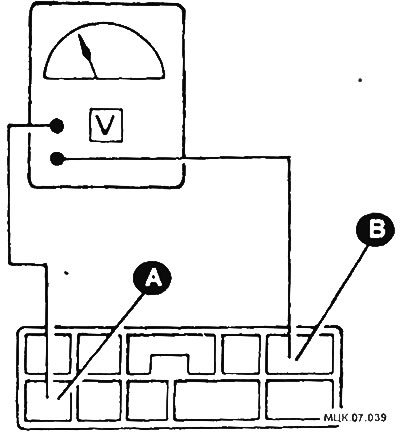
A - ground contact; B - self-diagnosis contact.
Turn on the ignition. If one or more fault codes are stored in the memory of the electronic control module, the voltmeter needle will begin to fluctuate between two voltage values. If there are no fault codes in the memory, the needle will remain motionless.
CAUTION: If the voltmeter does not behave as described, reverse the polarity of the connection to the self-diagnosis system plug.
- the first series of oscillations of the arrow determine the tens, the second series of oscillations of the arrow determine the units;
- the voltmeter needle will deflect over a longer period of time showing tens and over a shorter period of time showing units;
- if there are no fault codes, the arrow will only show periodic on and off pulses (oscillations).
Count the number of oscillations of the pointer in each series and write down the code. To determine the meaning of the fault code, refer to the tables at the end of the chapter.
Original material on the website: mitsubishiman
Continue reading codes until all stored codes have been read and written.
Turn off the ignition and disconnect the voltmeter to finish reading the codes.
LED Probe Method
Connect the LED tester between terminals A and B on the self-diagnosis system connector.
Turn the ignition on. If one or more fault codes are stored in the electronic control module memory, the LED will flash to identify the fault codes.
CAUTION: If the LED does not flash as described, reverse the polarity of the LED connection to the self-diagnosis system plug.
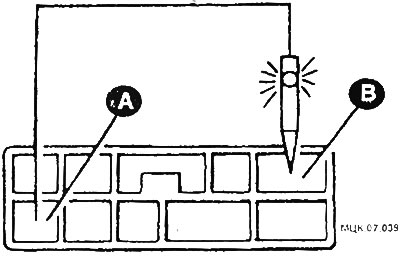
A - ground contact; B - self-diagnosis contact.
- the first series of flashes define tens, the second series of flashes define units;
- tens are defined by 1.5 second flashes separated by short pauses of 0.5 seconds;
- A 2-second pause separates each series of flashes that define tens and units;
- units are defined by 0.5 second flashes separated by short pauses of 0.5 seconds;
- four long and one short flash, for example, correspond to code 41;
- if there are no error codes, the LED turns on and off 8 times with pauses of 0.5 seconds.
Count the number of flashes in each series and write down the code. To determine the meaning of the fault code, refer to the tables at the end of the chapter.
Continue reading codes until all codes stored in memory have been read and written.
Turn off the ignition and disconnect the LED tester to finish reading the codes.