



Contents: Self-diagnosis function ⤓ Limited operation mode ⤓ Possibility of adaptation or…⤓ Self-diagnosis indicator lamp ⤓
Mitsubishi vehicles are equipped with Mitsubishi ECl-Multi engine management systems (EMS) which control the primary ignition circuit, fuel system and engine idle operation from a single control unit.
Self-diagnosis function
The electronic control unit has a self-diagnostic capability, in which the electronic control module constantly checks signals from certain sensors and actuators (drives) of the engine and compares each signal with pre-programmed values. If the diagnostic software determines that a fault is present, the electronic control module stores one or more fault codes. Codes will not be stored for those parts for which there are no codes or under conditions that are not provided for by the diagnostic software. Self-diagnostic systems issue 2-digit fault codes for reading manually or using an appropriate fault code reader.
Limited operation mode
The self-diagnostic systems discussed in this chapter include a reduced operation mode function (often called limp home mode). When a specific fault is identified (not all faults trigger the reduced operation mode), the ECM initiates the limp home mode and refers to the programmed values of individual quantities rather than to the signal from the sensor. This allows the vehicle to be driven safely to a diagnostic/repair location. When the fault is corrected, the ECM returns to normal operation.
Possibility of adaptation or "training"
These vehicles' systems also use an adaptive function that modifies basic programmed values for the most efficient operation under normal conditions and to compensate for engine component wear.
Self-diagnosis indicator lamp
Some models have a self-diagnosis indicator lamp located on the instrument panel (arrow).
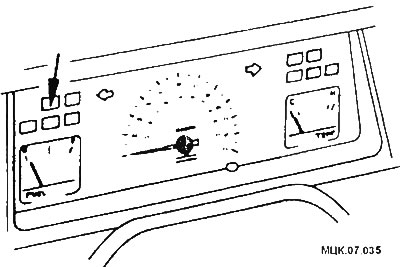
Typical location of the indicator lamp