
English Русский
Български
Беларускі
Український
Српски
Hrvatski
Română
Polski
Slovenský
Magyar
Articles Bookmark Contacts Sitemap   
Company Audi Company Ford Company Hyundai Company Kia Company Mazda Company Mercedes-Benz Company Nissan
MitsubishiMan.ru


Home Colt Lancer Galant L200 Outlander Pajero Others
Pajero 4 (2006-2021) Pajero 1 and 2 (1982-1999)

Design and description of the cooling system (Mitsubishi Pajero 1)

  • Home
  • Pajero
  • 1 (1982-1999)
  • Power unit
  • Cooling and lubrication system
  • Design and description of the cooling system
0

Engine cooling system parts
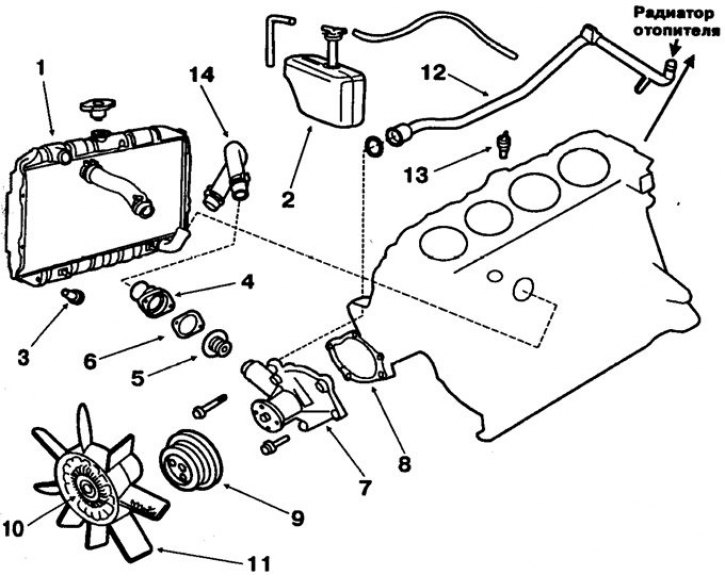


1. Radiator; 2. Expansion tank; 3. Drain plug; 4. Thermostat housing; 5. Thermostat; 6. Thermostat gasket; 7. Water pump; 8. Water pump gasket; 9. Pulley; 10. Viscous fan clutch; 11. Fan; 12. Heater outlet pipe; 13. Coolant temperature sensor; 14. Radiator drain hose


The car uses a closed-type liquid cooling system with forced circulation of liquid using a centrifugal pump (see figure Engine cooling system parts). It includes a radiator, water pump, thermostat, atmospheric expansion tank and a viscous fan. The 4D56T engines use an electric fan with a plastic impeller mounted on the electric motor shaft, which is switched on and off using the electric fan switch.

The tubular-fin radiator operates under high pressure.

Opening pressure of the filler cap valves, kgf/cm²:
  • exhaust valve: 0.75–1.05 (greater than or equal to 0.65)*;
  • intake valve: less than or equal to 0.05.

Note: Since May 1991, a one-piece fan guide casing has been installed, which has increased the cooling capacity of the radiator.


The thermostat housing is attached directly to the water pump housing.

Opening temperature of the main thermostat valve: 76.5°C.


Attention! On 4D56T engines, the main thermostat valve begins to open at a temperature of 82°C and opens completely at a temperature of 95°C.


The vane type centrifugal water pump is driven by a V-belt together with the generator. The fan is mounted on the water pump axle via a viscous coupling.

Please note! On 4D56 engines produced since May 1991, the water pump performance has been increased due to a change in the pump design on the suction side.


Water pump drive belt Mitsubishi MD159551.

The normal deflection of the belt when pressing with a force of 10.0 kgf on the middle of the branch between the generator pulley and the water pump pulley should be within 10–13 mm.
This article is available at: russian, bulgarian, belarusian, ukrainian, serbian, croatian, romanian, polish, slovak, hungarian
This article was reviewed by: Arseny Pavlov
Share with friends:
◀ Previous
Pajero 1 and 2: Cooling and lubrication system
Next ▶

Coolant pump — removal and installation
Radiator Fan — Removal and Installation
Oil cooler — removal and installation
Radiator — removal and installation
Cooling system thermostat — removal, inspection and installation
Checking the electric fan switch sensor
Replacing the coolant
Water Pump — Removal, Checking and Installation
Oil pump — design, removal and assembly
Checking the oil pump thermostat
Similar materials for other Mitsubishi models

➤ Cooling system pump — design description Mitsubishi Colt 5 (1995-2003, petrol)
➤ Checking the tightness of the cooling system Mitsubishi Lancer 3 and 5 (1984-1992)
➤ Removal and installation the cooling system radiator Mitsubishi Galant 6 and 7 (1987-1998)
➤ Fuel supply system — design description Mitsubishi L200 4 (2005-2014, diesel)
➤ Checking for leaks in the cooling system Mitsubishi Outlander 1 (2003-2008)
➤ Checking the tightness of the cooling system Mitsubishi Carisma (1995-2004)
Link in different formats to this article
Comments and feedback from visitors
No comments yet


Add up two numbers 47 + 36


Pajero 4 (2006-2021) 
  • General information
  • User manual
  • Troubleshooting
  • Maintenance
  • Technical specifications
  • Power unit
  • Engine repair
  • Cooling system
  • Lubrication system
  • Fuel system
  • Engine management system
  • Intake and exhaust system
  • Engine electrical equipment
  • Transmission
  • Clutch
  • Manual gearbox
  • Automatic gearbox
  • Drive shafts
  • Chassis and running gear
  • Front suspension
  • Rear suspension
  • Brake system
  • Steering
  • Body and interior
  • Exterior (external elements)
  • Interior (internal elements)
  • Doors, locks and windows
  • Body dimensions
  • Electrical equipment
  • Safety system (SRS)
  • Air conditioner
  • Equipment and devices
  • Electrical diagrams
Pajero 1 and 2 (1982-1999) 
  • General information
  • User manual
  • Seats and seat belts
  • Instruments and controls
  • Driving and operation
  • Maintenance
  • Power unit
  • Gasoline engines
  • Diesel engines
  • Ignition system
  • Engine electrical equipment
  • Cooling and lubrication system
  • Power and exhaust system
  • Fuel system (gasoline)
  • Fuel system (diesel)
  • Transmission
  • Clutch
  • Mechanical gearbox
  • Automatic gearbox
  • Drive shafts and axles
  • Chassis and running gear
  • Front suspension
  • Rear suspension
  • Steering
  • Brake system
  • Body and interior
  • Exterior (external elements)
  • Interior (internal elements)
  • Doors, locks and windows
  • Electrical equipment
  • Equipment and devices
  • Heater and air conditioner
  • Cruise control
  • Headlights and lighting
  • Electrical circuits
MitsubishiMan.ru © 2018–2026 • Mobile version • Articles about Mitsubishi • Contacts • Sitemap: EN BG BY UA RS HR RO PL SK HU • Site search • Bookmark
Colt 2 and 3 (1983-1993) · Colt 4 and 5 (1991-2003) · Colt 5 (1995-2003) · Lancer 3 and 5 (1984-1992) · Lancer 9 (2000-2007) · Galant 5 (1983-1989) · Galant 6 and 7 (1987-1998) · L200 4 (2005-2014) · Outlander 1 (2003-2008) · Pajero 1 and 2 (1982-1999) · Pajero 4 (2006-2021) · Carisma (1995-2004) · Space Star (1998-2005) ·
This resource sets cookies 🍪 to avoid bothering you with repeated data entry.