



2. The original tires fitted to this vehicle have a 12mm wide band around the edges which appears when the tread is worn to a depth of 1.5mm and is not visible during normal wear. Tread wear can be checked with a simple and inexpensive device known as a tread depth indicator.
3. Look for signs of abnormal tread wear. Irregularities in the tread pattern, such as cupped grooves, flat spots, and excessive wear on one side, indicate a misalignment or imbalance. If these signs appear, take your vehicle to a service technician.
4. Carefully inspect the tread for cuts, punctures, and nails. Sometimes a tire can hold pressure for a while or slowly deflate even after a nail gets stuck in the tread. If there is a small leak, check the valve. Inspect the tread for nails or "plugs" stuck in it, which can lead to a loss of seal. If you suspect a puncture, the easiest way to confirm this is to apply a soapy solution to the puncture area. In the event of a leak, the soapy solution will form bubbles.
5. Carefully check the inner sidewall of all tires for traces of brake fluid. If you find any, check the brake system immediately.
6. Maintaining the required tire pressure increases their mileage, service life and improves overall driving performance. Tire pressure cannot be accurately assessed visually, especially in radial tires. Therefore, a regular pressure gauge is necessary.
7. Check the pressure only in cold tires. "Cold" in this case means that the car has not driven more than a few kilometers during the three hours preceding the pressure check. Usually, in heated tires, the pressure can increase by 2-4 atmospheres.
8. Unscrew the cap of the valve stem protruding from the wheel and firmly place the pressure gauge on the valve stem. Measure the pressure and compare it with the value indicated on the plate on the left door. Replace the cap to prevent moisture and dust from entering the valve stem. Check all four tires and restore the pressure to normal if necessary.
9. Don't forget to inflate the spare tire as well (see your owner's manual or the information on the side of the tire).
| Tread condition | Probable cause | Corrective Actions | Tread condition | Probable cause | Corrective Actions |
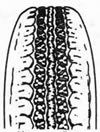 Wear of the outer tracks
 | Low tire pressure (wear on both sides). Incorrect wheel alignment (one-sided wear). Taking corners at high speed. Locking when braking | Adjust the pressure. Repair axle and suspension parts. Reduce speed. Swap the tires | steps 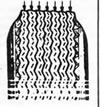 Spotted wear
 | Incorrect wheel alignment | Adjust the toe-in |
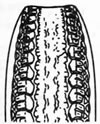 Wear of central tracks
 | High tire pressure. Locking when braking | Adjust the pressure. Swap the tires | 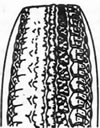 Uneven wear
 | Incorrect camber or kingpin caster. Problems with the suspension. The wheel is unbalanced. Brake drum out of roundness. Locking when braking | Repair axle and suspension parts. Repair suspension parts. Balance or replace. Replace. Swap the tires. |
[Original source of information: mitsubishiman.ru]