



Contents: Removal and installation ⤓ Disassembly and assembly ⤓ Checking after disassembly ⤓ Checking the wear of the brake shoe…⤓
Removal and installation
- Before removing parts, drain the brake fluid.
− The parts are removed in the order of numbers shown in the figure "Removing the front disc brake".
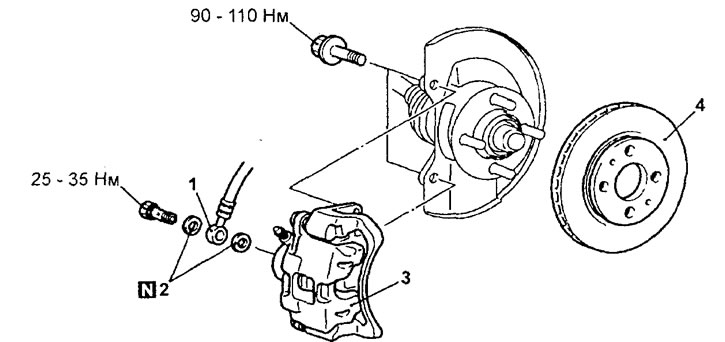
Disc brakes. 1 - brake hose connection, 2 - gasket, 3 - disc brake caliper assembly, 4 - brake disc.
− Installation of parts is carried out in the reverse order of removal.
− When installing the parts, pay attention to the operation of measuring the resistance force to wheel hub rotation when installing the caliper assembly for the front disc brake.
a) Remove the drive shaft (see chapter "Front drive shafts").
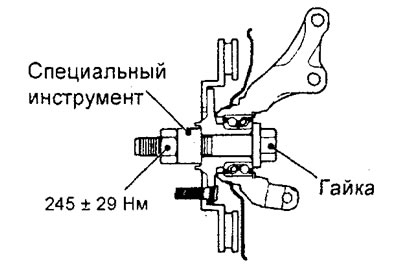
b) Install the special device into the hub as shown in the figure and tighten it.
Tightening torque - 216 - 274 Nm
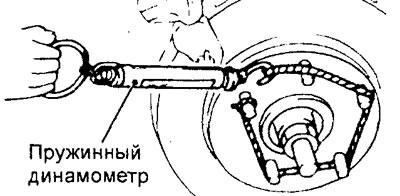
3. Measure the rotational resistance "A" of the wheel hub in the forward direction when the brake pads are not installed.
4. Start the engine and press the brake pedal hard 2 - 3 times.
5. Turn off the engine.
6. Rotate the brake disc in the forward direction approximately 10 revolutions.
7. Using a spring dynamometer, measure the resistance "B" to rotation of the wheel hub in the forward direction.
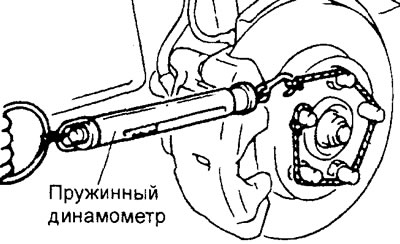
8. Calculate the magnitude of the resistance force to rotation of the wheel hub with a disc brake installed (the difference between values "A" and "B").
Nominal value - no more than 78 Nm
9. If the resistance force to the rotation of the wheel hub exceeds the nominal value, disassemble the caliper. Check for corrosion or wear of the piston sealing ring and piston, and check the ease of sliding of the caliper on the guide pins.
- After completing the installation of the parts, perform the following operations:
- a) Fill with brake fluid.
- b) Remove air from the brake hydraulic system.
Disassembly and assembly
− The parts are removed in the order of numbers shown in the figure "Disassembling the front disc brake".
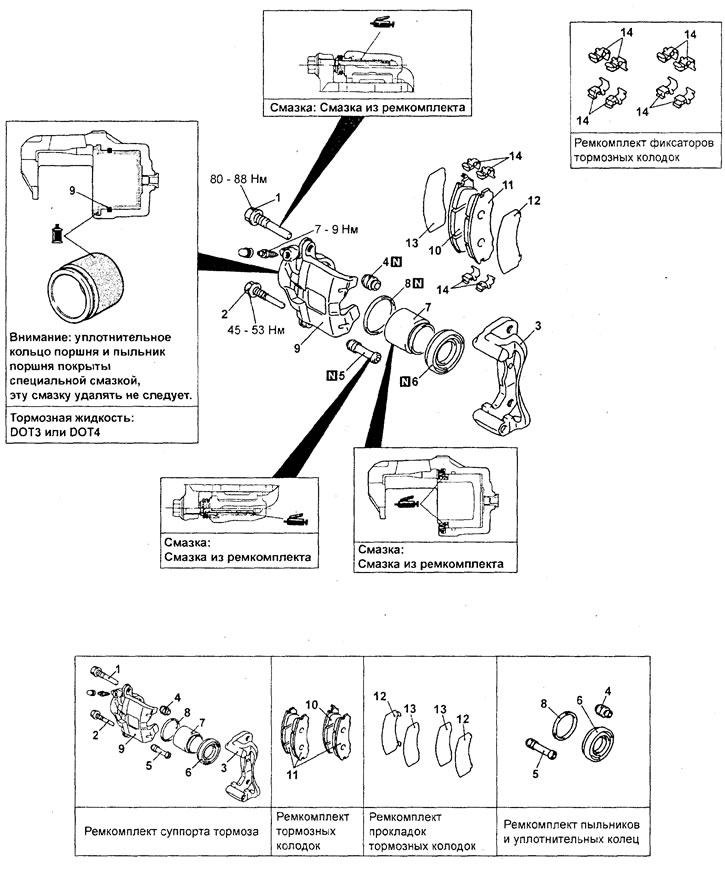
Disassembling the front disc brake (except for models with 4G63T engine). 1 - lock pin, 2 - guide pin, 3 - bushing, 4 - caliper bracket (complete with pads and retainers), 5 - pin boot, 6 - piston boot clamp, 7 - piston boot, 8 - piston, 9 - piston sealing ring, 10 - caliper, 11 - brake pad and wear indicator assembly, 12 - brake pad assembly, 13 - inner gasket, 14 - outer gasket, 15 - retainer.
- When removing parts, pay attention to the following operations:
- 1. Removing the piston and its dust cover.
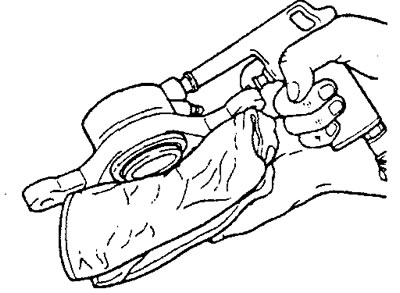
Wrap the caliper with a cloth. Blow compressed air into the brake hose hole to remove the piston and piston dust boot.
Caution: When removing the piston, be careful and apply compressed air gradually.
The material was created based on the website mitsubishiman.ru
- 2. Removing the piston sealing ring.
a) Use your finger to remove the piston sealing ring.
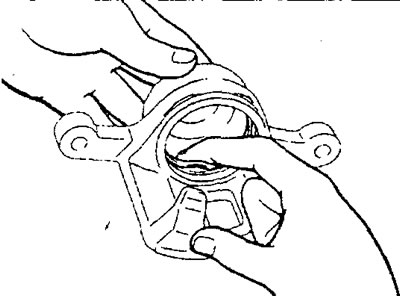
Caution: To prevent damage to the inner surface of the wheel cylinder, do not use a flat-head screwdriver or other tool to remove the ring.
b) Clean the piston and cylinder surfaces with trichloroethylene, alcohol or recommended brake fluid.
Brake fluid type - SAE J1703 or FMVSS 116 DOT3, or DOT4
Installation of parts is carried out in the reverse order of removal.
Checking after disassembly
1. Check the brake cylinder mirror for rust, wear or damage.
2. Check the surface of the brake cylinder piston for rust, damage or wear.
3. Check the caliper and bushings for wear.
4. Check for damage or oil on the brake pad linings and for damage on the metal bases of the pads.
Checking the wear of the brake shoe lining
Measure the brake shoe lining thickness at the narrowest and most worn point. Replace the brake shoes as an assembly if the lining thickness is less than the maximum permissible value.
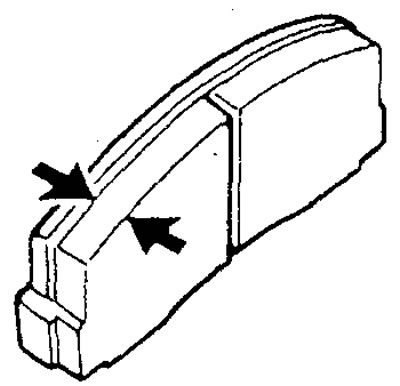
Nominal value - 10.0 mm
The maximum permissible value is 2.0 mm
Attention:
- - If the lining thickness of any pad is less than the maximum permissible value, replace the brake pads as a set, and also replace the brake pads on the opposite wheel of the axle at the same time.
- - If there is a noticeable difference in the thickness of the brake pads on the left and right sides, check the condition of the sliding parts of the caliper.