



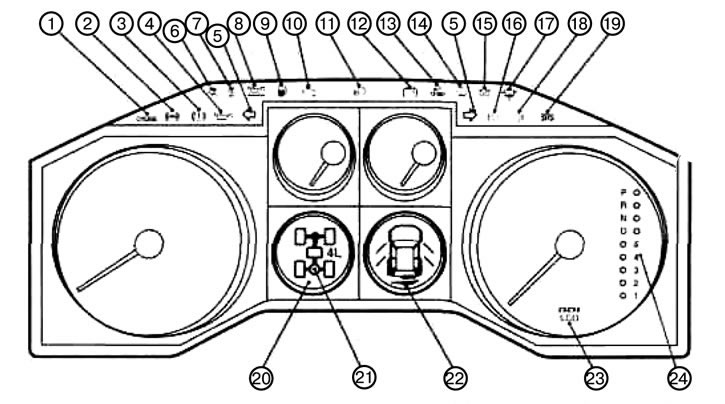
1. Cruise control indicator light. 2. Anti-lock brake system (ABS) warning light (option). 3. Brake system warning light. 4. Oil pressure warning lamp. 5. Direction indicator/hazard warning lights. 6. Active Stability Control (optional)/Active Traction Control (optional) indicator light. 7. Active Stability Control (optional) deactivation indicator light. 8. Engine oil level warning light. 9. Low fuel level warning lamp. 10. Engine diagnostic warning lamp. 11. High beam indicator lamp. 12. Battery charging warning lamp. 13. Automatic transmission oil temperature warning lamp (cars with automatic transmission). 14. Low washer fluid level indicator lamp (optional). 15. Glow plug indicator lamp (cars with diesel engines). 16. Front fog light indicator lamp (optional) 17. Fuel filter indicator lamp (cars with diesel engines). 18. Rear fog light indicator lamp. 19. Warning lamp of the security system (SRS). 20. Transmission operating mode indicator light. 21. Rear differential lock indicator light (optional). 22. Open door indicator light. 23. ECO control lamp (cars with gasoline engines). 24. Automatic transmission selector position indicator lamps (on vehicles with automatic transmission, the N indicator lamp is also used to warn of transmission faults). Sport mode indicator light (on cars with automatic transmission).
Note. GDI is a trademark of MITSUBISHI MOTORS CORPORATION. MPI: Multi-Point (distributed) injection.
 Direction indicator/hazard warning lights
These indicator lights flash when the turn signals are turned on.
Note: If the blinking frequency increases, this indicates a loose connection in the circuit of one of the turn signals or a faulty bulb.
When the hazard warning lights are switched on, all direction indicator lights flash.
 High beam indicator lamp
This indicator lamp lights up when the high beam headlights are on.
 Front fog light indicator lamp (optional)
This indicator lamp comes on when the front fog lights are on.
 Rear fog light indicator lamp
This indicator lamp comes on when the rear fog lamp is on.
 GDI ECO indicator light (Cars with gasoline engines)
This indicator light comes on when the GDI engine is operating in the mode for maximum fuel economy and minimum carbon dioxide emissions. It helps you drive your car in an economical and environmentally friendly manner.
Note: GDI is a trademark of MITSUBISHI MOTORS CORPORATION. GDI: Gasoline Direct Injection (direct petrol injection).
 Glow plug indicator light (Cars with diesel engines)
This indicator lamp comes on when the ignition is turned on. After the glow plugs have warmed up, the lamp goes out; after this you can start the engine.
Note:
- On a cold engine, the glow plug light stays on for a longer period of time.
- If the engine is not started within 5 seconds after the glow plug indicator lamp goes out, return the ignition switch to the LOCK position. Then turn the ignition switch back on to re-enable the glow plug preheating system.
- When the engine is warm, this lamp does not light even when the ignition is turned on.
 Low washer fluid level indicator lamp (optional)
This light comes on when the fluid level in the washer reservoir is low (approximately 0.8 l). If it lights up, add fluid to the washer reservoir as soon as possible.
 Fuel filter warning light (Cars with diesel engines)
This indicator lamp comes on when the ignition is turned on and goes out after the engine starts. If it lights up while the engine is running, it means that water has accumulated in the fuel filter; in this case, the water must be drained.
If the light goes out after this, you can continue driving. If it either doesn't go out or blinks (lights up periodically), it is recommended to have the vehicle checked.
Malfunction warning lights
 Brake system warning light (Vehicles with anti-lock brakes - warning buzzer)
This warning lamp comes on when the ignition is turned on and goes out after the engine starts. When the ignition key is in the ON position, this lamp lights up in the following cases:
- when the parking brake is applied;
- when the brake fluid level in the reservoir is low;
- when one of the brake system circuits fails.
Warning buzzer (Cars with anti-lock braking system)
If there is a risk of reduced braking system performance, a buzzer is activated to warn the driver. If the buzzer sounds for a long time, stop in a safe place. It is recommended to have the vehicle checked.
Note: If you repeatedly press the brake pedal, the brake warning light, ABS warning light and warning buzzer may come on. If after a few seconds the lamps go out and the buzzer turns off, no faults have been detected.
Attention:
- In the situations listed below, the effectiveness of the braking system may decrease or the vehicle may lose directional stability during sudden braking; in such cases, try to drive at low speed and avoid sudden braking. In addition, it is recommended to stop the vehicle in a safe place and have it checked.
- The brake warning light does not come on when the parking brake is applied or does not go out when the parking brake is released.
- The brake warning light remains on while driving.
- Brake system buzzer does not turn off (cars with anti-lock braking system).
Attention:
If the effectiveness of the brakes decreases, you should move to the parking place as follows:
- press the brake pedal harder than usual;
- if the braking system fails, use engine braking to reduce vehicle speed and slowly lift the parking brake lever to bring the vehicle to a complete stop.
Press the brake pedal to turn on the brake lights and warn drivers behind you that you are braking.
Note:
- In some cases, after starting the engine or after repeatedly pressing the brake pedal, noise emitted by the brake system mechanisms may be heard from the engine compartment. This is normal and should not be ignored. It indicates that the corresponding devices are working normally. (This applies to vehicles equipped with anti-lock braking systems.)
- On vehicles equipped with ABS, the pressure in the brake system is created by a pump.
 Engine diagnostic warning light
This lamp is an element of the on-board self-diagnostic system that monitors the composition of exhaust gases and the operation of the engine control systems and automatic transmission. If a fault is detected in one of these systems, this lamp comes on. Although this will usually leave the vehicle running and will not require towing, it is recommended that these systems be checked as soon as possible. This lamp also lights up for a few seconds when you turn the ignition key to the ON position. If it does not go out after a few seconds, it is recommended to have the car checked.
Attention:
- Driving for long periods with the check engine light on can cause serious damage to the emission control system. This may also reduce fuel efficiency and engine traction.
- If this lamp does not come on when the ignition key is turned to the ON position, it is recommended to have the system checked.
- If this light comes on while the engine is running, avoid driving at high speed and have the system checked as soon as possible. When driving with the check engine light on, the vehicle may not accelerate when the accelerator pedal is pressed.
- If the vehicle is stationary when this light is on or flashing, you must press the brake pedal harder than usual, because this increases the engine idle speed and a vehicle with an automatic transmission receives more traction due to the internal friction in the transmission.
Note: The electronic engine control unit, which coordinates the operation of the on-board diagnostic system, stores data on various faults (especially regarding malfunctions of the exhaust gas control system). When the terminal is removed from the battery, this data is erased from the memory, which complicates diagnostics and increases its duration. Therefore, you should not remove the battery terminal if the engine diagnostic warning light comes on.
 Battery charging warning light
This warning lamp comes on when the ignition is turned on and goes out after the engine starts.
Attention:
- If this lamp comes on while the engine is running, there is a problem with the battery charging system. In this case, immediately stop the vehicle in a safe place, it is recommended to have the system checked at an authorized Mitsubishi service center.
- Except for models with 2500 cc engine: Malfunction in the charging system.
- Models with 2500 cc engine: broken alternator belt or faulty charging system. When the alternator belt breaks, braking efficiency decreases. When you stop your car in a safe place, press the brake pedal harder than usual.
 Oil pressure warning light
This warning lamp comes on when the ignition is turned on and goes out after the engine starts. If it lights up while the engine is running, it indicates that the oil pressure is too low. If this lamp lights up while the engine is running, turn it off and check the vehicle.
Attention:
- This light may come on due to low engine oil level, check the oil level.
- This indicator light does not indicate the amount of oil in the crankcase. The amount of oil is determined with the engine not running using the oil dipstick.
- Driving with low engine oil or with the oil pressure warning light on may cause the engine to seize.
Note: The oil pressure warning light should not be used as an engine oil level indicator. The oil level should be checked using the dipstick.
 Engine oil level warning light
This warning lamp comes on when the ignition is turned on and goes out after the engine starts. If it lights up while the engine is running, it indicates that the oil level is too low. If this lamp lights up while the engine is running, turn it off and add oil to the required level.
 Door open warning light
This lamp lights up if one of the doors (including the trunk door) open or not tightly closed.
Caution: Make sure this light is off before driving the vehicle.